Navigating the bustling world of residential real estate means juggling countless leads, managing client relationships, tracking properties, and closing deals – often all at once. For small real estate businesses, where every agent wears multiple hats and every client interaction is paramount, efficiency isn’t just a buzzword; it’s the bedrock of success. This is precisely where a powerful, yet user-friendly CRM for small residential real estate becomes not just a helpful tool, but an indispensable partner.
Imagine a system that streamlines your entire operation, from that first tentative inquiry to the final handshake at closing, all while keeping your client data organized and accessible. That’s the promise of a well-chosen Customer Relationship Management (CRM) system. But with a sea of options available, how do you find the one that truly fits your unique needs, especially when “user-friendly” is at the top of your priority list? This comprehensive guide is designed to cut through the noise, offering an in-depth comparison of user-friendly CRM options tailored specifically for small residential real estate businesses, helping you make an informed decision that propels your business forward.
Understanding the Unique Operational Needs of Small Residential Real Estate Businesses
Before diving into specific CRM solutions, it’s crucial to acknowledge that small residential real estate firms operate with a distinct set of challenges and requirements. Unlike large corporations with dedicated IT teams and extensive budgets, your business likely relies on agility, personal touch, and maximizing every resource. This means your ideal user-friendly CRM for small residential real estate won’t be overly complex or require a steep learning curve. Instead, it needs to be intuitive, allowing your team to quickly adopt it and integrate it into their daily workflows without significant downtime or frustration.
Your focus is on building lasting relationships within your community, which demands a CRM capable of meticulous contact management and personalized communication. Every lead is precious, and the ability to track their journey from initial interest to becoming a homeowner is non-negotiable. Furthermore, small teams often mean limited administrative support, making automation features incredibly valuable. From scheduling follow-ups to sending out automated market updates, the right CRM can free up valuable time, allowing you to concentrate on what you do best: selling homes and serving clients. The nuances of property listings, transaction management, and agent performance tracking also need to be adequately addressed by your chosen solution.
Defining “User-Friendly” in the Context of a Real Estate CRM
When we talk about a “user-friendly CRM,” what exactly do we mean, especially for the fast-paced world of small residential real estate? It’s more than just a pretty interface; it’s about a seamless experience that empowers rather than complicates. For real estate professionals, user-friendliness translates into quick onboarding, minimal training required, and an intuitive layout that makes finding information or performing tasks effortless. Agents are often on the go, making mobile accessibility a cornerstone of any truly user-friendly system.
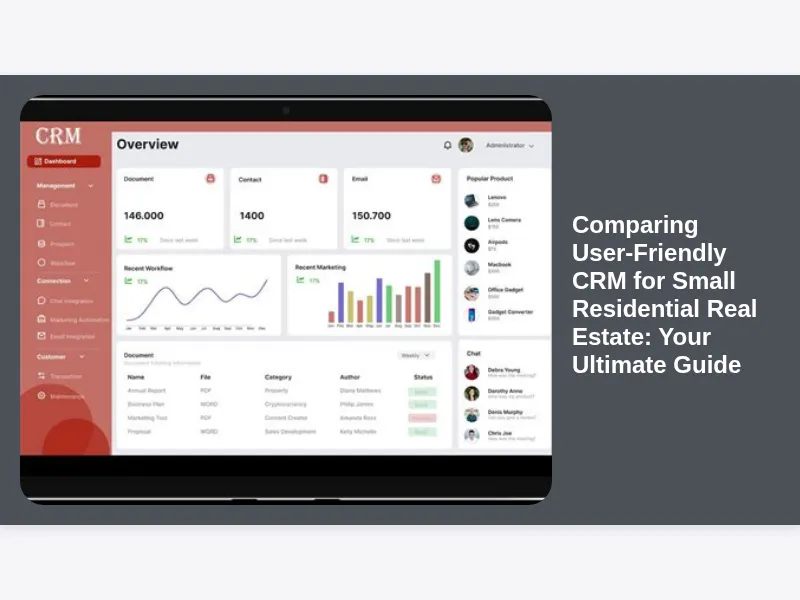
A user-friendly CRM should feature a clear dashboard that provides an at-a-glance overview of your pipeline, upcoming tasks, and critical client interactions. It should simplify complex processes, turning lead qualification, property matching, and transaction oversight into manageable steps. Drag-and-drop functionalities, clear navigation menus, and customizable views are all hallmarks of a system designed with the end-user in mind. Ultimately, a user-friendly CRM for small residential real estate minimizes clicks, reduces cognitive load, and maximizes productivity, allowing agents to spend less time wrestling with software and more time engaging with clients and closing deals.
Essential Features to Prioritize in Your Residential Real Estate CRM Selection
Choosing a user-friendly CRM for small residential real estate requires a keen eye for features that directly impact your daily operations and long-term growth. While many CRMs boast an array of functionalities, some are non-negotiable for real estate success. At the core, robust contact management is paramount. You need a system that not only stores names and numbers but also provides a comprehensive history of every interaction, preferences, property interests, and family details, allowing for deeply personalized service.
Lead tracking and management are equally critical. Your CRM should offer clear pipelines to visualize where each lead stands, from initial inquiry to qualified prospect, and provide tools to nurture them effectively. Property management features, including the ability to link specific properties to client interests and track listing details, are also vital. Furthermore, look for task automation capabilities that can handle routine follow-ups, appointment scheduling, and email campaigns. Integration with other real estate-specific tools, such as MLS systems, e-signature platforms, and accounting software, significantly enhances efficiency. Without these core functionalities, even the most aesthetically pleasing interface won’t deliver the true value your small residential real estate business needs from its CRM.
Deep Dive: Salesforce Essentials – A Scalable, User-Friendly CRM for Small Businesses
When considering a user-friendly CRM for small residential real estate, Salesforce Essentials often enters the conversation. While Salesforce is known for its enterprise-level solutions, Essentials is specifically designed to bring the power of Salesforce to smaller businesses, making it a compelling option. It offers core sales and service functionalities in a streamlined, accessible package. For real estate agents, this means robust contact and account management, giving you a 360-degree view of your clients and prospects. You can track communication history, document preferences, and manage all related tasks from a single dashboard.
Salesforce Essentials provides intuitive lead and opportunity management tools, allowing you to visualize your sales pipeline and move prospects through various stages with ease. Its drag-and-drop interface helps customize views, ensuring agents can quickly access the most relevant information. While not explicitly a “real estate CRM,” its flexibility allows for customization to fit residential real estate workflows. You can create custom fields for property types, desired features, or transaction statuses. Its mobile app is also highly regarded, enabling agents to update records, communicate with clients, and manage their pipeline from anywhere, making it a truly user-friendly CRM for the mobile real estate professional.
Exploring HubSpot CRM: A Marketing and Sales Powerhouse for Real Estate Teams
HubSpot CRM stands out as another strong contender when searching for a user-friendly CRM for small residential real estate, particularly for businesses that prioritize integrated marketing and sales efforts. One of HubSpot’s biggest strengths is its freemium model, offering a robust free CRM that provides essential contact management, deal tracking, and task scheduling features without any cost, making it an excellent starting point for budget-conscious small firms. As your business grows, you can seamlessly upgrade to paid tiers that unlock advanced marketing automation, sales enablement, and customer service tools.
For real estate, HubSpot excels in its ability to centralize client data and automate communication. You can segment your database based on buyer type, property interest, or lead source, then deploy targeted email campaigns directly from the CRM. Its intuitive interface and visual pipeline make it easy to manage leads from initial inquiry to closing. The platform’s robust analytics also help you understand which marketing efforts are generating the most qualified leads. With a strong emphasis on inbound methodology, HubSpot can help small residential real estate businesses attract, engage, and delight clients, ensuring a comprehensive and user-friendly CRM experience that extends beyond just sales tracking.
Unpacking Zoho CRM’s Potential for Small Real Estate Businesses: Customization and Affordability
Zoho CRM presents a compelling option for small residential real estate firms seeking a highly customizable and affordable user-friendly CRM. Part of a much larger suite of business applications, Zoho CRM offers a powerful platform that can be tailored to the specific needs of real estate agents without breaking the bank. Its interface is designed for clarity and ease of use, ensuring that even those new to CRM systems can get up and running quickly. This focus on accessibility makes it a prime candidate for businesses prioritizing a user-friendly CRM.
What sets Zoho apart is its flexibility. You can easily customize modules, fields, and layouts to mirror your real estate processes, from tracking property showings to managing transaction milestones. Its automation capabilities are robust, allowing agents to automate lead assignments, follow-up emails, and task creation, significantly reducing manual effort. For small residential real estate teams, Zoho CRM’s ability to integrate seamlessly with other Zoho products (like Zoho Mail, Zoho Campaigns, and Zoho Projects) creates a unified ecosystem for all business operations. This comprehensive yet manageable approach truly defines its value as a user-friendly CRM solution for the real estate sector.
A Closer Look at Follow Up Boss: CRM Tailored for Real Estate Success
When the search for a user-friendly CRM for small residential real estate narrows, platforms specifically built for real estate often rise to the top. Follow Up Boss is one such example, renowned for its laser focus on the unique workflows and challenges of real estate agents and teams. Its entire design philosophy revolves around making it exceptionally easy for agents to manage leads, track conversations, and ensure no opportunity falls through the cracks. This specialization inherently makes it a highly user-friendly CRM for its intended audience.
Follow Up Boss excels in lead management and distribution, ensuring new inquiries are routed to the right agent immediately. Its “Smart Lists” allow agents to create dynamic lists of clients based on specific criteria, ensuring proactive follow-up. The platform integrates seamlessly with major lead sources and provides built-in calling and texting functionalities, centralizing all client communication. For small residential real estate businesses, the ability to see a complete history of every client interaction – calls, texts, emails, and notes – on a single screen is invaluable. This focused approach on real estate-specific needs cements its position as a top-tier user-friendly CRM for professionals in the field.
Considering Realvolve: Advanced Workflow Automation for Discerning Real Estate Agents
For small residential real estate businesses looking for a user-friendly CRM with powerful, yet accessible, workflow automation, Realvolve deserves serious consideration. While some advanced features might suggest a steeper learning curve, Realvolve is designed with an intuitive interface that simplifies complex processes, making automation achievable for even non-technical users. It’s built from the ground up to support the intricate relationships and multi-step transactions inherent in real estate, positioning it as a sophisticated yet user-friendly CRM.
Realvolve shines in its ability to create highly detailed contact profiles, going beyond basic information to capture nuanced preferences, life events, and relationship histories that are crucial for personalized service. Its strength lies in its “workflows,” which are essentially automated action plans that guide agents through every stage of a transaction or client nurture sequence. These workflows can automatically trigger emails, assign tasks, and set reminders, ensuring consistency and preventing missed steps. For small residential real estate teams, this level of systematic support, combined with a clear visual representation of each client journey, makes Realvolve a profoundly efficient and user-friendly CRM that enhances productivity and client satisfaction.
BoomTown CRM: A Comprehensive Platform for Lead Generation and Management
For small residential real estate businesses where lead generation and management are paramount, BoomTown CRM offers a comprehensive, all-in-one solution that aims for high user-friendliness within its specialized niche. While it comes with a higher investment than some generalist CRMs, its integrated approach to attracting and nurturing leads makes it a powerful system for growth-oriented teams. The platform is specifically designed to streamline the entire sales process, making it a robust, user-friendly CRM for residential real estate.
BoomTown provides an IDX-enabled website, lead generation tools (including paid ad management), and a robust CRM for managing those leads. The system features a predictive CRM that helps agents prioritize who to call and when, based on engagement data, ensuring that valuable time is spent on the hottest prospects. Its communication tools, including integrated texting and email, keep all client interactions centralized. For small residential real estate teams looking for a holistic platform that combines marketing, lead management, and a user-friendly CRM for their agents, BoomTown offers a powerful ecosystem designed to drive conversions and scale operations.
LionDesk: An Affordable and Feature-Rich Option for Individual Agents and Small Teams
LionDesk emerges as a compelling contender for small residential real estate businesses and individual agents who prioritize affordability without sacrificing essential features. It positions itself as an all-in-one marketing and CRM solution, making it a highly user-friendly CRM that helps agents manage their entire pipeline from one platform. Its appeal lies in its straightforward interface and a comprehensive set of tools available at a competitive price point, making it accessible to a wider range of real estate professionals.
This user-friendly CRM provides robust contact management, allowing agents to store detailed client information and track communication history. Where LionDesk truly shines for real estate is its integrated communication features: it offers built-in texting, emailing, and even video messaging capabilities, all directly from the CRM. This streamlines outreach and keeps all conversations centralized. Furthermore, its drip campaigns and marketing automation tools enable agents to nurture leads with personalized content effortlessly. For small residential real estate operations seeking a powerful yet budget-friendly and user-friendly CRM to enhance productivity and client engagement, LionDesk provides an impressive array of functionalities.
Ease of Integration: Connecting Your User-Friendly CRM with Other Real Estate Tools
A crucial aspect of selecting a user-friendly CRM for small residential real estate is its ability to seamlessly integrate with other essential tools in your technology stack. No CRM operates in a vacuum, and the true power of your system is unleashed when it can communicate effortlessly with the applications you already rely on. Imagine having to manually transfer data between your CRM and your MLS system, or your e-signature platform, or your accounting software – that’s a recipe for inefficiency and frustration, negating any “user-friendly” claims.
Therefore, when comparing user-friendly CRM options, scrutinize their integration capabilities. Does it connect directly with your local MLS or a major IDX provider? Can it sync with popular e-signature solutions like DocuSign or Dotloop for contract management? Is there an easy way to push client data or transaction details to accounting software like QuickBooks? Strong integrations mean less manual data entry, reduced errors, and a more streamlined workflow across your entire small residential real estate business. A CRM that acts as the central hub for all your real estate technology makes your entire operation more cohesive and, by extension, significantly more user-friendly.
Pricing Structures: Understanding the Investment in a User-Friendly CRM
The investment required for a user-friendly CRM for small residential real estate is a significant consideration, and understanding the various pricing structures is key to making an informed decision. CRM costs can vary widely, from free basic plans to hundreds of dollars per user per month for enterprise-level solutions. For small businesses, finding a balance between features and affordability is crucial. Most CRMs operate on a subscription model, typically billed monthly or annually, with annual plans often offering a discount.
You’ll encounter different tiers of pricing, with increasing features and user limits corresponding to higher costs. Some CRMs charge per user, while others might have a base fee for a certain number of users and then charge per additional user. It’s vital to assess what features are included in each tier and ensure that the chosen plan meets your current and projected needs without overpaying for functionalities you won’t use. Always factor in potential setup fees, training costs, and integration expenses. A truly user-friendly CRM should offer transparent pricing that aligns with the value it provides, allowing small residential real estate firms to budget effectively and understand their return on investment.
Onboarding and Training: Ensuring a Smooth Transition to Your New User-Friendly CRM
Even the most feature-rich and seemingly user-friendly CRM for small residential real estate won’t deliver its full potential if your team struggles with adoption. This makes the onboarding process and available training resources absolutely critical. A steep learning curve can lead to frustration, underutilization of features, and ultimately, wasted investment. Therefore, when evaluating CRM options, inquire deeply into what kind of support is offered during the initial setup phase.
Look for CRMs that provide comprehensive onboarding guides, video tutorials, and dedicated training sessions. Some providers offer personalized one-on-one setup assistance, which can be invaluable for small teams with limited IT resources. A robust knowledge base, easily searchable FAQs, and responsive customer support channels are also indicators of a vendor committed to user success. The goal is to get your team proficient and comfortable with the new user-friendly CRM as quickly as possible, minimizing disruption to your ongoing residential real estate operations and ensuring a smooth transition that maximizes productivity from day one.
Data Migration: Moving Your Existing Contacts Seamlessly to Your New CRM
One of the most daunting aspects of adopting a new user-friendly CRM for small residential real estate is the process of data migration. You likely have years of client information, lead details, and property data scattered across spreadsheets, older systems, or even physical notepads. Moving this invaluable information accurately and efficiently into your new CRM is paramount for continuity and preventing data loss. A successful migration ensures that your new system is immediately functional and provides a complete picture of your client relationships.
When comparing CRMs, ask about their data import capabilities. Can you easily upload CSV files? Are there tools or services available to help clean and de-duplicate your data before import? Some CRM providers offer assisted migration services, which can be a lifesaver for small businesses without dedicated data specialists. While some manual effort might always be involved, a truly user-friendly CRM will streamline this process as much as possible, offering clear instructions and support to ensure that all your historical client interactions and property details are seamlessly transferred, making your new system instantly valuable for your residential real estate business.
Scalability: Choosing a User-Friendly CRM That Grows with Your Residential Real Estate Business
For any small residential real estate business with ambitions for growth, choosing a user-friendly CRM that is also scalable is a forward-thinking decision. What serves your needs perfectly today might become a bottleneck as you expand your team, increase your lead volume, or diversify your service offerings. Investing in a CRM that can evolve with you prevents the costly and disruptive process of having to switch systems again in a few years.
When evaluating user-friendly CRM options, consider their ability to accommodate more users, additional features, and increasing data volumes without significant performance degradation or prohibitive costs. Does the CRM offer different pricing tiers that unlock more advanced functionalities as your business matures? Can it integrate with more specialized tools as your needs become more complex? A scalable, user-friendly CRM for small residential real estate ensures that your initial investment is protected, allowing your technology to support your growth rather than hinder it. It’s about selecting a partner that can support your journey from a small team to a thriving enterprise.
Mobile Accessibility: Managing Your Business On-the-Go with CRM Apps
In the dynamic world of residential real estate, agents are rarely tied to a desk. They’re showing properties, meeting clients, attending open houses, and constantly on the move. This makes mobile accessibility a non-negotiable feature for any truly user-friendly CRM for small residential real estate. The ability to access and update client information, respond to leads, schedule appointments, and manage tasks directly from a smartphone or tablet is critical for maintaining efficiency and responsiveness.
When evaluating CRM options, scrutinize their mobile applications. Are they available for both iOS and Android? Is the interface intuitive and easy to navigate on a smaller screen? Can you perform all essential functions, such as logging calls, sending emails, updating lead statuses, and accessing property details, without having to return to your desktop? A robust and user-friendly CRM mobile app ensures that agents can capture information in real-time, respond instantly to inquiries, and manage their pipeline no matter where they are. This seamless mobile experience is paramount for staying competitive and providing exceptional service in the fast-paced residential real estate market.
Security and Compliance: Protecting Client Data in Your Real Estate CRM
In the digital age, protecting sensitive client information is not just good practice; it’s a legal and ethical imperative. For small residential real estate businesses, choosing a user-friendly CRM that also prioritizes robust security and compliance standards is absolutely essential. You’re handling personal data, financial details, and property information, all of which are attractive targets for cyber threats. A data breach can have devastating consequences, damaging your reputation, leading to legal liabilities, and eroding client trust.
Therefore, when comparing user-friendly CRM options, delve into their security protocols. Look for features like two-factor authentication, data encryption (both in transit and at rest), regular backups, and secure data centers. Inquire about their compliance with relevant data privacy regulations such as GDPR or CCPA, depending on your location and client base. Transparent privacy policies are a must. A truly user-friendly CRM for small residential real estate should not only make your work easier but also provide peace of mind that your clients’ valuable data is protected with the highest standards of digital security, building trust and safeguarding your business.
Customer Support and Resources: Getting Help When You Need It from Your CRM Provider
Even with the most user-friendly CRM for small residential real estate, questions and challenges will inevitably arise. The quality and availability of customer support can make all the difference in quickly resolving issues and maximizing your system’s potential. For small residential real estate firms, who often lack dedicated IT support, having reliable and accessible help from the CRM provider is crucial for continued productivity and successful adoption.
When evaluating CRM options, investigate their customer support offerings. What channels are available (phone, email, live chat)? What are their response times? Is support available during your working hours, especially if you operate across different time zones? Beyond direct support, look for comprehensive self-help resources such as a searchable knowledge base, community forums, video tutorials, and webinars. A proactive and responsive support team, coupled with extensive self-service resources, ensures that your small residential real estate team can quickly find answers and overcome hurdles, making your chosen user-friendly CRM truly a supportive partner in your business operations.
Making the Final Decision: A Checklist for Your User-Friendly Real Estate CRM
Choosing the perfect user-friendly CRM for your small residential real estate business can feel like a monumental task, but with a structured approach, you can make an informed decision. Before you commit, create a checklist based on your specific needs, drawing from the insights we’ve discussed. Start by revisiting your core requirements: What are the absolute non-negotiable features for your team? Is it superior lead management, transaction tracking, or marketing automation? How many users will you initially have, and what’s your growth projection?
Then, evaluate each shortlisted CRM against these criteria. Test drive the software with free trials to get a real feel for its user-friendliness and how it aligns with your team’s workflow. Engage your agents in the trial process; their feedback on usability is invaluable. Compare pricing tiers carefully, considering not just the monthly cost but also potential hidden fees for integrations or advanced support. Look at the vendor’s reputation, their track record for updates, and the quality of their customer support. By systematically ticking off these boxes, you can confidently select a user-friendly CRM for small residential real estate that will truly empower your business for years to come.
Beyond the Software: Maximizing Your User-Friendly CRM Investment for Residential Real Estate
Acquiring a user-friendly CRM for small residential real estate is a significant step, but the journey doesn’t end with installation. To truly maximize your investment and unlock the full potential of your new system, you need a strategy for ongoing adoption and optimization. The best CRM in the world will only be as effective as your team’s commitment to using it consistently and correctly. This means fostering a culture where the CRM is seen not as an administrative burden, but as an indispensable tool that simplifies tasks and drives success.
Start by establishing clear guidelines and best practices for data entry, lead management, and communication logging. Consistent data ensures the CRM’s reports and insights are accurate and valuable. Provide continuous training and refreshers to ensure all team members are comfortable with its features and any new updates. Encourage feedback from your agents; their real-world experience can highlight areas for improvement or customization. Regularly review your CRM usage and performance metrics to identify trends, optimize workflows, and adapt the system to evolving market conditions. By actively engaging with and continuously refining your approach to your user-friendly CRM, your small residential real estate business will not only manage client relationships more effectively but also achieve sustained growth and success in a competitive market.