In the dynamic world of real estate, generic solutions often fall short. You, as a small real estate business owner, an independent agent, or a boutique brokerage, navigate a landscape brimming with unique challenges and opportunities. Your client interactions are personal, your lead generation strategies might be unconventional, and your transaction processes are finely tuned to your specific market niche. This is precisely why an off-the-shelf Customer Relationship Management (CRM) system can feel like a square peg in a round hole, failing to truly support your distinct way of doing business. What you need isn’t just a CRM; you need a Customizable CRM for Unique Small Real Estate Workflows.
This comprehensive guide will explore why flexibility is paramount in real estate technology, how to identify your unique operational needs, and the transformative power of a CRM solution that molds itself to your business, rather than forcing your business to conform to its rigid structure. We’ll delve into the intricacies of selecting, implementing, and optimizing a truly bespoke CRM experience that empowers you to grow, scale, and thrive in your specific real estate domain. Forget the frustration of mismatched software; it’s time to discover a system that truly understands and supports your singular vision.
The Singular Nature of Small Real Estate Businesses: Why One Size Doesn’t Fit All
Small real estate businesses, whether they are individual agents, husband-and-wife teams, or niche boutique brokerages, operate with a distinct character that sets them apart from larger, corporate entities. They often pride themselves on a highly personalized approach, deep community roots, and a specialized understanding of particular property types or geographic areas. This innate individuality is their strength, fostering client loyalty and allowing for agility in a rapidly changing market. However, this same uniqueness presents a challenge when it comes to adopting standardized business software.
Unlike large brokerages with uniform processes and vast teams, small operations frequently have highly idiosyncratic workflows developed over years of experience. One agent might specialize in luxury rural properties, requiring different lead nurturing sequences than another focused on urban condo rentals. A boutique firm dealing exclusively in historic homes will have a distinct set of data points and compliance requirements compared to one specializing in commercial retail spaces. These variances mean that a “standard” real estate CRM, designed for broad applicability, often misses the mark, providing too many irrelevant features while lacking critical tailored functionalities essential for their specific niche.
Why Generic CRM Systems Struggle with Real Estate Workflow Optimization
The market is flooded with CRM options, many of which claim to be “for real estate.” While these systems might offer basic contact management and deal tracking, their inherent lack of flexibility becomes a significant hurdle for businesses with non-standard operations. Imagine trying to track specific architectural features for historic homes in a generic CRM field designed for “number of bedrooms.” Or attempting to manage a complex multi-party commercial lease negotiation within a sales pipeline built for simple residential transactions. The mismatch is evident, leading to inefficiencies, frustration, and ultimately, underutilization of the software.
These off-the-shelf solutions often come with pre-defined stages, fields, and automation rules that are difficult or impossible to alter. This forces small businesses to either contort their proven, efficient workflows to fit the software’s limitations, or resort to manual workarounds, spreadsheets, and sticky notes – precisely what a CRM is supposed to eliminate. The result is a system that feels more like a burden than an asset, failing to genuinely enhance client relationships or streamline complex real estate processes. This inability to adapt to the nuances of specific real estate niches means they struggle with true real estate workflow optimization, leaving critical gaps in data management and client communication.
Defining “Customizable CRM”: Beyond Surface-Level Changes
When we talk about a Customizable CRM for Unique Small Real Estate Workflows, we’re not simply referring to the ability to change your company logo or rearrange a few dashboard widgets. True customization runs much deeper, empowering you to fundamentally reshape the system to mirror your business logic, terminology, and operational steps. It’s about having the power to define every aspect of your client journey, from the initial spark of a lead to the long-term relationship cultivated after a successful closing. This profound level of adaptability is what differentiates a truly effective CRM from a merely functional one.
At its core, a customizable CRM allows you to modify data fields, create custom objects, design unique deal pipelines, and build bespoke automation rules. It means you can rename “Opportunities” to “Active Listings” or “Buyer Engagements,” add specific fields for “Property Zoning Restrictions” or “Client Investment Portfolio,” and even design entirely new modules to track renovation projects or tenant lease agreements. This level of granular control ensures that every piece of information relevant to your specific real estate niche is captured, organized, and leveraged efficiently, truly serving your business’s unique needs rather than dictating them.
Mapping Your Unique Small Real Estate Workflows: The First Step to Customization
Before you can effectively implement a Customizable CRM for Unique Small Real Estate Workflows, you must first have a clear understanding of those workflows themselves. This involves a comprehensive audit of your current processes, from the moment a potential client enters your ecosystem to the successful conclusion of a transaction and subsequent follow-up. It’s an exercise in introspection, requiring you to document every step, decision point, and communication touchpoint that defines how you do business. Think of it as drawing a detailed map of your operational journey.
Start by breaking down your operations into key phases: lead generation, initial contact, qualification, property search/listing, negotiation, closing, and post-sale engagement. Within each phase, identify the specific tasks performed, the information gathered, the documents required, and the individuals involved. For example, your lead generation workflow might include specific steps for social media inquiries, open house registrations, and referral tracking, each with its own data points and follow-up sequence. By meticulously mapping these unique steps, you’ll uncover the exact requirements your custom CRM needs to fulfill, ensuring a seamless fit and optimal efficiency.
Essential Features a Customizable CRM Must Offer for Real Estate Professionals
While the beauty of a customizable CRM lies in its adaptability, certain core functionalities are non-negotiable for real estate professionals, especially when targeting unique workflows. These foundational features serve as the building blocks upon which your tailored system will be constructed, ensuring robust support for every stage of the client and property lifecycle. Without these essentials, even the most flexible platform might struggle to deliver the comprehensive value you seek.
Key among these are advanced lead management capabilities that go beyond simple contact storage, allowing for custom lead scoring, source tracking, and automated initial outreach. Robust property tracking is crucial, enabling detailed records of listings, showings, offers, and comparable sales, all with custom fields pertinent to your niche. Furthermore, integrated client communication tools are vital, encompassing email, SMS, and even sometimes calling capabilities, ensuring all interactions are logged and easily accessible. Document management, including secure storage and e-signature integration, streamlines paperwork, while powerful reporting and analytics provide insights into your unique performance metrics. These features form the backbone of a high-performing Customizable CRM for Unique Small Real Estate Workflows.
Tailoring Your Lead Management Process with a Flexible CRM Solution
Lead management in real estate is far from a one-size-fits-all endeavor. The way you capture, qualify, and nurture leads often reflects your unique market position, whether you specialize in first-time homebuyers, luxury estates, or commercial leasing. A truly flexible CRM allows you to precisely tailor this critical initial phase, ensuring no promising lead falls through the cracks and every prospect receives communication that resonates with their specific needs and interests. This bespoke approach to lead handling is a cornerstone of effective client acquisition and relationship building.
With a customizable CRM, you can define your own lead sources, implement unique lead scoring criteria based on behaviors specific to your niche, and even create dynamic lead qualification workflows. Imagine automatically routing inquiries about commercial properties to one team member and residential inquiries to another, or setting up automated drip campaigns that deliver content specifically tailored to high-net-worth investors versus first-time buyers. You can design custom fields to capture unique lead data, such as “preferred investment type” or “historic property features desired,” ensuring your initial outreach is always informed and highly personalized, dramatically improving conversion rates for your specific Small Real Estate Workflows.
Streamlining Property Listing and Showing Management with Precision
Managing property listings and coordinating showings can quickly become a logistical nightmare without a system built for precision and flexibility. For small real estate operations with unique portfolios, this task is even more nuanced. A generic CRM might offer basic property fields, but it rarely accounts for the specific attributes that define a niche market, nor does it provide the granular control needed for complex scheduling and feedback loops. This is where the power of a Customizable CRM for Unique Small Real Estate Workflows truly shines, transforming chaos into clarity.
Imagine a system where you can create custom fields for “historical designation,” “energy efficiency ratings,” “potential for subdivision,” or “unique architectural details,” ensuring every relevant aspect of your specific property type is meticulously recorded. You can design custom pipelines to track the journey of a listing from initial appraisal to active marketing, offers, and closing, with automated tasks assigned at each stage. Furthermore, a customizable CRM allows for seamless integration with showing scheduling tools, enabling agents to manage appointments, gather instant feedback from buyers, and track property interest levels directly within the system, providing a holistic view of each listing’s performance tailored to your operational specifics.
Automating Client Communication and Follow-Up for Personalized Engagement
In real estate, strong client relationships are built on consistent, timely, and personalized communication. However, managing follow-ups, sending market updates, and remembering key client milestones manually can be incredibly time-consuming and prone to oversight, especially for busy small real estate businesses. A Customizable CRM for Unique Small Real Estate Workflows provides the automation capabilities necessary to maintain high-touch engagement without overwhelming your schedule, ensuring that every client feels valued and remembered.
This level of customization means you can design highly specific email and SMS drip campaigns tailored to different client segments – new leads, active buyers, sellers, past clients, or referral partners. Imagine automatically sending a personalized market report to past sellers six months after closing, or a curated list of new listings to active buyers based on their unique preferences (e.g., specific school districts, types of unique architecture, or investment criteria). You can set up automated reminders for client anniversaries, birthdays, or follow-up calls related to specific property interests. By automating these touchpoints, your CRM acts as a proactive assistant, ensuring your communication is always relevant, consistent, and deeply personal, fostering stronger bonds and driving repeat business, all while aligning with your particular client engagement strategies.
The Power of Customized Deal Pipelines for Real Estate Transactions
Every real estate transaction, regardless of its type, follows a certain progression. However, the specific stages and requirements can vary dramatically between residential sales, commercial leases, land deals, or even property management agreements. A generic CRM often provides a fixed “sales pipeline” that might broadly fit, but rarely accounts for the granular, specialized steps inherent in unique real estate transactions. This is where a Customizable CRM for Unique Small Real Estate Workflows becomes indispensable, allowing you to design deal pipelines that precisely mirror your operational reality.
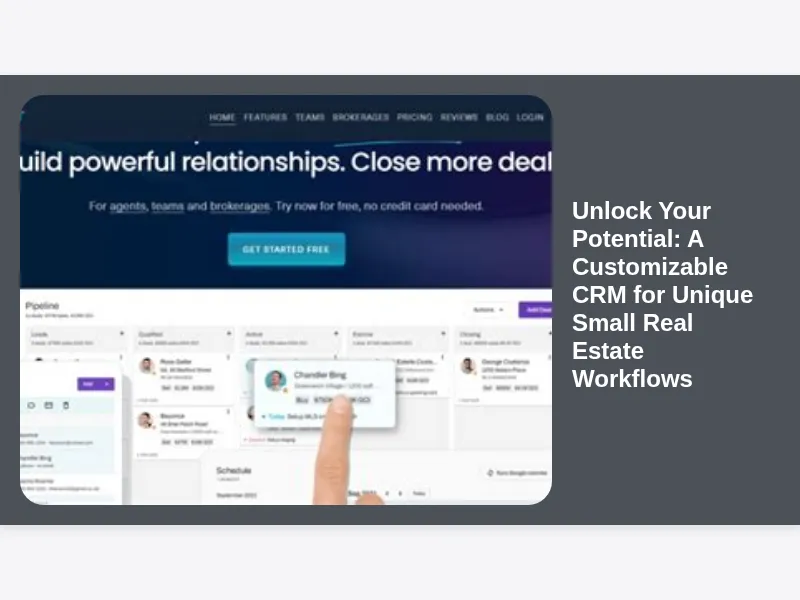
With a flexible CRM, you can define your own pipeline stages, renaming them to reflect your specific terminology – perhaps “Initial Consultation,” “Property Sourcing,” “Due Diligence,” “Offer Submitted,” “Inspection Period,” “Under Contract,” or “Lease Signed.” Within each stage, you can create automated tasks, reminders, and checklists tailored to the necessary actions for that specific type of deal. For instance, a “Due Diligence” stage for a commercial property might trigger tasks for zoning checks, environmental assessments, and financial review, whereas a “Home Inspection” stage for a residential property would prompt different actions. This level of customized visibility ensures that every unique transaction type is managed with precision, reducing errors and accelerating progress, offering an unparalleled level of control over your Real Estate Transaction Management.
Beyond Sales: Managing Post-Sale Relationships and Referrals Effectively
The relationship with a client doesn’t end when the papers are signed; in real estate, it’s often just the beginning of a long-term connection that can lead to referrals and repeat business. For small real estate businesses, nurturing these post-sale relationships is absolutely crucial for sustainable growth. Generic CRMs often treat a closed deal as the end of the line, lacking the specific tools and workflows needed to cultivate lasting advocacy. A Customizable CRM for Unique Small Real Estate Workflows understands this critical distinction and empowers you to manage post-sale engagement with the same precision as your initial lead nurturing.
Imagine creating a dedicated “Past Client” pipeline with custom stages for follow-up activities: “6-Month Check-in,” “Annual Market Update,” “Holiday Greeting,” or “Referral Solicitation.” You can automate personalized emails or calls to celebrate home anniversaries, offer exclusive market insights, or simply check in, reinforcing your value as their trusted real estate advisor. Furthermore, a custom CRM allows you to track referrals received from past clients, crediting advocates and even automating thank-you gestures. By systematizing this post-sale interaction, you transform satisfied clients into enthusiastic promoters, significantly boosting your referral network and ensuring your unique brand of service continues to resonate long after the transaction is complete.
Seamless Integration with Your Existing Real Estate Tech Stack
In today’s digital real estate landscape, your CRM rarely operates in a vacuum. It needs to be a central hub, communicating effectively with other specialized tools you use daily – from the Multiple Listing Service (MLS) to e-signature platforms, accounting software, and dedicated marketing automation systems. For a Customizable CRM for Unique Small Real Estate Workflows, robust integration capabilities are not just a convenience; they are a necessity, preventing data silos and ensuring a streamlined flow of information across your entire technology ecosystem.
A truly flexible CRM should offer native integrations or robust API access that allows it to connect with your most vital tools. Imagine automatically pulling new listings from the MLS directly into your property tracking module, syncing client contact information with your preferred email marketing platform, or pushing closed deal data to your accounting software without manual data entry. The ability to integrate with e-signature solutions like DocuSign or Adobe Sign means contracts can be prepared and executed seamlessly within your workflow, cutting down on administrative time. This interconnectedness ensures that your unique real estate processes are supported end-to-end, eliminating redundant tasks and providing a unified view of your operations, making it a pivotal component for real estate business growth.
Data Security and Compliance: Safeguarding Sensitive Real Estate Information
In the real estate industry, handling sensitive client data – personal financial information, property details, legal documents – is an everyday reality. Protecting this information is not just about maintaining client trust; it’s a legal and ethical imperative. For small real estate businesses, ensuring data security and compliance with relevant regulations can feel daunting, especially when dealing with unique workflows that might involve specialized data points. A robust, Customizable CRM for Unique Small Real Estate Workflows must therefore prioritize these aspects, offering peace of mind alongside operational efficiency.
When selecting a CRM, delve into its security protocols: encryption standards, data backup procedures, user access controls, and adherence to privacy regulations like GDPR or CCPA where applicable. A customizable platform allows you to define who has access to specific data fields or modules, ensuring only authorized personnel view sensitive information, which is particularly important for niche operations handling unique property types or high-net-worth clients. Furthermore, the ability to store and organize compliance-related documents, track consent, and maintain audit trails directly within your customized workflows helps streamline regulatory adherence, protecting both your business and your clients from potential risks. According to industry best practices published by organizations like the National Association of Realtors (NAR) [link to NAR data security guidelines], robust data protection is non-negotiable for real estate professionals.
Choosing the Right Customizable CRM Platform: What to Look For
The market offers a bewildering array of CRM platforms, some claiming to be highly customizable, others offering specific real estate editions. Navigating this landscape to find the perfect Customizable CRM for Unique Small Real Estate Workflows requires a discerning eye and a clear understanding of your business’s priorities. It’s not just about features; it’s about the underlying architecture, the vendor’s philosophy, and the overall ecosystem that supports your specific needs. Making the right choice here will define your operational efficiency for years to come.
Consider first the platform’s core customizability: Can you create custom objects, fields, and workflow rules without extensive coding? Does it offer a drag-and-drop interface for pipeline design? Evaluate its integration capabilities – is there a robust API, or does it offer native connectors to the tools you already rely on? Scalability is another key factor; even if you’re a small operation now, you want a CRM that can grow with you without requiring a complete overhaul. Finally, assess the vendor’s support and community resources. A strong support team and an active user community can be invaluable during implementation and ongoing optimization. Factor in pricing models, ensuring transparency and alignment with your budget, whether it’s an open-source solution requiring more technical expertise or a SaaS platform with recurring subscriptions.
Implementing Your Customizable CRM: A Strategic Step-by-Step Guide
Implementing a new CRM, especially one designed for unique workflows, is more than just installing software; it’s a strategic business transformation. Rushing this process can lead to suboptimal adoption, wasted resources, and user frustration. A thoughtful, phased approach is essential to ensure your Customizable CRM for Unique Small Real Estate Workflows truly integrates into your daily operations and delivers its promised value. This isn’t just about getting it set up; it’s about making it work for you.
The first step is thorough planning: revisit your workflow maps, identify key customization requirements, and set clear goals for what you want to achieve with the CRM. Next, focus on data migration. Clean and accurate data is paramount, so carefully plan how to import existing client and property information, ensuring integrity and avoiding duplicates. Then comes the customization phase: build your unique fields, pipelines, automation rules, and dashboards. User training is critical; engage your team early, provide hands-on sessions, and emphasize the “why” behind the new system and how it benefits their specific roles. Finally, adopt an iterative approach. A CRM is never truly “finished”; regularly review its performance, gather user feedback, and make continuous adjustments to optimize its effectiveness as your unique real estate workflows evolve.
Real-World Impact: How a Tailored CRM Boosts Small Real Estate Businesses
The theoretical benefits of a Customizable CRM for Unique Small Real Estate Workflows become profoundly tangible when observed in real-world scenarios. Small real estate businesses, from independent agents to boutique brokerages specializing in niche markets, consistently report transformative improvements once they transition to a system that truly aligns with their operations. The impact extends far beyond mere organizational efficiency, touching every aspect of their business, from client satisfaction to overall profitability.
Imagine an independent agent specializing in equestrian properties. With a generic CRM, they struggled to track details like stable capacity, paddock sizes, or water rights. A customizable CRM allowed them to create these specific fields, automate follow-ups based on unique property features, and build pipelines tailored to the complex multi-stage process of selling ranches. The result? Faster, more accurate matching of buyers to properties, more informed client conversations, and ultimately, a significant increase in successful transactions. Similarly, a boutique firm focused on commercial retail leases found that custom pipelines for tenant acquisition, lease negotiation, and property management within their CRM drastically reduced administrative overhead and accelerated deal closures by 20%, simply because the system spoke their language and supported their specific process, underscoring the vital role of Custom CRM for Agents and firms.
Overcoming Common Challenges in CRM Adoption for Real Estate
Even with the most meticulously chosen Customizable CRM for Unique Small Real Estate Workflows, the path to full adoption isn’t always without hurdles. Small real estate businesses often face unique challenges during implementation, from limited internal IT resources to resistance from team members accustomed to established routines. Addressing these potential roadblocks proactively is key to ensuring a smooth transition and maximizing your investment in the new system. Ignoring these challenges can lead to underutilization and frustration, negating many of the benefits.
One of the most common challenges is user resistance. Agents and staff, often comfortable with their existing (even if inefficient) methods, may view a new CRM as an added burden. Overcome this by involving them in the planning and customization process, demonstrating how the CRM will simplify their daily tasks, not complicate them. Another challenge is data cleanliness; migrating messy or incomplete data can undermine the system’s effectiveness. Prioritize data audit and cleanup before migration. Finally, avoid “feature creep” – the temptation to customize too much too soon. Start with your core unique workflows, get them right, and then iteratively add more advanced customizations as your team becomes comfortable. Clear communication, thorough training, and continuous support are your best allies in navigating these adoption challenges.
The Future of Real Estate CRM: AI, Machine Learning, and Hyper-Customization
The evolution of CRM technology is relentless, driven by advancements in artificial intelligence (AI) and machine learning (ML). For a Customizable CRM for Unique Small Real Estate Workflows, this future promises even deeper levels of personalization, predictive capabilities, and automation that will further empower small businesses to compete and excel. The days of simply tracking contacts are long gone; the next generation of CRMs will act as intelligent partners, proactively guiding your business strategy.
Imagine a CRM that uses AI to analyze your unique lead data and predict which prospects are most likely to convert, automatically prioritizing them and suggesting personalized outreach strategies. Or a system that leverages machine learning to identify emerging market trends specific to your niche, helping you proactively adjust your listings or marketing efforts. Hyper-customization will move beyond manual configuration, with AI-powered suggestions for optimizing your workflows, identifying bottlenecks, and even drafting personalized client communications based on historical interactions. These advancements mean that flexible CRMs will become not just data repositories, but intelligent operational hubs that continuously learn and adapt to your unique business environment, offering unprecedented insights and efficiencies for real estate marketing automation and targeted client engagement.
Measuring ROI: How a Tailored CRM Boosts Your Real Estate Business Growth
Investing in a Customizable CRM for Unique Small Real Estate Workflows is a strategic decision, and like any investment, it should deliver a measurable return. For small real estate businesses, quantifying the Return on Investment (ROI) often involves looking beyond simple cost savings to encompass improvements in efficiency, increased sales, enhanced client satisfaction, and overall real estate business growth. A tailored CRM provides the data and insights necessary to clearly demonstrate its value.
Start by tracking key performance indicators (KPIs) before and after implementation: lead conversion rates, average time to close a deal, client retention rates, referral volume, and the time spent on administrative tasks. A well-implemented customizable CRM can significantly reduce the manual effort required for data entry and follow-up, freeing up agents to focus on high-value activities like client interactions and negotiations. This translates directly into more deals closed and a higher gross commission income. Furthermore, by ensuring consistent, personalized communication and meticulous client management, a tailored CRM fosters stronger relationships, leading to more repeat business and referrals – the lifeblood of any successful small real estate operation. The ability to generate custom reports on these specific metrics allows you to see the tangible impact of your CRM, proving its worth in quantifiable terms and driving strategic decisions for continuous improvement.
Conclusion: Your Future with a Truly Customizable Real Estate CRM
The real estate industry thrives on relationships, specialization, and efficiency. For small real estate businesses, independent agents, and boutique brokerages with their distinct identities and highly individualized operational methods, the quest for the perfect technological partner can be challenging. Generic CRMs, while offering broad utility, simply cannot provide the nuanced support required for truly unique workflows. This is why the concept of a Customizable CRM for Unique Small Real Estate Workflows isn’t just a desirable feature; it’s an absolute necessity for sustainable growth and competitive advantage.
By embracing a CRM that molds itself to your specific processes – from tailored lead management and precise property tracking to automated personalized communication and bespoke transaction pipelines – you unlock a new level of operational fluidity. You transform your software from a rigid constraint into a dynamic extension of your business, empowering your team, enhancing client satisfaction, and ultimately driving greater profitability. The future of real estate demands flexibility, and with a truly customizable CRM, you’re not just ready for that future; you’re actively shaping it. It’s time to stop fitting your business into a box and instead, invest in a solution that’s custom-built to elevate your unique vision and propel your success.