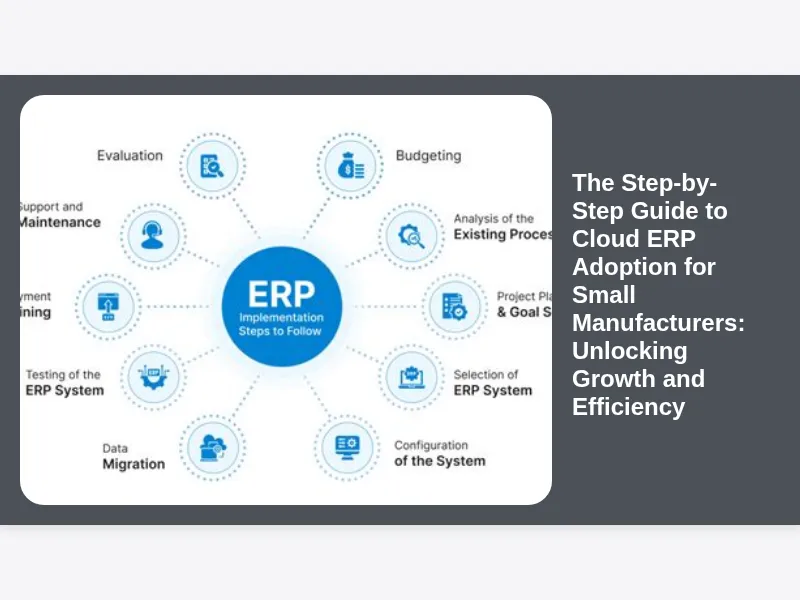
In today’s fast-paced manufacturing landscape, small manufacturers often find themselves at a crossroads. They grapple with outdated systems, manual processes, and a desperate need for real-time visibility to stay competitive. The dream of seamless operations, accurate inventory, and informed decision-making often feels out of reach, buried under a mountain of spreadsheets and disconnected software. But what if there was a clear pathway to revolutionize your operations? This comprehensive step-by-step guide to Cloud ERP adoption for small manufacturers is designed to demystify the process, offering a practical roadmap to digital transformation.
Embracing cloud-based Enterprise Resource Planning (ERP) is no longer a luxury reserved for large enterprises; it’s a strategic imperative for small manufacturers aiming to scale, innovate, and thrive. This article will walk you through every critical phase, from initial assessment to successful implementation and ongoing optimization. We’ll explore the unique benefits, potential challenges, and best practices, ensuring your journey into the cloud is not just successful but also profoundly transformative. Get ready to unlock new levels of efficiency, gain unparalleled insights, and future-proof your manufacturing business.
Why Cloud ERP Matters for Small Manufacturing Businesses: Addressing Unique Challenges
Small manufacturers face a distinct set of challenges that can either hinder growth or become catalysts for innovation. Limited budgets, fewer dedicated IT resources, and the need for agility to respond quickly to market changes often make traditional, on-premise ERP systems an impractical choice. These businesses are constantly juggling inventory management, production scheduling, quality control, and customer demands, often with fragmented data spread across disparate systems. The sheer complexity can be overwhelming, leading to inefficiencies, errors, and missed opportunities.
This is precisely where cloud ERP steps in as a game-changer. Unlike its on-premise counterpart, cloud ERP requires minimal upfront hardware investment, shifts IT burdens to the vendor, and offers unparalleled scalability. For a small manufacturer, this means access to enterprise-grade functionality without the associated enterprise-level costs and maintenance headaches. It’s about democratizing sophisticated business tools, enabling smaller players to compete more effectively with larger organizations by leveraging real-time data, streamlined processes, and enhanced collaboration across their entire value chain.
Understanding Cloud ERP Solutions: More Than Just Software
Before embarking on the step-by-step guide to Cloud ERP adoption for small manufacturers, it’s crucial to truly grasp what cloud ERP entails. At its core, ERP is a suite of integrated applications that manage and integrate core business processes, from finance and human resources to manufacturing and supply chain management. Cloud ERP takes this a step further by hosting these applications and data on remote servers, accessed via the internet. Instead of installing software on your own servers, you subscribe to a service, much like you would with Netflix or Spotify, but for your entire business operations.
This shift from an ownership model to a subscription service brings significant advantages. It eliminates the need for expensive server infrastructure, reduces the burden of IT maintenance, and ensures that your software is always up-to-date with the latest features and security patches. For small manufacturers, this means less time worrying about IT infrastructure and more time focusing on production, innovation, and growth. It’s not merely about having software in the cloud; it’s about adopting a flexible, scalable, and accessible operational backbone that can evolve alongside your business.
The Foundational Benefits of Cloud ERP for Small Manufacturers: Driving Efficiency and Growth
The adoption of cloud ERP offers a multitude of tangible benefits that directly address the pain points common among small manufacturers. One of the most significant advantages is the dramatic reduction in upfront capital expenditure. Instead of investing heavily in hardware and software licenses, small businesses can leverage a predictable monthly or annual subscription model, freeing up crucial capital for other growth initiatives. This financial flexibility is often a deciding factor for manufacturers operating on tighter budgets.
Beyond cost savings, cloud ERP delivers enhanced accessibility and flexibility. Your team can access critical business data and applications from anywhere, at any time, using any device with an internet connection. This is invaluable for manufacturing teams that might operate across multiple locations, for sales teams on the road, or for management needing real-time insights outside the factory floor. Furthermore, cloud solutions inherently offer superior scalability, allowing manufacturers to easily add users, modules, or storage as their business expands, without the need for costly and time-consuming hardware upgrades. The ability to quickly adapt to changing market demands and business needs is a powerful competitive advantage that cloud ERP readily provides.
Phase 1: Assessing Your Current State and Operational Needs
The very first and arguably most critical step in the step-by-step guide to Cloud ERP adoption for small manufacturers is a thorough and honest assessment of your current operational state. Before you can choose a solution, you need to understand the problems you’re trying to solve. This phase involves a deep dive into your existing business processes, identifying inefficiencies, bottlenecks, and areas where data is fragmented or inaccurate. Are you still using spreadsheets for inventory, paper trails for quality control, or disparate systems that don’t communicate with each other? Document all these pain points meticulously.
Beyond identifying problems, this phase also requires defining your strategic objectives for adopting cloud ERP. What do you hope to achieve? Is it improved inventory accuracy, faster order fulfillment, better production planning, reduced operational costs, or enhanced customer satisfaction? Having clear, measurable goals will serve as your compass throughout the entire adoption process and will be instrumental in evaluating potential solutions and measuring success post-implementation. Involving key stakeholders from various departments—production, finance, sales, and management—will ensure a holistic understanding of your needs and foster early buy-in.
Phase 2: Building Your Cloud ERP Project Team: Internal Champions and Stakeholder Engagement
Successfully navigating the step-by-step guide to Cloud ERP adoption for small manufacturers demands a dedicated and well-structured project team. While small manufacturers may not have the luxury of a large IT department, assembling the right internal champions is paramount. This team should ideally include a project lead who can dedicate significant time, representatives from key operational areas like production, finance, and sales, and a decision-maker from upper management. The project lead will be responsible for day-to-day coordination, communication, and ensuring the project stays on track.
Crucially, securing strong leadership buy-in and active participation from the outset is non-negotiable. Executive sponsorship demonstrates the company’s commitment to the project, helps overcome resistance to change, and ensures necessary resources are allocated. These internal champions will act as liaisons between departments, articulate specific needs, test the system, and ultimately become advocates for the new ERP system. Their involvement not only ensures that the chosen solution aligns with actual business needs but also lays the groundwork for successful user adoption across the entire organization.
Phase 3: Defining Your Cloud ERP Requirements: A Manufacturer’s Checklist
With your current state assessed and your project team assembled, the next critical step in the step-by-step guide to Cloud ERP adoption for small manufacturers is to meticulously define your specific functional and technical requirements. This isn’t just a wish list; it’s a detailed blueprint of what your ideal cloud ERP solution must be able to do. For manufacturers, certain functionalities are non-negotiable. Think about your core processes: do you need robust Bill of Materials (BOM) management, Material Requirements Planning (MRP), capacity planning, shop floor control, or advanced scheduling features?
Consider your entire product lifecycle, from design to delivery. Does your ERP need to integrate with CAD software, manage quality control processes, track serial numbers, or handle multi-level assemblies? Don’t forget the financial and sales aspects either – comprehensive accounting, robust reporting, order management, and customer relationship management (CRM) capabilities are often integral. Prioritize your requirements into “must-haves,” “should-haves,” and “nice-to-haves.” This prioritized list will be invaluable when evaluating vendors and their offerings, ensuring you select a system that genuinely addresses your most pressing manufacturing needs and aligns with your long-term growth strategy.
Phase 4: Navigating the Cloud ERP Vendor Selection Process: Finding the Right Partner
Choosing the right cloud ERP vendor is perhaps the most pivotal decision in the step-by-step guide to Cloud ERP adoption for small manufacturers. This isn’t just about selecting software; it’s about establishing a long-term partnership with a provider who understands the unique nuances of your industry and your business size. Begin by researching vendors that specifically cater to small and mid-sized manufacturers, as their solutions and support models are often better aligned with your needs than those designed for large enterprises. Look beyond the big names and explore niche providers who specialize in discrete, process, or mixed-mode manufacturing, depending on your operation.
Once you have a shortlist, send out a Request for Proposal (RFP) that clearly outlines your defined requirements from Phase 3. Pay close attention to how vendors respond, their pricing models (subscription costs, implementation fees, support), and their commitment to customer success. Request live demonstrations that are tailored to your specific manufacturing processes, rather than generic presentations. Most importantly, check references from other small manufacturing companies that have implemented their solution. Speaking directly with their existing clients can provide invaluable insights into their implementation process, ongoing support, and the overall satisfaction levels. A good vendor will not only provide a powerful solution but also act as a trusted advisor throughout your digital transformation journey.
Phase 5: Crafting a Robust Cloud ERP Implementation Plan: Project Timelines and Resources
Once a vendor has been selected, the next crucial phase in the step-by-step guide to Cloud ERP adoption for small manufacturers is to develop a comprehensive implementation plan. This blueprint will outline all the tasks, timelines, responsibilities, and resources required to bring your cloud ERP system to life. Work closely with your chosen vendor’s implementation team, leveraging their experience and methodologies, but ensure your internal project team remains actively involved in every step. A detailed project plan should include key milestones, such as data migration, system configuration, integration testing, and user training.
Careful resource allocation is also vital during this phase. Identify who on your internal team will be responsible for data cleaning, process mapping, and user training, and ensure they have sufficient time allocated away from their daily tasks to dedicate to the ERP project. Realistic timelines are paramount; don’t rush the process, as shortcuts can lead to significant problems down the line. Build in buffer time for unexpected challenges, and regularly review progress against your plan. Effective project management, coupled with clear communication channels between your team and the vendor, will be the bedrock of a smooth and successful cloud ERP implementation.
Phase 6: Data Migration Strategies for Small Manufacturers: Ensuring Accuracy and Integrity
Data migration is often cited as one of the most challenging aspects of any ERP implementation, and it’s a critical component of the step-by-step guide to Cloud ERP adoption for small manufacturers. The accuracy and integrity of your historical data, such as customer records, vendor information, product catalogs, inventory levels, and financial data, are paramount to the success of your new system. Begin by identifying all the data sources you need to migrate. This might include old spreadsheets, legacy accounting software, or other manufacturing-specific databases.
Before moving any data, a thorough data cleansing process is essential. This involves removing duplicate entries, correcting inaccuracies, standardizing formats, and archiving outdated information. “Garbage in, garbage out” perfectly summarizes the risk here; migrating poor quality data will only replicate existing problems in your new cloud ERP system. Work with your vendor to understand their data migration tools and templates, and establish a clear data mapping strategy to ensure that information from your old systems correctly populates the fields in the new ERP. Always perform test migrations to validate the data, resolve any issues, and refine the process before the final cutover. Taking the time to get data migration right will pay dividends in the long run by ensuring reliable insights and smooth operations.
Phase 7: Customization vs. Configuration in Cloud ERP: Balancing Needs with Future Agility
As small manufacturers progress through the step-by-step guide to Cloud ERP adoption for small manufacturers, they will inevitably face decisions regarding system tailoring: should they customize or configure? Configuration involves using the built-in settings and parameters within the cloud ERP system to align it with your specific business processes, without altering the core code. This might include setting up specific workflows, creating custom reports using the system’s tools, or defining user roles and permissions. Configuration is generally preferred because it keeps the system closer to its standard form, making upgrades and maintenance much simpler and less costly.
Customization, on the other hand, involves modifying the core code of the ERP system to add unique functionalities not available through configuration. While customization might seem appealing for very specific needs, it comes with significant drawbacks, especially for small manufacturers. Customized systems are often more expensive to implement, harder to upgrade (as modifications may break with new versions), and can tie you more closely to a specific vendor. For small manufacturers, the general advice is to prioritize configuration over customization wherever possible. Embrace best practices inherent in the ERP system, and only consider customization for truly differentiating processes that cannot be handled otherwise. This approach ensures greater agility, lower total cost of ownership, and a smoother path for future system enhancements.
Phase 8: Comprehensive User Training and Change Management: Empowering Your Team
A technically perfect cloud ERP implementation can fail if your team doesn’t embrace and effectively use the new system. Therefore, comprehensive user training and a robust change management strategy are pivotal elements in the step-by-step guide to Cloud ERP adoption for small manufacturers. Change can be daunting, and employees may resist new tools, especially if they are comfortable with existing, albeit inefficient, processes. It’s crucial to communicate the “why” behind the ERP adoption from the very beginning, highlighting the benefits for individual roles and the company as a whole.
Develop a multi-faceted training program tailored to different user groups – finance, production, sales, etc. This might involve hands-on workshops, online tutorials, user manuals, and dedicated practice environments. Encourage super-users or internal champions to become trainers and first-line support within their departments. Beyond initial training, plan for ongoing support, refresher courses, and opportunities for users to provide feedback. Actively listen to concerns and address them promptly. By empowering your team with the knowledge and support they need, you transform potential resistance into enthusiastic adoption, ensuring your investment in cloud ERP truly translates into improved productivity and morale.
Phase 9: Go-Live and Post-Implementation Support: The Critical Transition
The “go-live” day marks a significant milestone in the step-by-step guide to Cloud ERP adoption for small manufacturers. This is when your new cloud ERP system officially replaces your old processes. While exciting, it’s often accompanied by a period known as “hypercare,” where heightened support and vigilance are essential. During go-live, ensure your project team, key users, and vendor support are readily available to address any immediate issues, answer questions, and provide on-the-spot troubleshooting. It’s common to encounter minor hiccups or unexpected scenarios as users navigate the new system in a live environment, and quick resolution is key to maintaining confidence.
Post-implementation support extends beyond the initial hypercare period. Establish clear channels for ongoing technical support, user questions, and feature requests. Your vendor should have a reliable support structure in place, but also ensure you have internal points of contact. Regular check-ins with your team will help identify areas where additional training might be needed or processes could be further optimized. Remember, cloud ERP is not a static solution; it’s a dynamic tool that should continuously evolve with your business. Ongoing support ensures your small manufacturing business maximizes its investment and leverages new features as they become available.
Phase 10: Measuring Success and Optimizing Your Cloud ERP Investment: Continuous Improvement
The journey doesn’t end after go-live; the final, continuous phase in the step-by-step guide to Cloud ERP adoption for small manufacturers involves measuring the success of your implementation and continuously optimizing your investment. Go back to the strategic objectives you defined in Phase 1. Are you achieving them? Establish key performance indicators (KPIs) related to inventory accuracy, on-time delivery, production efficiency, order fulfillment cycles, and financial reporting speed. Regularly track these metrics to quantify the tangible benefits derived from your cloud ERP system.
Don’t just measure; use the insights to drive continuous improvement. Cloud ERP systems are designed to be flexible and adaptable. Encourage users to provide feedback on what works well and what could be improved. Periodically review your business processes within the ERP to identify opportunities for further automation, integration with other systems (like IoT devices on the factory floor), or leveraging advanced analytics. Attending vendor webinars, user conferences, and staying informed about new features will help you unlock even greater value from your ERP. Your cloud ERP should be a living, breathing asset that continuously helps your small manufacturing business grow and optimize its operations.
Overcoming Common Challenges in Cloud ERP Adoption: Proactive Strategies
Even with a meticulous step-by-step guide to Cloud ERP adoption for small manufacturers, challenges are inevitable. Being proactive in recognizing and addressing them can significantly impact your project’s success. One common hurdle is budget constraints, as small manufacturers often operate with tighter financial resources. Combat this by focusing on cloud solutions that offer scalable pricing models and clearly articulate the return on investment (ROI) to secure stakeholder buy-in, emphasizing cost savings from reduced manual efforts and improved efficiency.
Another significant challenge is data quality. Legacy data is often messy, inconsistent, and incomplete. Allocate ample time and resources for data cleansing and migration (as discussed in Phase 6), understanding that poor data will cripple even the best ERP system. User resistance to change is also prevalent. This can be mitigated through transparent communication, involving employees early in the process, providing comprehensive training, and highlighting the benefits to their daily work. Finally, be wary of vendor lock-in. While cloud ERP implies a partnership, ensure your contract terms allow for data portability and reasonable exit strategies should the need arise. Proactive planning and open communication can transform these potential roadblocks into stepping stones for a successful transformation.
Future-Proofing Your Small Manufacturing Business with Cloud ERP: Beyond Today’s Needs
Adopting cloud ERP isn’t just about solving today’s operational problems; it’s about strategically future-proofing your small manufacturing business. As laid out in the step-by-step guide to Cloud ERP adoption for small manufacturers, the inherent scalability and flexibility of cloud solutions are key advantages in an ever-evolving market. Unlike rigid on-premise systems, cloud ERP platforms are designed to easily integrate with emerging technologies, allowing your business to adapt and leverage innovations without undergoing another massive overhaul.
Consider the potential for integrating your cloud ERP with Internet of Things (IoT) devices on your factory floor to gather real-time machine data for predictive maintenance or enhanced production visibility. Imagine leveraging artificial intelligence (AI) and machine learning (ML) capabilities embedded within or integrated with your ERP for more accurate demand forecasting, optimized inventory levels, or automated quality control. As your business grows, cloud ERP can seamlessly accommodate increased transaction volumes, new product lines, or expansion into new markets. By choosing a robust, future-ready cloud ERP, small manufacturers are not just implementing software; they are building a resilient, adaptable foundation that can propel them forward for years to come.
Cloud ERP and Regulatory Compliance for Manufacturers: Navigating the Landscape
For many small manufacturers, especially those in regulated industries like medical devices, aerospace, or food production, navigating regulatory compliance is a complex and non-negotiable aspect of business. This is where a well-implemented cloud ERP system, as discussed throughout the step-by-step guide to Cloud ERP adoption for small manufacturers, can become an invaluable asset. Modern cloud ERP solutions are often designed with features that aid in compliance, from robust audit trails to detailed traceability capabilities.
The ability to accurately track raw materials, components, and finished goods throughout the entire production process, along with capturing quality control data and maintaining comprehensive documentation, is crucial for satisfying regulatory bodies. Cloud ERP can automate much of this data collection and reporting, significantly reducing the manual effort and potential for error associated with compliance. Furthermore, trusted cloud ERP providers typically adhere to stringent data security standards and certifications (e.g., ISO 27001, SOC 2), which can help manufacturers meet data privacy and security requirements. By centralizing data and standardizing processes, cloud ERP empowers small manufacturers to maintain compliance more efficiently and confidently, reducing risks and demonstrating due diligence.
The True Cost of Cloud ERP: Beyond the Subscription Fee for Small Manufacturers
While a key benefit highlighted in the step-by-step guide to Cloud ERP adoption for small manufacturers is the reduction in upfront capital expenditure, it’s essential to understand the true total cost of ownership (TCO). Focusing solely on the monthly subscription fee can be misleading. A comprehensive view of costs includes several crucial components that small manufacturers must budget for to avoid unpleasant surprises.
Firstly, there are implementation costs. These typically involve vendor professional services for data migration, system configuration, integration with other existing systems, and initial training. These fees can sometimes be substantial, depending on the complexity of your requirements. Secondly, ongoing training and change management initiatives will require internal resources and potentially external consulting. Thirdly, consider the cost of potential customizations, although it’s always recommended to minimize these for cloud solutions. Lastly, factor in the time your internal team will spend on the project, from initial assessment to ongoing optimization. By considering all these elements, small manufacturers can create a realistic budget and truly understand the financial commitment involved in transforming their operations with cloud ERP, ensuring long-term financial viability and return on investment.
Real-World Success Stories: Small Manufacturers Thriving with Cloud ERP
To truly appreciate the step-by-step guide to Cloud ERP adoption for small manufacturers, it’s helpful to consider how real businesses have benefited. Imagine a small metal fabrication shop that struggled with accurate job costing and inconsistent production schedules. Before cloud ERP, they relied on manual spreadsheets and tribal knowledge, leading to frequent delays and unexpected budget overruns. After adopting a specialized cloud ERP, they gained real-time visibility into every project, from raw material procurement to final assembly. Their production scheduling became optimized, inventory levels were reduced by 20% due to better forecasting, and their job costing accuracy improved dramatically, allowing them to bid more competitively and profitably.
Consider another example: a small artisan food producer experiencing rapid growth but held back by fragmented inventory and order management. They couldn’t keep up with demand, often overselling popular products or having excess of others, leading to waste. Implementing a cloud ERP system unified their sales orders, production planning, and ingredient inventory. This allowed them to manage lot tracking for regulatory compliance, optimize production batches, and reduce stockouts, all while scaling their operations to meet growing consumer demand. These stories, though illustrative, underscore the tangible impacts – increased efficiency, better decision-making, and sustainable growth – that cloud ERP can bring to small manufacturing businesses.
Conclusion: Your Path to Digital Transformation with Cloud ERP
Embarking on the step-by-step guide to Cloud ERP adoption for small manufacturers is a strategic journey that promises to redefine your operational capabilities and unlock unprecedented growth. We’ve traversed the critical phases, from understanding the unique advantages of cloud ERP for small businesses to meticulously defining requirements, selecting the right vendor, and navigating the complexities of implementation and post-go-live optimization. The path may present challenges, but with a proactive approach, a dedicated team, and a clear vision, these hurdles can be transformed into stepping stones toward success.
Embracing cloud ERP is more than just investing in new software; it’s investing in the future of your manufacturing business. It’s about gaining real-time insights, fostering collaboration, streamlining processes, and building a foundation that is flexible enough to adapt to market shifts and scalable enough to support your ambitions. By following this comprehensive guide, small manufacturers can confidently step into the digital age, transforming their operations from reactive to proactive, and securing their place as innovative, efficient, and resilient players in the competitive manufacturing landscape. The time to unlock your full potential with cloud ERP is now.