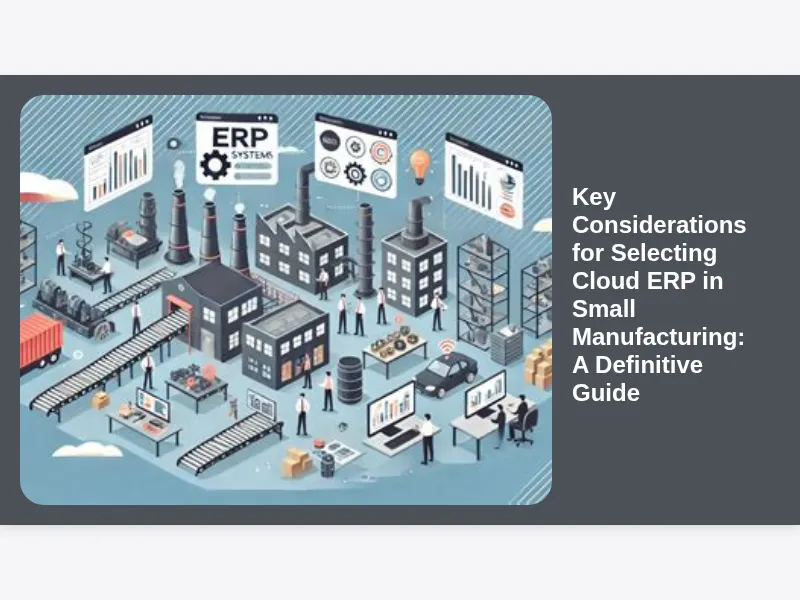
The manufacturing world, even for its smaller players, is undergoing a profound digital transformation. Gone are the days when sophisticated enterprise resource planning (ERP) systems were solely the domain of multinational corporations. Today, cloud-based ERP solutions offer small manufacturing businesses an unprecedented opportunity to streamline operations, enhance efficiency, and gain a competitive edge. However, the journey to selecting the right system isn’t without its complexities. This guide will walk you through the key considerations for selecting cloud ERP in small manufacturing, ensuring you make an informed decision that drives sustainable growth and operational excellence.
Navigating the Modern Manufacturing Landscape: Why Cloud ERP Now?
Small manufacturing businesses often operate with tight margins, diverse product lines, and a constant need to innovate. The traditional methods of managing production, inventory, sales, and accounting, often relying on disparate spreadsheets and siloed systems, are simply no longer sufficient. These manual processes are prone to errors, lead to inefficiencies, and prevent a holistic view of the business, hindering agility and responsiveness in an ever-changing market. The question for many isn’t if they need an integrated system, but what kind and how to choose it.
Embracing a cloud-based ERP isn’t just about modernizing; it’s about future-proofing. It allows small manufacturers to leverage advanced functionalities without the prohibitive upfront costs and IT infrastructure requirements of on-premise systems. This accessibility democratizes powerful business tools, enabling smaller entities to compete more effectively with larger rivals. The shift towards cloud computing in manufacturing reflects a broader industry trend where agility, data access, and scalability are paramount for survival and growth.
Understanding the Core Value Proposition of Cloud ERP for Small Manufacturers
At its heart, a cloud ERP system for small manufacturing is designed to integrate all core business functions into a single, unified platform accessible via the internet. Imagine having a real-time view of your production schedule, inventory levels, customer orders, and financial data, all from one dashboard. This level of visibility eliminates guesswork, reduces lead times, and improves decision-making across the board. The power of cloud ERP lies in its ability to centralize information that was once scattered.
For small manufacturers, this translates into tangible benefits. Processes that once took hours, like calculating material requirements or tracking job costs, can be automated and optimized. This efficiency gain allows valuable human capital to be redirected from administrative tasks to more strategic initiatives, such as product development or customer engagement. The subscription-based model of cloud ERP also shifts IT expenses from large capital expenditures to predictable operational costs, which is often more palatable for businesses with constrained budgets.
The Digital Transformation Imperative for Small-Scale Operations
The phrase “digital transformation” might sound daunting for a small manufacturing enterprise, but at its core, it simply means leveraging digital technologies to improve processes, culture, and customer experiences. For small manufacturers, this imperative is particularly strong because competitors, both large and small, are increasingly adopting these technologies. Remaining tethered to outdated systems puts you at a significant disadvantage, limiting your ability to adapt to market demands, respond to supply chain disruptions, or innovate efficiently.
A well-chosen cloud ERP acts as the backbone of this digital transformation. It enables smoother communication between departments, provides data-driven insights, and supports automated workflows, all of which are crucial for maintaining competitiveness. From enhanced inventory control to more accurate production scheduling, digital tools empower small manufacturers to operate with the precision and responsiveness typically associated with much larger organizations. Ignoring this shift is no longer an option; embracing it is a pathway to resilience and growth.
Assessing Your Current Manufacturing Landscape: Pinpointing Pain Points and Opportunities
Before embarking on the search for a new ERP system, it’s absolutely crucial for small manufacturers to conduct a thorough internal audit of their current operations. What are your biggest pain points? Is it inaccurate inventory leading to stockouts or overstock? Are production delays common because of poor scheduling? Is customer order fulfillment a chaotic process? Identifying these inefficiencies and bottlenecks will not only clarify what you need from an ERP but also help in articulating your requirements to potential vendors.
This assessment should go beyond just identifying problems; it should also uncover opportunities for improvement. Perhaps there are manual data entry tasks that can be automated, or information silos that, if integrated, could unlock significant efficiencies. Involving key stakeholders from various departments – production, sales, finance, and logistics – in this assessment process is vital. Their insights will provide a comprehensive picture of your current state and help ensure that the chosen ERP addresses the needs of the entire organization, not just a single department. This foundational work is a key consideration for selecting cloud ERP in small manufacturing effectively.
Defining Your Business Requirements and Goals: Tailoring the Solution
Once you understand your current landscape, the next critical step is to articulate what you want your cloud ERP to achieve. This involves defining specific business requirements and measurable goals. Do you aim to reduce production lead times by 15%? Improve on-time delivery rates to 98%? Gain better visibility into real-time profit margins? These precise objectives will guide your selection process and provide benchmarks for measuring the success of the implementation. Without clear goals, the selection process can become an aimless search, potentially leading to a system that doesn’t truly meet your needs.
Beyond high-level goals, delve into specific functional requirements. What kind of financial modules do you need? How robust should your inventory management be? Do you require advanced production planning and scheduling capabilities? Consider your unique manufacturing processes—whether you’re make-to-stock, make-to-order, assemble-to-order, or discrete manufacturing—as these will dictate the specific features essential for your operations. A well-defined list of requirements acts as your compass, ensuring that the selected cloud ERP directly supports your strategic objectives and enhances your operational efficiency through ERP.
Unpacking the Total Cost of Ownership (TCO) for Cloud ERP for Manufacturing
While cloud ERPs offer a compelling alternative to expensive on-premise solutions, it’s a misconception to think they are simply “cheap.” Understanding the Total Cost of Ownership (TCO) is paramount, extending far beyond the monthly subscription fees. For small manufacturers, budget constraints are a reality, and a comprehensive understanding of all potential costs is a key consideration for selecting cloud ERP in small manufacturing. This includes not just the software licenses but also implementation services, data migration, potential integrations with existing systems, training, and ongoing support.
Often, businesses overlook the internal costs associated with implementation, such as the time employees spend learning the new system or assisting with data cleanup. Hidden costs can also emerge from unexpected customizations or additional modules that weren’t initially planned. Requesting a detailed breakdown of all potential costs from vendors is essential, including any setup fees, annual price increases, or additional charges for specific features or user tiers. A clear TCO analysis will help small manufacturers budget accurately and avoid unwelcome financial surprises down the line.
Scalability and Future-Proofing Your Operations: Growing with Your System
One of the most attractive attributes of cloud ERP for small manufacturing is its inherent scalability. As your business grows, whether by increasing production volume, expanding product lines, or adding new facilities, your ERP system needs to be able to grow with you without requiring a complete overhaul. This is where the cloud model shines, allowing you to easily add users, modules, or storage capacity as needed, often with just a few clicks or a conversation with your vendor. Ensuring this capability is a critical key consideration for selecting cloud ERP in small manufacturing.
Future-proofing also means selecting a system that can adapt to evolving technological landscapes and industry trends. Does the vendor offer regular updates and new features? Is their platform built on a modern architecture that can integrate with emerging technologies like IoT or AI? Choosing a flexible and forward-thinking solution will prevent your business from being locked into an obsolete system in a few years, protecting your initial investment and ensuring long-term utility. Scalability of cloud ERP is not just about accommodating more users; it’s about enabling strategic evolution.
Data Security, Compliance, and Regulatory Concerns in the Cloud Environment
For any manufacturing business, data is a critical asset. Protecting proprietary designs, customer information, financial records, and operational data is non-negotiable. When moving to a cloud ERP, small manufacturers must rigorously evaluate the vendor’s data security protocols. This involves understanding their data centers’ physical security, encryption methods, disaster recovery plans, and cybersecurity certifications. Entrusting your vital business information to a third party requires a deep level of trust and verified security measures.
Furthermore, many manufacturing sectors are subject to specific regulatory compliance requirements, whether for product quality, environmental standards, or financial reporting. Your chosen cloud ERP must support these compliance needs, offering features for traceability, audit trails, and data retention that align with industry standards (e.g., ISO, FDA regulations if applicable). Understanding the vendor’s approach to data security in cloud ERP and their ability to help you meet regulatory obligations is not just good practice; it’s a fundamental requirement for risk management and operational integrity.
Seamless Integration Capabilities with Existing Systems: Harmonizing Your Tech Stack
No ERP system operates in a vacuum, especially within a manufacturing environment that often relies on a diverse set of specialized tools. Small manufacturers typically use systems for Computer-Aided Design (CAD), Customer Relationship Management (CRM), shop floor control (MES), quality management, and e-commerce, among others. A crucial key consideration for selecting cloud ERP in small manufacturing is its ability to seamlessly integrate with these existing applications. Without robust integration, you risk creating new data silos and negating many of the benefits an ERP aims to provide.
When evaluating potential solutions, inquire about their API (Application Programming Interface) capabilities and pre-built connectors. A strong API allows for custom integrations, while pre-built connectors can significantly reduce implementation time and costs. Understand how data will flow between systems and what level of real-time synchronization is possible. Poor integration can lead to manual data re-entry, discrepancies, and operational friction, undermining the very purpose of an integrated system. Effective integration with existing systems is the key to a cohesive and efficient technology ecosystem.
Vendor Evaluation and Due Diligence: Choosing the Right Strategic Partner
Selecting a cloud ERP isn’t just about choosing software; it’s about choosing a long-term strategic partner. The vendor you choose will be integral to your business success, providing support, updates, and guidance for years to come. Therefore, rigorous vendor evaluation and due diligence are paramount. Beyond the software’s features, assess the vendor’s reputation, financial stability, industry expertise, and commitment to customer success. A company that has a deep understanding of small manufacturing challenges will be better equipped to support your specific needs.
Look for a vendor with a proven track record, positive customer testimonials, and case studies relevant to businesses of your size and industry. Engage with their sales and support teams to gauge their responsiveness and expertise. Ask about their implementation methodology, training programs, and ongoing support structure. A reliable vendor will offer clear communication, transparency, and a partnership approach, ensuring that your investment yields maximum returns. Making the right choice in vendor selection criteria is as important as the software itself.
Customization Versus Configuration: Finding the Right Balance for Your Business
One of the nuanced decisions in ERP selection for small manufacturing involves the extent of customization. While some degree of tailoring might seem appealing to perfectly fit your unique processes, excessive customization can introduce significant risks. Custom code can be costly to develop, difficult to maintain, and often breaks with software updates, leading to upgrade headaches and increased TCO. It can also make it harder to leverage standard best practices that the ERP is designed to support.
The ideal approach often lies in configuration rather than deep customization. Modern cloud ERPs are highly configurable, allowing you to adjust workflows, fields, reports, and dashboards to match your operational needs without altering the core code. This flexibility allows small manufacturers to adapt the software to their business without incurring the technical debt of bespoke solutions. Understand the difference between these two approaches and prioritize a system that offers robust configuration options to meet your requirements while preserving the integrity and upgradeability of the standard platform. Customization options should always be weighed against long-term maintainability.
The Importance of User Experience (UX) and Adoption: Making it Work for Your Team
Even the most feature-rich cloud ERP system will fail if your team doesn’t embrace and effectively use it. This highlights the critical importance of User Experience (UX) and system adoption. For small manufacturing teams, who may have limited IT exposure or be accustomed to traditional methods, an intuitive, easy-to-use interface is not just a luxury—it’s a necessity. A complex or clunky system will lead to frustration, errors, and ultimately, low adoption rates, undermining your entire investment.
During demonstrations, pay close attention to the system’s navigability, clarity of reporting, and ease of data entry. Involve a diverse group of end-users in the evaluation process to gather their feedback on the interface and workflow. A system that is logically structured, visually appealing, and requires minimal training for basic functions will significantly boost user buy-in and proficiency. Prioritizing a good UX ensures that your cloud ERP becomes an empowering tool for your team, not a burden, and helps address ERP implementation challenges for SMBs.
Training, Support, and Post-Implementation Services: Ensuring Long-Term Success
Implementing a new cloud ERP is a significant undertaking, but the journey doesn’t end at “go-live.” Effective training, robust ongoing support, and quality post-implementation services are critical for maximizing the value of your investment and ensuring long-term success. Small manufacturers often have limited internal IT resources, making external vendor support even more vital. A key consideration for selecting cloud ERP in small manufacturing is a clear understanding of what kind of support you can expect.
Inquire about the vendor’s training programs: Are they online, in-person, or a blend? What resources are available (documentation, tutorials, help desks)? How is ongoing technical support delivered, what are the response times, and are there different support tiers? Also, consider what kind of post-implementation review or optimization services are offered. A proactive vendor will offer regular check-ins and opportunities to refine your system usage, helping you continuously adapt and improve your operations over time. Strong training and support are the bedrock of successful ERP longevity.
Measuring Return on Investment (ROI): Justifying Your ERP Expenditure
For any significant business investment, especially for small manufacturers, justifying the expenditure with a clear Return on Investment (ROI) is crucial. While some benefits of cloud ERP are qualitative, such as improved decision-making or reduced stress, many others can and should be quantified. Before implementation, establish baseline metrics for areas you expect the ERP to impact: inventory accuracy, production cycle times, on-time delivery rates, administrative overhead, and overall operational costs.
After implementation, regularly track these metrics to demonstrate the tangible benefits. Calculate savings from reduced errors, faster processes, optimized inventory, and improved resource utilization. The goal is to show that the investment in your cloud ERP is generating financial returns, whether through cost reductions, increased revenue, or enhanced efficiency that frees up resources for growth. A well-articulated ROI demonstrates the strategic value of your ERP and provides compelling evidence for its continued support and optimization. Understanding the ROI of cloud ERP makes the initial investment much clearer.
Industry-Specific Functionalities and Best Practices: Tailored for Manufacturing
Manufacturing is a diverse sector, and a generic ERP solution might not fully address the unique nuances of your specific industry niche. Whether you’re in discrete manufacturing, process manufacturing, batch production, or job shop operations, certain functionalities are critical. A key consideration for selecting cloud ERP in small manufacturing is ensuring the system offers robust, industry-specific features that align with your operational model and best practices. This could include specific quality control modules, advanced material requirements planning (MRP), shop floor data collection, or unique traceability requirements.
Look for vendors that have a deep understanding of manufacturing processes and can demonstrate how their solution specifically caters to challenges like bill of materials (BOM) management, production scheduling, work order processing, and capacity planning. A system designed with manufacturing in mind will speak your language and embed industry best practices, making implementation smoother and results more impactful. Avoiding a one-size-fits-all approach ensures your ERP truly enhances your specific operations and strengthens your competitive edge through industry-specific features.
Implementation Strategy and Change Management: Preparing for a Smooth Rollout
Even the most perfectly chosen cloud ERP can flounder without a well-planned implementation strategy and effective change management. For small manufacturers, limited resources mean a structured approach is even more vital. Begin with a clear project plan, outlining phases, timelines, responsibilities, and deliverables. This plan should include data migration, system configuration, user training, and testing. It’s important to acknowledge that implementation will require time and effort from your team, and resources need to be allocated accordingly.
Equally important is change management—the process of helping your employees adapt to new processes and technologies. Communicate clearly and frequently about why the ERP is being implemented, what benefits it will bring, and how it will impact their daily roles. Involve key users early in the process, designate internal champions, and address concerns proactively. Resistance to change is natural, but with thoughtful communication and support, your team can become advocates for the new system, ensuring a smoother transition and successful adoption. This crucial phase directly impacts your ability to navigate ERP implementation challenges for SMBs.
Post-Implementation Review and Continuous Improvement: The ERP Journey Continues
The “go-live” date for your cloud ERP is a significant milestone, but it’s by no means the finish line. The true value of an ERP system is realized through continuous improvement and optimization. After the initial implementation, it’s essential for small manufacturers to conduct regular post-implementation reviews. These reviews help assess if the system is meeting the defined goals, identify any areas that might require further configuration or training, and uncover new opportunities for leveraging the software.
Regularly gather feedback from users on what’s working well and what challenges they still face. Many cloud ERP vendors release updates and new features periodically, so staying abreast of these enhancements and evaluating how they can further benefit your operations is crucial. Treat your ERP as a living system that evolves with your business. This commitment to ongoing refinement ensures that your investment continues to deliver maximum value, adapting to market changes and supporting your long-term growth objectives.
Final Thoughts: Making an Informed Decision for Your Manufacturing Future
Selecting a cloud ERP for a small manufacturing business is a strategic decision that carries significant implications for operational efficiency, competitive advantage, and future growth. It’s a journey that requires careful planning, thorough evaluation, and a clear understanding of your business needs and the capabilities of modern solutions. By meticulously considering each of the points discussed—from defining requirements and understanding TCO to evaluating vendors and planning for implementation and continuous improvement—you empower your business to make an informed choice.
Embracing cloud ERP is more than just adopting new software; it’s about committing to a digital transformation that will streamline processes, enhance decision-making, and unlock new levels of productivity and profitability. The right cloud ERP will not only solve your current pain points but also serve as a robust foundation for innovation and sustained success in the dynamic manufacturing landscape. Take the time, ask the right questions, and choose wisely to build a more resilient and efficient future for your small manufacturing enterprise.