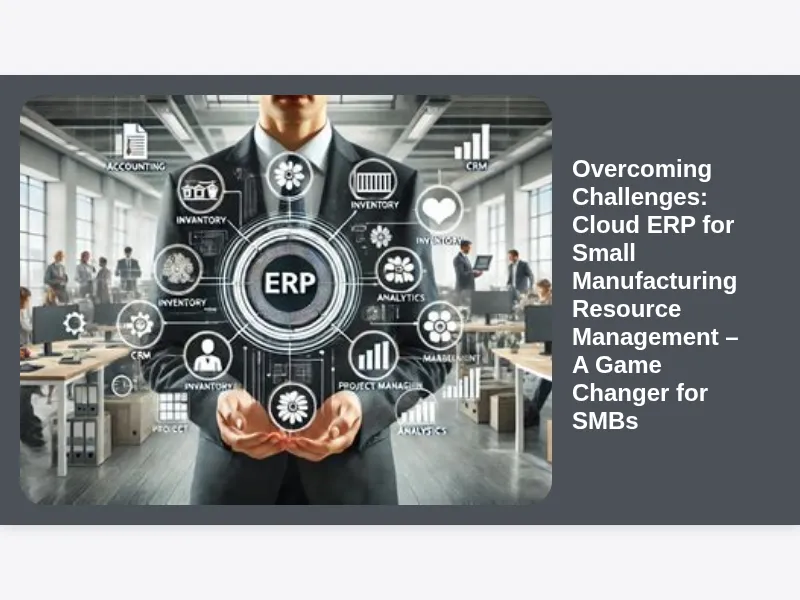
Manufacturing in the modern era is a dynamic and often demanding landscape, particularly for small and medium-sized businesses (SMBs). The agility that once defined smaller operations is constantly tested by evolving customer demands, global supply chain complexities, and intense competition. Many small manufacturers find themselves grappling with operational inefficiencies, fragmented data, and a lack of real-time visibility into their processes, hindering their potential for growth and profitability. This article delves into the transformative power of Cloud Enterprise Resource Planning (ERP) systems, specifically tailored to address and overcome the unique challenges faced in small manufacturing resource management. We’ll explore how embracing a cloud-based ERP solution can not only streamline operations but also pave the way for sustainable success and competitive advantage.
The Modern Small Manufacturing Landscape: Navigating a Sea of Complexity
Small manufacturing enterprises are the backbone of many economies, driving innovation and creating jobs. However, they operate within an environment that has become increasingly complex over the past two decades. The days of localized supply chains and predictable market demands seem like a distant memory. Today, small manufacturers must contend with a globalized marketplace, rapid technological advancements, and a workforce that expects digital tools. This constant flux means that traditional, often manual, or disconnected methods of managing resources are no longer sufficient to maintain competitiveness or even solvency. The pressure to produce high-quality goods, quickly and cost-effectively, while adhering to stringent compliance standards, has never been higher.
The journey of a manufactured product, from raw material sourcing to final delivery, involves countless intricate steps, each presenting a potential point of failure or inefficiency. For small manufacturers, these points are exacerbated by limited budgets, fewer personnel, and often, an inherited patchwork of disparate software systems or reliance on spreadsheets. Imagine a company trying to forecast demand for a seasonal product, manage hundreds of unique SKUs, schedule complex machinery, and track worker productivity, all while ensuring compliance with evolving industry regulations. Without a unified system, this becomes a monumental, if not impossible, task. The need for a robust, integrated solution is not merely a luxury; it’s a strategic imperative for survival and growth.
Common Challenges in Small Manufacturing Resource Management
At the heart of many small manufacturing operations lies a web of challenges related to resource management. These issues, if left unaddressed, can stifle growth, erode profits, and lead to significant customer dissatisfaction. One primary hurdle is the notorious “data silo” phenomenon. Imagine production data residing in one system, inventory data in another, and financial records in yet a third. This fragmentation makes it nearly impossible to get a holistic view of the business, leading to delayed decisions, inaccurate forecasts, and missed opportunities. Without a centralized repository, even basic reporting becomes an arduous, time-consuming process, often yielding outdated information.
Furthermore, accurate inventory management often plagues small manufacturers. Overstocking ties up valuable capital and warehouse space, risking obsolescence, while understocking leads to production delays, lost sales, and unhappy customers. Real-time visibility into inventory levels, across multiple locations and stages of production, is a rare luxury for many. Similarly, production planning and scheduling present formidable obstacles. Manually scheduling complex jobs across limited machines and personnel, while trying to minimize downtime and meet delivery dates, is a constant balancing act. A single unexpected machine breakdown or a sudden rush order can throw an entire production schedule into chaos, impacting multiple departments and ultimately affecting the bottom line. Overcoming challenges: Cloud ERP for small manufacturing resource management offers a pathway to address these deeply entrenched operational difficulties directly and efficiently.
What is Cloud ERP and Why is it Relevant for SMBs?
Cloud ERP, or Enterprise Resource Planning in the cloud, refers to a software system that integrates all core business processes – from finance and HR to manufacturing, supply chain, services, and procurement – into a single, unified platform, hosted and accessed over the internet. Unlike traditional on-premise ERP systems, which require significant upfront investment in hardware, software licenses, and IT infrastructure, Cloud ERP operates on a subscription model (Software-as-a-Service, or SaaS). The vendor manages the servers, software, security, and maintenance, freeing the client from these responsibilities. This model is revolutionary for SMBs, effectively democratizing access to powerful enterprise-grade tools that were once exclusive to large corporations.
The relevance of Cloud ERP for small and medium-sized manufacturing businesses cannot be overstated. Firstly, the reduced upfront cost and predictable monthly subscription eliminate the prohibitive capital expenditure barrier that often prevents SMBs from investing in such crucial technology. Secondly, the rapid deployment of Cloud ERP means businesses can realize value much faster, often within weeks or months, compared to the lengthy implementation cycles of on-premise solutions. Thirdly, and perhaps most critically, Cloud ERP offers unparalleled scalability. As a small manufacturer grows, adding new users, modules, or locations is simple and cost-effective, ensuring the system evolves with the business. This flexibility means that the solution a small business adopts today won’t become obsolete as they expand, making it a sustainable long-term investment.
Overcoming Inventory Management Woes with Cloud ERP
Inventory management is a critical area where small manufacturers frequently struggle, often leading to significant financial drains and operational bottlenecks. The quest for real-time visibility into raw materials, work-in-progress, and finished goods across various storage locations is often an elusive dream. Without this clarity, forecasting becomes guesswork, purchasing decisions are suboptimal, and production lines face constant disruptions. Cloud ERP systems fundamentally transform this aspect of small manufacturing resource management. They provide a centralized, real-time view of inventory levels, locations, and movements across the entire operation.
With a Cloud ERP, every transaction – from receiving raw materials to issuing components to production, and ultimately shipping finished products – is immediately recorded and reflected in the system. This eliminates the need for manual tracking, reduces human error, and provides accurate data for decision-making. Advanced features within Cloud ERPs can automate reorder points, generate purchase orders based on demand forecasts, and even track lot numbers and serial numbers for enhanced traceability. This level of control minimizes the risk of stockouts, reduces excess inventory, and optimizes carrying costs. By connecting inventory directly to sales orders and production schedules, a Cloud ERP ensures that materials are available precisely when and where they are needed, significantly improving efficiency and reducing waste, which is paramount for a lean manufacturing environment.
Streamlining Production Planning and Scheduling
For a small manufacturer, managing production can feel like juggling countless variables: machine capacity, labor availability, material constraints, and customer delivery deadlines. Manual planning often results in inefficient machine utilization, missed delivery dates, and constant firefighting. This is another area where Overcoming Challenges: Cloud ERP for Small Manufacturing Resource Management truly shines. Cloud ERP systems integrate production planning and scheduling capabilities that provide a comprehensive, real-time view of the entire manufacturing process, from order intake to shipment.
These systems leverage data from sales orders, inventory levels, and historical production performance to create optimized production schedules. They can account for finite capacity, balancing workloads across machines and work centers to minimize bottlenecks and maximize throughput. Advanced scheduling modules can handle complex routings, multiple bill of materials (BOMs), and even re-prioritize jobs on the fly in response to unexpected events like rush orders or machine breakdowns. This agility is a game-changer, allowing small manufacturers to adapt quickly without disrupting the entire operation. By automating and optimizing the scheduling process, Cloud ERP reduces manual effort, improves on-time delivery rates, and ensures that resources—both human and mechanical—are used to their fullest potential, directly contributing to increased profitability and customer satisfaction.
Enhancing Quality Control and Compliance Across the Board
In manufacturing, quality is non-negotiable. For small manufacturers, maintaining consistent quality while adhering to increasingly complex regulatory standards can be a daunting task. Manual quality control processes are prone to inconsistencies, difficult to audit, and often react to issues rather than preventing them. A Cloud ERP system acts as a central hub for integrating quality management processes directly into the manufacturing workflow, providing unprecedented levels of control and traceability. This holistic approach is essential for overcoming challenges: Cloud ERP for small manufacturing resource management related to product integrity.
A well-implemented Cloud ERP can track materials from their source to the finished product, including supplier information, batch numbers, and inspection results. If a quality issue arises, it can quickly pinpoint the affected batches, products, or even components, enabling rapid containment and root cause analysis. The system can also enforce quality checkpoints throughout the production process, requiring specific tests or approvals at various stages before production can proceed. For compliance, Cloud ERP provides comprehensive audit trails, documenting every change and transaction, which is invaluable for regulatory inspections or certifications like ISO. This integrated approach not only improves product quality and reduces rework but also builds customer trust and protects the manufacturer’s brand reputation, giving smaller businesses a significant edge in competitive markets.
Financial Management and Cost Control in the Cloud
Financial health is the lifeblood of any business, but for small manufacturers, accurately tracking costs, managing cash flow, and making sound financial decisions can be particularly challenging. Disconnected systems often lead to delayed financial reporting, errors in cost accounting, and a lack of clear visibility into profitability by product or production run. Cloud ERP systems consolidate all financial data within the same platform that manages manufacturing operations, providing a single source of truth for financial management and significantly enhancing cost control. This unified approach is fundamental to overcoming challenges: Cloud ERP for small manufacturing resource management related to financial transparency.
With a Cloud ERP, all transactions – from raw material purchases to labor costs, machine depreciation, and sales revenues – are captured and automatically integrated into the general ledger. This enables real-time financial reporting, allowing business owners to monitor key performance indicators (KPIs) like gross margins, operational expenses, and profitability at any given moment. Advanced features can break down costs by product, batch, or customer, providing granular insights into where money is being spent and where efficiencies can be gained. Budgeting and forecasting become more accurate, supported by historical data from actual production and sales. Furthermore, automating invoicing, accounts payable, and accounts receivable processes reduces administrative overhead and improves cash flow. By providing a clear, accurate, and immediate financial picture, Cloud ERP empowers small manufacturers to make informed strategic decisions, optimize pricing, and ultimately, improve their bottom line.
Optimizing Supply Chain Operations for Small Manufacturers
The supply chain for small manufacturers can be surprisingly complex, often involving multiple suppliers, fluctuating material costs, and intricate logistics. Managing these elements manually or with disparate tools can lead to delays, increased costs, and disruptions that ripple throughout the entire operation. Overcoming Challenges: Cloud ERP for Small Manufacturing Resource Management extends its benefits profoundly to the supply chain, offering tools that streamline procurement, supplier management, and logistics, transforming a potential weakness into a source of competitive advantage.
A Cloud ERP system provides end-to-end visibility across the entire supply chain. From the moment a purchase order is created to the receipt of goods and their subsequent use in production, every step is tracked and monitored. This real-time data allows manufacturers to better manage supplier relationships, assess supplier performance, and negotiate more favorable terms based on accurate demand forecasts. Automated procurement processes can generate purchase requisitions and orders based on real-time inventory levels and production schedules, minimizing the risk of material shortages or overstocking. Furthermore, by integrating with shipping carriers and logistics providers, Cloud ERP can optimize transportation routes, track shipments, and ensure on-time delivery to customers. This holistic approach to supply chain management reduces operational risk, improves efficiency, and allows small manufacturers to be more responsive to market changes and customer demands, solidifying their position in the market.
Data-Driven Decision Making with Cloud ERP Analytics
In today’s competitive manufacturing environment, decisions based on intuition or outdated information are a recipe for stagnation, if not failure. For small manufacturers, the sheer volume of operational data can be overwhelming, yet extracting meaningful insights from it often remains a significant hurdle. This is precisely where the analytical capabilities of a Cloud ERP system become invaluable, turning raw data into actionable intelligence. This capability is a cornerstone of overcoming challenges: Cloud ERP for small manufacturing resource management by transforming how leaders strategize.
Cloud ERP platforms are designed with powerful built-in reporting and analytics tools that can pull data from every module—finance, inventory, production, sales, and supply chain. This means a small manufacturer can generate custom dashboards and reports that display key performance indicators (KPIs) relevant to their specific business goals. Want to know the profitability of a specific product line? Or identify the most efficient production line? Or track the root causes of production delays? A Cloud ERP can provide these answers with just a few clicks. Beyond standard reporting, many systems offer advanced analytics, machine learning, and even predictive capabilities. This allows manufacturers to forecast future demand more accurately, identify potential bottlenecks before they occur, and even predict equipment maintenance needs. By enabling data-driven decision-making, Cloud ERP empowers small manufacturers to move from reactive problem-solving to proactive strategic planning, fostering continuous improvement and sustainable growth.
The Myth of ERP Being Only for Large Enterprises
For many years, the perception that ERP systems were only within the reach of large, multinational corporations persisted. This myth stemmed from the high costs, extensive IT infrastructure requirements, and complex implementation processes associated with traditional on-premise ERP solutions. Small manufacturers often shied away, believing they couldn’t afford it, didn’t have the internal IT resources to manage it, or simply weren’t “big enough” to need such a sophisticated system. However, the advent of Cloud ERP has utterly debunked this myth, making these powerful tools accessible and highly beneficial for businesses of all sizes, including the smallest manufacturing operations.
Cloud ERP completely removes the barriers of entry that once existed. The subscription-based model eliminates the need for massive upfront capital investment, making it an operational expense that can be budgeted monthly. The vendor handles all the IT infrastructure, maintenance, and security, effectively providing a full IT department at a fraction of the cost. Furthermore, modern Cloud ERP solutions are often designed with user-friendly interfaces and modular structures, allowing small businesses to start with the functionalities they need most and expand as they grow. They are robust enough to handle complex manufacturing processes but flexible enough to be tailored to simpler operations. Therefore, the idea that ERP is an “enterprise-only” solution is outdated. Today, Cloud ERP is a vital strategic tool for any small manufacturer looking to streamline operations, enhance efficiency, and compete effectively in the modern marketplace, squarely fitting the objective of overcoming challenges: Cloud ERP for small manufacturing resource management.
Key Considerations When Choosing a Cloud ERP for Your Small Manufacturing Business
Selecting the right Cloud ERP system is a pivotal decision that can shape the future trajectory of a small manufacturing business. It’s not a choice to be taken lightly, and involves careful consideration beyond just features and price. One of the most critical aspects is ensuring the solution is specifically designed for manufacturing operations. While many ERPs exist, those tailored to manufacturing will have functionalities like Bill of Materials (BOM) management, production routing, capacity planning, and shop floor control built-in, rather than requiring complex customizations or third-party integrations. This specialized focus is key for effective small manufacturing resource management.
Another vital consideration is scalability. As a small manufacturer, your goal is likely growth. The chosen Cloud ERP must be able to seamlessly expand its capabilities and user capacity as your business scales, without requiring a complete system overhaul. Evaluate the vendor’s reputation, their track record with similar-sized manufacturing businesses, and the quality of their customer support. Implementation support and ongoing training are also paramount, as a powerful system is only as good as its users’ ability to leverage it. Finally, security protocols and data privacy policies are non-negotiable; understand how your data will be protected in the cloud environment, ensuring compliance with relevant industry regulations. Taking the time to thoroughly evaluate these factors will help guarantee a successful adoption and long-term benefit from your Cloud ERP investment.
Navigating the Implementation Journey for SMB Manufacturers
The implementation of any new software system can appear daunting, especially for small manufacturing businesses with limited internal IT resources. However, with Cloud ERP, the process is significantly streamlined compared to traditional on-premise deployments. A successful implementation hinges on careful planning, clear communication, and dedicated internal resources. The first step involves a thorough business process analysis, understanding your current workflows, identifying pain points, and defining clear objectives for what you want the ERP to achieve. This discovery phase is crucial for tailoring the system to your specific needs, even within a standardized cloud environment.
Most Cloud ERP vendors offer structured implementation methodologies, often involving phased rollouts. This approach allows businesses to implement critical modules first (e.g., inventory and production), realize immediate benefits, and then gradually introduce other functionalities like finance or CRM. Dedicated project managers from both the vendor and the manufacturer side are essential to keep the project on track, manage expectations, and address any challenges proactively. Change management is another critical component; employees must be educated on the benefits of the new system and adequately trained to use it effectively. Investing in comprehensive user training ensures user adoption, which is paramount to realizing the full potential of the Cloud ERP in overcoming challenges: Cloud ERP for small manufacturing resource management. While the journey requires commitment, a well-executed Cloud ERP implementation can quickly translate into significant operational improvements and a strong return on investment.
Measuring ROI: The Tangible Benefits of Cloud ERP Investment
For any small manufacturing business, investing in a new software system, even a Cloud ERP, requires a clear demonstration of return on investment (ROI). Fortunately, the benefits of implementing a Cloud ERP are not just theoretical; they translate into tangible, measurable improvements across various aspects of the business. One of the most immediate and significant ROIs comes from enhanced operational efficiency. By automating manual processes, reducing data entry errors, and streamlining workflows, businesses can achieve substantial time savings and reduce labor costs. This translates into increased output with the same or fewer resources.
Consider the impact on inventory management: precise tracking and demand forecasting reduce carrying costs by minimizing excess stock and prevent lost sales due to stockouts. This direct impact on the balance sheet is easily quantifiable. Similarly, optimized production scheduling leads to higher machine utilization, reduced overtime, and improved on-time delivery rates, which directly contribute to revenue growth and customer satisfaction. The financial transparency offered by integrated accounting modules allows for better cost control, identifying unprofitable products or processes. Over time, the improved decision-making driven by real-time data analytics, enhanced supply chain coordination, and superior quality control all contribute to increased profitability and sustained growth. A study by [Industry Research Firm, e.g., Aberdeen Group] found that companies leveraging ERP systems achieved significant reductions in operational costs and improvements in key business metrics, underscoring the powerful ROI of such an investment for small manufacturing resource management.
Security and Data Protection in Cloud ERP Environments
One of the initial concerns for many small manufacturers contemplating a move to Cloud ERP is the security of their proprietary data. The idea of business-critical information residing on external servers, rather than within their own premises, can raise legitimate questions about data protection, access, and compliance. However, modern Cloud ERP providers invest significantly more in security infrastructure and expertise than most small businesses could ever afford on their own. This dedicated focus on security is a key advantage of the cloud model for overcoming challenges: Cloud ERP for small manufacturing resource management.
Reputable Cloud ERP vendors employ multi-layered security protocols, including robust firewalls, encryption for data in transit and at rest, intrusion detection systems, and regular vulnerability assessments. They adhere to stringent industry standards and compliance certifications (e.g., ISO 27001, SOC 2) and often implement physical security measures for their data centers that are far more advanced than what an individual business could achieve. Furthermore, disaster recovery and data backup are typically integral parts of the service, ensuring business continuity even in the event of an unforeseen incident. While a shared responsibility model exists (the vendor secures the infrastructure, the client is responsible for user access management and data integrity within the application), the overall security posture is often significantly enhanced by moving to a specialized cloud provider. Understanding these security measures and a vendor’s commitment to data privacy should be a key part of the evaluation process.
Future-Proofing Your Manufacturing Operations with Cloud ERP
The pace of technological change shows no signs of slowing down. For small manufacturers, keeping up with advancements like Artificial Intelligence (AI), Machine Learning (ML), and the Internet of Things (IoT) can seem daunting, especially when resources are already stretched thin. However, by adopting a Cloud ERP system, small businesses are not just solving today’s problems; they are effectively future-proofing their operations. Cloud ERP platforms are inherently designed to be agile, scalable, and receptive to integration with emerging technologies, making them a cornerstone for long-term growth.
Many modern Cloud ERP solutions are built on flexible architectures that allow for easy integration with other systems and APIs. This means that as new technologies become essential – perhaps IoT sensors on the shop floor providing real-time machine data, or AI-driven predictive maintenance – the Cloud ERP can act as the central brain, collecting, processing, and leveraging this information. Vendors continually update their cloud solutions, pushing new features and functionalities automatically, meaning small manufacturers always have access to the latest innovations without the burden of manual upgrades. This continuous evolution ensures that the ERP system remains a relevant and powerful tool for optimization and competitive advantage for years to come. Investing in Cloud ERP is an investment in a resilient, adaptive, and technologically advanced future for any small manufacturing business, central to overcoming challenges: Cloud ERP for small manufacturing resource management in the long run.
Addressing Specific Concerns: Customization vs. Standardization
One common apprehension among small manufacturers considering Cloud ERP is the perceived lack of customization. Many small businesses believe their processes are unique and require bespoke software to function effectively. While traditional on-premise ERPs often allowed for extensive, and often costly, customizations, Cloud ERPs tend to favor a more standardized approach. However, this isn’t necessarily a drawback, and finding the right balance between customization and standardization is crucial for successful small manufacturing resource management.
The emphasis on standardization in Cloud ERP platforms stems from the vendor’s need to maintain a single code base for all clients, enabling easier updates and maintenance. This standardization often reflects industry best practices, which can actually be beneficial, encouraging small manufacturers to optimize their processes rather than simply replicating existing inefficiencies. Modern Cloud ERPs, however, offer significant flexibility through configuration options, allowing businesses to tailor workflows, fields, and reports without altering the core code. They also often provide powerful low-code/no-code platforms and robust APIs that enable specific integrations or extensions when absolutely necessary, without compromising the upgrade path. The key is to distinguish between “must-have” unique requirements and “nice-to-have” preferences. Embracing best practices and leveraging configurable options usually provides enough flexibility, ensuring the benefits of a cloud solution (scalability, lower cost, automatic updates) are not sacrificed for unnecessary bespoke features.
Beyond the Initial Implementation: Continuous Improvement with Cloud ERP
The journey with Cloud ERP doesn’t end once the system is live; in fact, that’s often just the beginning of a continuous improvement cycle. For small manufacturers, the true long-term value of their Cloud ERP investment lies in leveraging its data and capabilities to drive ongoing optimization across all facets of their operations. The initial implementation provides a solid foundation, unifying data and streamlining core processes. Post-implementation, the focus shifts to deeper analysis, refinement, and expansion of how the system is used to identify further efficiencies and strategic opportunities. This iterative approach is vital for overcoming challenges: Cloud ERP for small manufacturing resource management on an ongoing basis.
Businesses can use the rich data aggregated within the ERP to regularly review key performance indicators, identify trends, and pinpoint areas that require attention. For example, by analyzing production lead times, a manufacturer might discover bottlenecks in a specific work center that can be addressed through process adjustments or additional equipment. Regular performance reviews of suppliers, informed by ERP data, can lead to better procurement strategies. Furthermore, as the business evolves, new modules or functionalities within the Cloud ERP can be explored and implemented. This might include advanced planning and scheduling, customer relationship management (CRM) integration, or even mobile access for shop floor personnel. The Cloud ERP becomes a living, breathing tool that constantly provides insights, facilitates process enhancements, and supports the manufacturer’s journey towards operational excellence and sustained competitiveness.
Conclusion: Empowering Small Manufacturers for a Digital Future
The journey of overcoming challenges: Cloud ERP for small manufacturing resource management is no longer a distant aspiration but a tangible reality for small and medium-sized businesses. The modern manufacturing landscape demands agility, precision, and data-driven decision-making, and traditional, disconnected systems simply cannot keep pace. Cloud ERP emerges as a powerful, accessible, and scalable solution, providing a unified platform that integrates every critical aspect of a manufacturing operation – from inventory and production to finance and supply chain.
By embracing a Cloud ERP system, small manufacturers can dismantle data silos, gain real-time visibility into their entire enterprise, optimize production schedules, manage inventory with unprecedented accuracy, and make informed financial decisions. The reduced upfront costs, simplified IT management, and continuous updates inherent in the cloud model mean that sophisticated tools are no longer the exclusive domain of large enterprises. Instead, they are now within reach of the smaller players who are eager to innovate and compete. Investing in Cloud ERP is not just about adopting new software; it’s about embarking on a digital transformation that empowers small manufacturers to achieve greater efficiency, enhance profitability, secure their future, and truly thrive in an increasingly complex global economy. The time for small manufacturing to embrace the cloud is now.