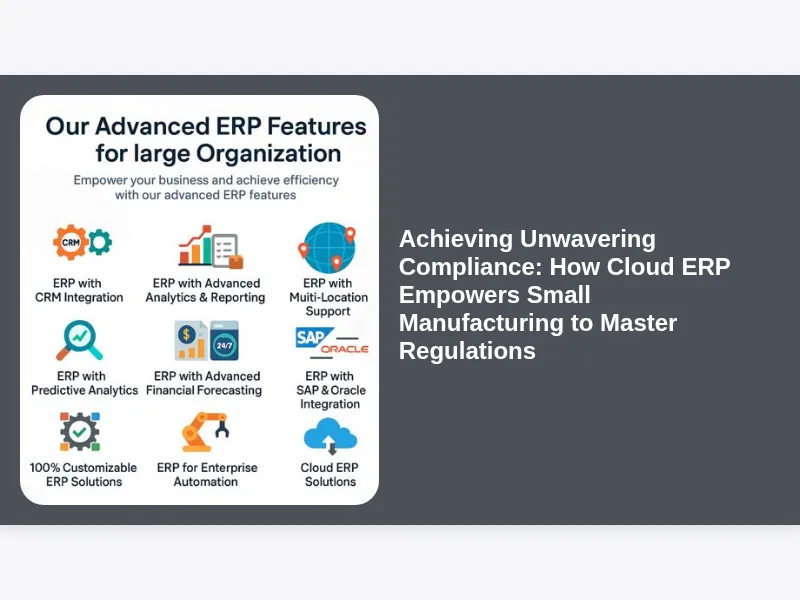
The world of small manufacturing is a vibrant, dynamic space, fueled by innovation and a relentless drive to produce quality goods. Yet, beneath the hum of machinery and the careful crafting of products, lies a complex web of regulations, mandates, and compliance standards that can feel overwhelmingly daunting. For small manufacturers, navigating this intricate landscape isn’t just a best practice; it’s an existential necessity. Failure to comply can lead to hefty fines, damaged reputations, and even operational shutdowns. But what if there was a strategic ally, a technological backbone that not only eased the burden but transformed compliance from a reactive chore into a proactive advantage? This is precisely the power offered by achieving compliance with Cloud ERP for small manufacturing regulations.
Imagine a scenario where every piece of data, every process, and every product detail is meticulously tracked, readily accessible, and inherently compliant. This isn’t a futuristic dream; it’s the present reality made possible by modern Cloud Enterprise Resource Planning (ERP) systems. For years, ERP solutions were considered the exclusive domain of large corporations, their complexity and cost prohibitive for smaller operations. However, the advent of cloud technology has democratized access to these powerful tools, making them not just affordable but indispensable for small manufacturers striving to meet an ever-growing list of regulatory demands, from environmental safety to product quality and financial transparency.
Decoding the Regulatory Labyrinth: Understanding Small Manufacturing Compliance Challenges
Small manufacturers, despite their size, are often subject to a surprisingly broad spectrum of regulations. These aren’t just vague guidelines; they are specific, legally binding requirements that govern nearly every aspect of their operations. From the moment raw materials enter the facility to the point the finished product ships, and even beyond, a small manufacturer must demonstrate adherence to various standards. This regulatory labyrinth encompasses everything from product safety and quality (e.g., FDA, CE marking, ISO standards) to environmental protection (e.g., EPA, waste disposal) and occupational health and safety (e.g., OSHA).
The sheer volume and diversity of these regulations pose significant challenges. Many small businesses operate with limited resources, often lacking dedicated compliance departments or specialized legal teams that larger enterprises can afford. This means the responsibility for understanding, implementing, and monitoring compliance often falls on already overburdened managers or even owners themselves. Keeping track of evolving regulations, ensuring staff training, maintaining meticulous records, and preparing for audits can consume an inordinate amount of time and energy, diverting focus from core manufacturing activities and innovation. Without a robust system, the risk of oversight, misunderstanding, or outright non-compliance skyrockets, leaving the business vulnerable.
The High Stakes of Non-Compliance: Why Small Manufacturers Cannot Afford to Fail
The consequences of failing to meet regulatory requirements are severe and multifaceted, extending far beyond simple monetary penalties. While fines are often the most immediate and tangible repercussion, they are just the tip of the iceberg. Imagine an environmental violation leading to a six-figure penalty, or a product safety recall costing millions in lost revenue, remediation efforts, and irreparable brand damage. For a small manufacturer, such financial blows can be catastrophic, potentially leading to bankruptcy and the loss of livelihoods for employees and owners alike.
Beyond the financial impact, non-compliance erodes trust – a precious commodity in any business, especially manufacturing. Customers, suppliers, and even employees expect a certain level of integrity and adherence to standards. A publicized violation can severely tarnish a company’s reputation, making it difficult to attract new clients, retain existing ones, or secure favorable terms with suppliers. Regulatory bodies may impose stricter oversight, demand more frequent audits, or even revoke operating licenses. The ripple effect can be devastating, impacting not only the current operations but also future growth opportunities and market standing. Achieving compliance with Cloud ERP for small manufacturing regulations isn’t merely about avoiding penalties; it’s about safeguarding the very foundation and future viability of the business.
Manual Mayhem to Digital Mastery: The Evolution of Regulatory Compliance for Small Businesses
Historically, small manufacturers relied heavily on manual processes for compliance. Think filing cabinets overflowing with paper documents, spreadsheets meticulously maintained (or sometimes neglected), and a heavy dependence on individual human memory or institutional knowledge. While these methods might have seemed sufficient in simpler times, they are profoundly ill-equipped to handle the complexities of today’s regulatory environment. The inherent risks are enormous: documents can be lost, version control becomes a nightmare, human error in data entry or interpretation is common, and retrieving specific information for an audit can be a slow, agonizing scavenger hunt.
This “manual mayhem” creates a constant state of anxiety, turning every audit into a high-stress event. The time and labor required to prepare for and undergo an audit using purely manual systems are staggering, pulling valuable resources away from production. Furthermore, these traditional methods offer little in the way of real-time insight or proactive alerts. By the time a compliance issue is manually identified, it may already be too late to mitigate its full impact. The clear path forward, therefore, involves embracing digital mastery – leveraging technology to transform compliance from a reactive, error-prone burden into a streamlined, proactive, and integral part of the manufacturing process.
Introducing Cloud ERP: A Modern Cornerstone for Manufacturing Excellence and Compliance
At its core, Enterprise Resource Planning (ERP) is an integrated software system designed to manage and connect all facets of a business operation – from production and inventory to finance, human resources, and customer relations. For decades, these systems were hosted on-premise, requiring significant upfront investment in hardware, software licenses, and dedicated IT staff for maintenance and upgrades. This barrier to entry effectively locked out many small manufacturers who simply couldn’t justify the cost or complexity.
Enter Cloud ERP. This paradigm shift means the software and its associated data are hosted and managed by a third-party provider over the internet, accessible from anywhere with an internet connection. The “cloud” model dramatically reduces upfront costs, eliminating the need for extensive hardware infrastructure and ongoing IT maintenance. Small manufacturers can now subscribe to ERP services, paying a predictable monthly or annual fee, essentially renting the powerful capabilities that were once out of reach. This accessibility is a game-changer, leveling the playing field and allowing small businesses to leverage sophisticated tools to enhance efficiency, drive growth, and critically, master regulatory compliance. Achieving compliance with Cloud ERP for small manufacturing regulations becomes not just a possibility, but an attainable reality.
Unlocking Core Capabilities: How Cloud ERP Streamlines Compliance Management
The true power of Cloud ERP in a regulatory context lies in its ability to centralize and integrate critical business functions. Instead of disparate systems and data silos, a Cloud ERP provides a single source of truth for all operational information. This means production schedules, inventory levels, quality control data, customer orders, supplier information, and financial records all reside within one cohesive platform. This inherent integration is foundational to compliance.
Consider the benefits: data consistency across departments, automated workflows that enforce standard operating procedures, and comprehensive audit trails that record every transaction and change. These core capabilities drastically reduce the potential for human error, ensure that processes are followed consistently, and provide an irrefutable record of activities. For small manufacturers grappling with complex regulations, this integrated approach transforms compliance from a fragmented, manual effort into a streamlined, automated, and continuous process. It’s about building compliance directly into the operational fabric, rather than treating it as an afterthought.
Real-Time Data Visibility: The Bedrock of Regulatory Audit Readiness
One of the most profound advantages of Cloud ERP for small manufacturers is its capacity to deliver real-time data visibility across the entire enterprise. In a traditional, fragmented environment, compiling information for an audit often involves chasing down spreadsheets, digging through paper files, and querying multiple legacy systems. This process is time-consuming, prone to error, and often results in outdated or incomplete information. With Cloud ERP, however, critical data is continuously updated and accessible instantly.
Imagine an auditor arrives unannounced, requesting specific production records, quality control reports, or environmental compliance documentation from six months ago. With a Cloud ERP, a few clicks can retrieve the exact information needed, complete with timestamps, user logs, and associated documents. This immediate access to accurate, up-to-date information dramatically reduces the stress and labor associated with audits. It demonstrates to regulators a commitment to transparency and meticulous record-keeping, fostering confidence in the manufacturer’s compliance posture. This real-time visibility is not just a convenience; it’s a strategic asset for achieving compliance with Cloud ERP for small manufacturing regulations, transforming audit readiness from a crisis into a routine capability.
Integrating Quality Management Systems (QMS): Elevating Product Standards and Adherence
For many small manufacturers, particularly those in regulated industries like food, pharmaceuticals, medical devices, or aerospace, maintaining robust quality management systems (QMS) is non-negotiable. Standards like ISO 9001, FDA’s cGMP (current Good Manufacturing Practices), or industry-specific quality requirements are critical for product safety, efficacy, and market acceptance. Traditionally, QMS might involve separate software, manual checklists, or a patchwork of systems that are difficult to integrate with core production processes.
Modern Cloud ERP solutions often include integrated QMS modules or offer seamless integration with specialized QMS platforms. This integration means that quality control checkpoints are built directly into the manufacturing workflow. For example, incoming raw materials can be automatically flagged for inspection, in-process production steps can require specific quality checks before proceeding, and finished goods cannot be shipped until all quality parameters are met. This embedding of quality processes within the ERP ensures consistency, tracks non-conformances, manages corrective and preventive actions (CAPA), and maintains a comprehensive record of every quality event. Such integration is vital for small manufacturers aiming for rigorous product standards and achieving compliance with Cloud ERP for small manufacturing regulations related to quality assurance.
Streamlining Documentation and Record-Keeping: Bidding Farewell to Paperwork Nightmares
The sheer volume of documentation required for regulatory compliance can be overwhelming for small manufacturers. From standard operating procedures (SOPs) and work instructions to training records, equipment maintenance logs, calibration certificates, and material safety data sheets (MSDS), the paper trail can be immense. Managing these documents manually is a recipe for disaster: documents get misfiled, outdated versions circulate, and critical information can be lost or inaccessible when needed most.
Cloud ERP systems offer powerful document management capabilities that virtually eliminate these paperwork nightmares. They provide a centralized, secure repository for all compliance-related documents, ensuring that only the latest, approved versions are accessible. Features like version control, audit trails for document changes, electronic signatures, and automated routing for approvals drastically streamline the process. Imagine an auditor requesting an SOP from two years ago; with Cloud ERP, you can instantly pull up the exact version that was active at that time, complete with its revision history and approval signatures. This digital approach to record-keeping not only saves time and reduces storage costs but also significantly enhances the accuracy and integrity of documentation, which is paramount for achieving compliance with Cloud ERP for small manufacturing regulations.
Enhancing Supply Chain Traceability and Vendor Management: Meeting Industry-Specific Demands
In today’s globalized economy, a small manufacturer’s compliance extends far beyond its own four walls. Regulations increasingly demand supply chain transparency and traceability, particularly in industries where raw material origins, ethical sourcing, or component quality are critical. Whether it’s tracking ingredients in food production, verifying conflict-free minerals, or ensuring the authenticity of pharmaceutical components, knowing “who, what, where, and when” across the supply chain is vital. Managing supplier relationships, qualifications, and performance also falls under this umbrella, especially when regulatory bodies require proof of supplier compliance.
Cloud ERP solutions provide robust modules for supply chain management, purchasing, and vendor management. These capabilities allow small manufacturers to track materials from their source through every stage of production to the final customer. Lot tracking, serial number tracking, and comprehensive vendor profiles within the ERP system make it possible to quickly identify the origin of a faulty component or recall a specific batch of products if an issue arises. Furthermore, the system can manage vendor contracts, certifications, and performance reviews, ensuring that all suppliers meet necessary regulatory standards. This comprehensive approach to supply chain oversight is instrumental for achieving compliance with Cloud ERP for small manufacturing regulations that demand end-to-end visibility and control.
Fortifying Financial Compliance and Audit Trails: Keeping the Books in Order
While often overlooked in the context of operational compliance, financial regulations are a critical component of a small manufacturer’s overall compliance burden. These can range from local tax laws and GAAP (Generally Accepted Accounting Principles) to more stringent requirements like aspects of Sarbanes-Oxley (SOX) for publicly traded companies (though not directly applicable to most small manufacturers, the principles of financial transparency and internal controls are universally valuable). Accurate financial reporting is essential for tax purposes, securing loans, attracting investors, and simply understanding the health of the business.
Cloud ERP systems integrate financial management modules directly with operational data. Every transaction, from purchasing raw materials to selling finished goods, is recorded within the system, creating an unbreakable audit trail. This integration ensures that inventory valuations are accurate, production costs are correctly allocated, and revenue recognition adheres to accounting standards. The system can generate detailed financial reports, manage accounts payable and receivable, and facilitate reconciliation, making financial audits significantly smoother and more reliable. By providing a clear, immutable record of all financial activities, Cloud ERP strengthens a small manufacturer’s financial compliance posture and builds confidence among stakeholders and regulators regarding the integrity of their financial reporting.
Navigating Environmental, Health, and Safety (EHS) Compliance: Protecting People and Planet with ERP
Environmental, Health, and Safety (EHS) regulations represent another significant area of compliance for small manufacturers. These mandates, often enforced by bodies like OSHA (Occupational Safety and Health Administration) and the EPA (Environmental Protection Agency), cover everything from workplace safety protocols and hazardous material handling to waste disposal, emissions limits, and energy consumption. Non-compliance in this arena can lead to severe penalties, employee injuries, environmental damage, and extensive negative publicity.
While specialized EHS software exists, many Cloud ERP systems offer robust functionalities or integration points that can significantly support EHS compliance. For instance, the ERP can track hazardous material inventory and usage, manage waste disposal manifests, schedule preventative maintenance for safety equipment, and maintain records of safety training and incidents. It can also help monitor energy consumption and greenhouse gas emissions, enabling reporting for environmental regulations. By centralizing EHS-related data and automating reporting processes, Cloud ERP helps small manufacturers proactively manage risks, ensure worker safety, and demonstrate adherence to environmental mandates. This proactive approach is key to achieving compliance with Cloud ERP for small manufacturing regulations concerning the health of their workforce and the planet.
Ensuring Data Security and Integrity in the Cloud: Trusting Your Compliance Platform
A natural concern for any business moving its critical operations, especially compliance-sensitive data, to the cloud is security. Small manufacturers need assurance that their sensitive production data, customer information, and intellectual property are protected from cyber threats, unauthorized access, and data loss. This is a legitimate concern, and it’s essential to understand how Cloud ERP providers address it.
Reputable Cloud ERP vendors invest heavily in state-of-the-art security infrastructure. This includes robust physical security for data centers, advanced encryption for data at rest and in transit, multi-factor authentication, regular security audits, and adherence to industry-recognized security standards (e.g., ISO 27001, SOC 2 Type II). These providers often have far more sophisticated security measures in place than a typical small manufacturer could ever afford to implement and maintain on-premise. Furthermore, Cloud ERP ensures data integrity through automated backups, disaster recovery protocols, and version control, safeguarding against accidental data corruption or loss. When selecting a vendor, small manufacturers must diligently vet their security practices to ensure their chosen Cloud ERP truly provides a trusted, secure platform for achieving compliance with Cloud ERP for small manufacturing regulations.
Scalability and Cost-Effectiveness: Why Cloud ERP is Perfect for Growing Small Businesses
One of the most compelling arguments for Cloud ERP, particularly for small manufacturers, lies in its inherent scalability and cost-effectiveness. Traditional on-premise ERP required a substantial upfront capital expenditure for software licenses, servers, and IT infrastructure. This significant financial barrier often made robust ERP solutions unattainable for growing small businesses operating on tight budgets.
Cloud ERP, by contrast, operates on a subscription model, typically a monthly or annual fee based on the number of users and modules utilized. This “pay-as-you-go” approach transforms a large capital expense into a predictable operational expense. Furthermore, as a small manufacturer grows, their Cloud ERP can easily scale with them, adding more users, modules, or storage capacity as needed without requiring massive hardware upgrades or complex migrations. This flexibility ensures that the investment remains aligned with the business’s current needs and budget, making it an economically smart choice. For small manufacturers aiming to grow while simultaneously strengthening their compliance posture, the cost efficiency and scalability of cloud solutions are unparalleled, making achieving compliance with Cloud ERP for small manufacturing regulations a sustainable long-term strategy.
Implementing Cloud ERP for Compliance: A Strategic Approach for Small Manufacturers
Embarking on a Cloud ERP implementation is a significant undertaking, even for a small manufacturer. It requires careful planning, strategic decision-making, and a clear understanding of the project’s objectives, especially when compliance is a primary driver. The first step involves a thorough assessment of existing processes and a detailed identification of all relevant regulatory requirements. What are the specific mandates from OSHA, FDA, ISO, or other industry bodies that the business must adhere to? Where are the current compliance gaps and pain points?
Once the regulatory landscape is mapped, the next phase is vendor selection. This isn’t just about finding software; it’s about choosing a strategic partner. Manufacturers should look for Cloud ERP providers with a proven track record in their specific industry, offering modules and functionalities that directly address their compliance needs. A successful implementation requires a clear project plan, dedicated internal resources, and a phased approach, perhaps starting with the most critical compliance areas or operational modules. It’s not just about installing software; it’s about redesigning workflows, integrating compliance checkpoints into every process, and ensuring that the system is configured to generate the necessary audit trails and reports to confidently demonstrate adherence.
Overcoming Implementation Challenges: Practical Tips for a Smooth Transition
Even with meticulous planning, implementing Cloud ERP can present its share of challenges. For small manufacturers, limited IT resources, resistance to change among employees, and the complexity of migrating existing data are common hurdles. One of the most significant challenges often revolves around “change management.” Employees who are accustomed to manual processes or disparate systems may resist adopting new workflows, even if they promise greater efficiency and compliance. Overcoming this requires clear communication, comprehensive training, and demonstrating the tangible benefits of the new system from the outset.
To ensure a smooth transition, small manufacturers should prioritize user training tailored to specific roles and responsibilities. Investing in adequate training helps build user confidence, reduces errors, and fosters system adoption. Furthermore, data migration, while crucial, needs to be handled with extreme care to maintain data integrity. A phased rollout, where different modules or departments go live sequentially, can also help mitigate risk and allow the team to learn and adapt incrementally. Partnering closely with the Cloud ERP vendor and leveraging their expertise in implementation best practices is invaluable. By proactively addressing these challenges, small manufacturers can maximize their chances of a successful ERP deployment, paving the way for seamlessly achieving compliance with Cloud ERP for small manufacturing regulations.
Continuous Compliance: Ongoing Maintenance and Updates in an Evolving Regulatory Environment
Regulatory environments are rarely static; they are dynamic and constantly evolving. New laws are enacted, existing standards are updated, and interpretations of requirements can shift. For a small manufacturer, staying abreast of these changes and ensuring ongoing compliance can be a formidable task. This is where the continuous nature of Cloud ERP truly shines. Unlike on-premise systems that require manual updates and patches, Cloud ERP providers automatically handle software maintenance, security updates, and often, updates to regulatory reporting formats.
This means that as regulations change, the Cloud ERP vendor may release updates to their software to help their clients remain compliant. While the manufacturer still bears the ultimate responsibility for understanding and implementing the new requirements within their processes, the technological heavy lifting of the software itself is managed externally. Furthermore, the robust reporting and analytics capabilities of Cloud ERP allow small manufacturers to continuously monitor their compliance performance, identify potential issues early, and make proactive adjustments. This ongoing vigilance and system support are vital for maintaining an ironclad compliance posture and ensuring that the initial investment in achieving compliance with Cloud ERP for small manufacturing regulations yields long-term benefits.
The Future of Compliance: Harnessing AI, IoT, and Cloud ERP Synergy
The digital transformation in manufacturing is accelerating, bringing with it new technologies that promise to further revolutionize compliance management. Artificial Intelligence (AI) and the Internet of Things (IoT) are rapidly becoming integral components of modern manufacturing, and their synergy with Cloud ERP holds immense potential for future compliance strategies. Imagine IoT sensors on machinery constantly monitoring operational parameters, automatically feeding data into the ERP system, and triggering alerts if deviations indicate a potential safety or quality issue before it becomes a non-compliance event.
AI, integrated within the Cloud ERP, could analyze vast datasets to identify compliance risks, predict potential failures, or even automate complex regulatory reporting, learning from historical data and adapting to new regulations. For example, AI could cross-reference product specifications with evolving international standards, highlighting discrepancies automatically. This intelligent automation moves compliance beyond reactive auditing into a predictive, self-optimizing system. For small manufacturers, embracing these emerging technologies in conjunction with their Cloud ERP will not only enhance efficiency but also elevate their compliance capabilities to an unprecedented level, solidifying their position in an increasingly regulated marketplace. The future of achieving compliance with Cloud ERP for small manufacturing regulations is intelligent, automated, and proactive.
Choosing the Right Cloud ERP Vendor: Key Considerations for Compliance Focus
Selecting the right Cloud ERP vendor is perhaps the most critical decision a small manufacturer will make on their journey to enhanced compliance. It’s not a one-size-fits-all solution; the ideal system will depend heavily on the specific industry, the size of the operation, the complexity of its processes, and the particular regulatory landscape it navigates. Beyond the general features, several compliance-specific considerations should guide this choice.
First, look for vendors with deep industry expertise. A Cloud ERP designed specifically for manufacturing, and even better, for your sub-segment (e.g., food & beverage, medical devices, automotive), will inherently understand the common compliance challenges and offer relevant functionalities out of the box. Second, inquire about the vendor’s own compliance and security certifications (e.g., ISO 27001, SOC 2). This demonstrates their commitment to protecting your data. Third, assess the system’s audit trail capabilities, document management features, and reporting flexibility. Can it easily generate the specific reports your regulators require? Finally, evaluate the vendor’s customer support and their commitment to ongoing updates. Will they provide timely assistance and adapt their software as regulations evolve? A thorough due diligence process ensures that the chosen Cloud ERP becomes a true partner in achieving compliance with Cloud ERP for small manufacturing regulations.
Empowering Small Manufacturers Through Smart Compliance: A Concluding Vision
The journey of a small manufacturer is often characterized by agility, innovation, and resilience. In an era of ever-tightening regulations and increasing scrutiny, achieving compliance with Cloud ERP for small manufacturing regulations is no longer an optional add-on but a fundamental pillar of sustained success. We’ve explored how Cloud ERP centralizes data, automates processes, provides real-time visibility, and integrates crucial functions like quality management, supply chain traceability, and financial reporting. We’ve seen how it transforms the daunting task of regulatory adherence from a manual, error-prone burden into a streamlined, proactive, and integral part of daily operations.
By embracing Cloud ERP, small manufacturers can shed the anxiety of audits, minimize the risk of costly penalties, and build a reputation for reliability and integrity. It frees up valuable time and resources, allowing them to focus on what they do best: innovating, growing, and delivering exceptional products. The initial investment in time and effort to implement such a system is quickly recouped through improved efficiency, reduced risk, and the immense confidence that comes from knowing your business is robustly compliant. In essence, Cloud ERP doesn’t just help small manufacturers meet regulations; it empowers them to master compliance, transforming it into a competitive advantage that fuels sustainable growth and secures their future in a complex, demanding world.