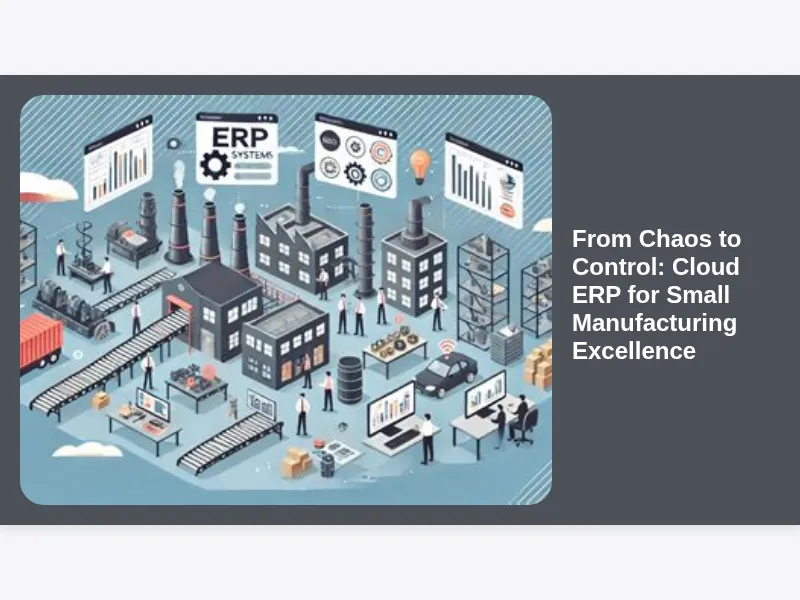
The world of small manufacturing is dynamic, challenging, and filled with immense potential. Yet, for many small-to-medium-sized manufacturers (SMMs), realizing this potential often feels like an uphill battle against an ever-present tide of operational chaos. Disconnected systems, manual data entry, opaque inventory levels, and a constant struggle to meet production deadlines can transform promising growth into perpetual stress. But what if there was a strategic pathway to transform this chaos into unwavering control, paving the way for sustained excellence? This is precisely the promise of Cloud ERP for small manufacturing, a transformative solution that acts as the central nervous system for your entire operation, guiding you From Chaos to Control and towards unparalleled efficiency.
The Dynamic Yet Demanding World of Small Manufacturing
Small manufacturing businesses are the backbone of many economies, driving innovation, creating jobs, and meeting specialized market demands. Unlike their larger counterparts, SMMs often operate with leaner teams, tighter budgets, and a more intimate understanding of their customer base. This agility can be a strength, but it also means they face unique pressures, from managing intricate supply chains to optimizing every penny spent on production.
The competitive landscape is more fierce than ever. Customers expect faster turnaround times, higher quality, and personalized products, all while global supply chain disruptions introduce unforeseen hurdles. Without a robust system to manage these complexities, even the most dedicated small manufacturer can quickly become overwhelmed, losing sight of opportunities amidst the daily grind of problem-solving. It’s a constant juggling act of production, inventory, sales, and finance, often handled with disparate tools or, even worse, reliance on spreadsheets and manual communication.
The Agony of Disconnected Systems: Why Traditional Methods Fall Short
Imagine your manufacturing business as an orchestra. For it to perform beautifully, every musician must be in sync, playing from the same score, guided by a single conductor. Now, imagine that orchestra where the strings don’t know what the brass are doing, and the percussion section is using a completely different tempo. That’s often the reality for small manufacturers relying on disconnected systems.
Production planning might happen on one spreadsheet, inventory tracking on another, sales orders in an email inbox, and financial records in a separate accounting software. This creates informational silos, leading to errors, delays, and a critical lack of real-time visibility. Decisions are based on outdated or incomplete data, making strategic planning a gamble rather than an informed choice. The absence of a single source of truth inevitably breeds inefficiency and frustration.
What is Cloud ERP, Anyway? Demystifying Enterprise Resource Planning
At its core, ERP, or Enterprise Resource Planning, is an integrated software system designed to manage and connect all core business processes, from finance and human resources to manufacturing and supply chain. Think of it as a central hub where all your business data converges and can be accessed and acted upon. When we add “Cloud” to ERP, it means this powerful software is hosted on remote servers and accessed over the internet, rather than being installed on your company’s on-site computers.
This distinction is crucial, especially for small manufacturers. Cloud ERP eliminates the need for significant upfront IT infrastructure investments, constant maintenance, and dedicated IT staff. Instead, the ERP vendor handles all the technical heavy lifting, allowing your team to focus squarely on what they do best: manufacturing exceptional products. It’s a subscription-based service, making it an operational expense rather than a capital expenditure, which is often more appealing for growing businesses.
The Promise of Integrated Operations: A Unified Vision for Your Enterprise
The most compelling benefit of Cloud ERP is its ability to foster truly integrated operations. Instead of disparate departments operating in isolation, Cloud ERP creates a seamless flow of information across your entire organization. An order placed by a customer instantly updates inventory levels, triggers production planning, informs purchasing about material needs, and automatically updates financial ledgers.
This integration isn’t just about convenience; it’s about strategic advantage. With all data residing in a single, unified database, you gain a holistic view of your business performance. Bottlenecks become visible, opportunities are highlighted, and every team member operates with the most current and accurate information available. This unified vision is key to moving From Chaos to Control, enabling a responsive and agile manufacturing environment.
Beyond Basic Accounting: Core ERP Modules for Manufacturing Excellence
While traditional accounting software is essential, it only scratches the surface of a small manufacturer’s needs. Cloud ERP extends far beyond, offering specialized modules that are critical for operational excellence. These typically include production planning and scheduling, inventory management, sales and order management, procurement, quality control, and even CRM capabilities. Each module is designed to streamline a specific function, but their true power lies in their interconnectedness.
For instance, the production module can receive real-time updates from sales orders, automatically adjusting schedules and generating work orders. Simultaneously, the inventory module ensures that raw materials are available precisely when needed, preventing costly delays. This comprehensive approach means that every step of your manufacturing process, from raw material acquisition to final product delivery, is managed, monitored, and optimized within one powerful system, underpinning your journey towards manufacturing excellence.
Cloud Advantages: Why “Cloud” Matters So Much for Small Manufacturers
For small manufacturing businesses, the “cloud” aspect of ERP isn’t just a technical detail; it’s a strategic game-changer. One of the primary advantages is significantly reduced upfront costs. Traditional on-premise ERP systems require substantial investments in servers, licenses, and IT personnel for installation and maintenance. Cloud ERP, on the other hand, is offered as a service, typically on a subscription basis, meaning lower initial outlays and predictable monthly expenses. This frees up valuable capital that can be reinvested directly into production or product development.
Furthermore, cloud-based solutions offer unparalleled accessibility. Your team can access the system from anywhere, at any time, on any device with an internet connection. This flexibility is invaluable for remote workers, sales teams on the road, or even shop floor supervisors using tablets to update production statuses. The vendor also handles all software updates, security patches, and data backups, ensuring your system is always running on the latest, most secure version without placing a burden on your limited internal IT resources. This allows small manufacturers to leverage enterprise-grade technology without the enterprise-level overhead, giving them a significant competitive edge.
Inventory Management: Taming the Warehouse Beast with Real-Time Precision
For manufacturers, inventory is often a double-edged sword: essential for production, but a massive drain on capital if not managed effectively. Excess inventory ties up cash, takes up valuable warehouse space, and risks obsolescence. Too little inventory, however, can lead to production delays, missed orders, and unhappy customers. This delicate balance is often the biggest source of chaos in small manufacturing.
Cloud ERP transforms inventory management From Chaos to Control by providing real-time visibility into every item in your warehouse. It tracks raw materials, work-in-progress, and finished goods with precision, allowing you to monitor stock levels, set reorder points, and even analyze demand patterns. By integrating with sales and production, the system can automatically suggest optimal order quantities, helping you minimize carrying costs while ensuring you always have what you need, when you need it. This real-time inventory optimization drastically reduces waste, improves cash flow, and ensures your production lines never grind to a halt due to missing components.
Streamlining Production: From Order to Delivery with Unmatched Precision
The heart of any manufacturing operation is its production process. Without efficient production, even the best sales team and most robust inventory system will falter. Small manufacturers often struggle with manual scheduling, sudden changes in demand, and unexpected equipment downtime, leading to missed deadlines and rushed jobs. This is where Cloud ERP shines, bringing a new level of precision to your production floor.
A robust Cloud ERP system allows you to meticulously plan and schedule production runs based on current orders, material availability, and machine capacity. It can generate detailed work orders, track job progress in real-time, and even integrate with shop floor equipment for automated data capture. Should a rush order come in, the system can quickly assess its impact on existing schedules and suggest the most efficient way to accommodate it. This proactive approach to production management ensures that your manufacturing process is not just reactive, but optimized for throughput, quality, and on-time delivery, transforming potential chaos into controlled, predictable output.
Empowering Your Supply Chain: Building Better Relationships for Better Outcomes
Your manufacturing business doesn’t operate in a vacuum; it’s part of a larger ecosystem of suppliers, distributors, and logistics partners. The efficiency of your supply chain directly impacts your ability to produce and deliver goods on time and within budget. For small manufacturers, managing these external relationships and the flow of goods can be incredibly complex, often relying on a patchwork of emails, phone calls, and manual tracking.
Cloud ERP centralizes and streamlines your entire supply chain management. It allows you to manage supplier information, track purchase orders, monitor vendor performance, and even automate procurement processes. By integrating with inventory and production, it can proactively alert you to potential material shortages or delays from suppliers, enabling you to take corrective action before they impact your production schedule. Furthermore, enhanced visibility across the supply chain can lead to stronger, more collaborative relationships with your partners, fostering reliability and potentially unlocking better pricing or terms. This strategic command over your supply chain is crucial for achieving manufacturing excellence in today’s interconnected world.
Data-Driven Decisions: The Power of Real-Time Insights for Strategic Growth
In an era where data is king, small manufacturers often find themselves flying blind, making critical business decisions based on gut feelings or incomplete historical data. The inability to quickly access and analyze key performance indicators (KPIs) can hinder growth and prevent swift responses to market changes. Cloud ERP eliminates this guesswork, offering powerful analytics and reporting tools that provide real-time insights into every facet of your operation.
With a Cloud ERP system, you can generate customized reports on production efficiency, inventory turnover, sales performance, cost variances, and profitability margins at the click of a button. Dashboards can be configured to display critical KPIs relevant to your role, offering a bird’s-eye view of your business health. This access to accurate, up-to-the-minute data empowers owners and managers to make truly data-driven decisions, identify trends, spot inefficiencies, and seize opportunities faster than ever before. It shifts the paradigm From Chaos to Control by replacing uncertainty with actionable intelligence, laying the groundwork for strategic growth and sustained profitability.
Financial Management Made Easy: Boosting Your Bottom Line and Ensuring Fiscal Health
Sound financial management is the lifeblood of any business, but for small manufacturers, tracking costs, managing cash flow, and ensuring profitability can be particularly challenging amidst complex production processes. Cloud ERP integrates all financial transactions with operational activities, providing a comprehensive and accurate picture of your fiscal health.
From general ledger and accounts payable/receivable to fixed asset management and cost accounting, Cloud ERP automates many tedious financial tasks. It can track the actual cost of production for each item, including raw materials, labor, and overhead, giving you a true understanding of your profitability per product. This granular financial data enables better pricing strategies, more accurate budgeting, and stronger cash flow forecasting. By eliminating manual reconciliation and reducing errors, Cloud ERP boosts efficiency in your finance department, ensures compliance, and provides the clear financial insights necessary to confidently navigate your business towards sustained growth and a healthier bottom line.
Ensuring Quality and Compliance: Meeting High Standards in a Regulated World
For many small manufacturers, especially those in regulated industries, maintaining stringent quality standards and ensuring compliance is non-negotiable. Manual quality checks, paper-based records, and reactive problem-solving can be time-consuming, error-prone, and expose your business to significant risks. Cloud ERP offers a structured approach to quality control and compliance management, embedding these critical functions into your daily operations.
With ERP, you can define quality checkpoints at various stages of production, capture inspection results electronically, and track non-conformances. It can manage documentation, such as batch records, certifications, and audit trails, making it easier to demonstrate adherence to industry standards (like ISO) or regulatory requirements. By providing a centralized system for quality data, you can quickly identify root causes of defects, implement corrective actions, and continuously improve your processes. This proactive approach to quality not only enhances your reputation but also minimizes costly recalls and strengthens your position in competitive markets, moving your quality management From Chaos to Control.
Customer Relationship Management (CRM) Integration: Keeping Customers Happy and Loyal
While often viewed as an internal system, Cloud ERP can profoundly impact your external relationships, particularly with customers. Many modern ERP solutions offer integrated CRM functionalities or seamless integration with leading CRM platforms. This connection is invaluable for small manufacturers who rely heavily on strong customer relationships and repeat business.
By linking sales orders, production status, and delivery schedules directly with customer profiles, your sales and service teams gain a complete, 360-degree view of every customer interaction. They can provide accurate lead times, update customers on order progress, and quickly resolve any issues, all from a single system. This enhanced visibility and responsiveness lead to higher customer satisfaction, stronger loyalty, and ultimately, increased sales. Understanding your customer’s complete journey, from initial inquiry to post-delivery support, is a cornerstone of manufacturing excellence, ensuring that your operational control translates directly into delighted customers.
Overcoming Implementation Hurdles: A Smooth Transition to Control
The prospect of implementing a new ERP system can feel daunting, especially for small businesses with limited resources and aversion to disruption. Concerns about cost, complexity, data migration, and user adoption are valid and often cause hesitation. However, modern Cloud ERP solutions are designed with ease of implementation in mind, and a well-planned strategy can ensure a smooth transition.
Key to a successful implementation is selecting the right vendor and partner, clearly defining your business requirements, and dedicating an internal project team. Cloud ERP typically offers faster deployment times compared to on-premise systems, as much of the infrastructure is already managed by the vendor. Focus on phased rollouts, comprehensive user training, and strong change management strategies to ensure your team embraces the new system. While any significant technological shift requires effort, the long-term benefits of Cloud ERP for small manufacturing far outweigh the initial investment in time and resources, making the journey From Chaos to Control a truly worthwhile endeavor.
Scalability and Future-Proofing Your Business: Growing Without Growing Pains
One of the most attractive features of Cloud ERP for small manufacturers is its inherent scalability. As your business grows, so too can your ERP system, seamlessly accommodating increased transaction volumes, additional users, and new functionalities without requiring a complete system overhaul. This “grow with you” capability is crucial for future-proofing your operations and ensuring that your technology infrastructure supports, rather than hinders, your expansion.
Whether you’re adding new product lines, expanding into new markets, or increasing your production capacity, Cloud ERP can adapt to your evolving needs. You can easily add more users, activate new modules, or integrate with other specialized software as your business demands. This flexibility eliminates the risk of outgrowing your system and the costly, disruptive process of replacing it. It ensures that your investment in Cloud ERP for small manufacturing today continues to provide value and strategic advantage well into the future, making your path towards manufacturing excellence sustainable.
The ROI of Cloud ERP: Justifying Your Investment for Tangible Returns
Any significant business investment requires a clear justification, and Cloud ERP is no exception. While the benefits of moving From Chaos to Control are clear, quantifying the Return on Investment (ROI) helps small manufacturers make an informed decision. The ROI of Cloud ERP is multifaceted, encompassing both tangible cost savings and intangible operational improvements that collectively contribute to profitability and growth.
Tangible benefits include reduced operational costs through improved efficiency, minimized inventory carrying costs, decreased waste, and streamlined administrative tasks. Faster order-to-delivery cycles lead to quicker revenue realization. Intangible benefits, though harder to measure directly, are equally powerful: enhanced decision-making from real-time data, improved customer satisfaction, better compliance, reduced risk, and the invaluable peace of mind that comes from having a centralized, controlled operation. Over time, these combined benefits far outweigh the initial investment and ongoing subscription costs, positioning Cloud ERP for small manufacturing as a powerful engine for financial and operational success.
Choosing the Right Cloud ERP Partner: A Critical Decision for Your Future
The decision to implement Cloud ERP is significant, and selecting the right vendor and implementation partner is paramount to its success. With numerous Cloud ERP solutions available, each with its own strengths and specializations, small manufacturers must conduct thorough due diligence to find a system that aligns perfectly with their unique needs and budget.
Consider factors such as industry-specific functionalities (e.g., discrete manufacturing vs. process manufacturing), ease of use, scalability, integration capabilities with existing tools, and the vendor’s reputation for customer support. Look for a partner who understands the intricacies of small manufacturing businesses and can offer tailored implementation, training, and ongoing support. Request demonstrations, speak to references, and carefully evaluate the total cost of ownership over several years. A well-chosen Cloud ERP for small manufacturing partner isn’t just a software provider; they become a strategic ally in your journey From Chaos to Control and towards sustained manufacturing excellence.
Embracing Excellence in a Competitive World: Your Path to Sustainable Growth
In today’s highly competitive manufacturing landscape, simply “getting by” is no longer an option. Small manufacturers must be agile, efficient, and data-driven to thrive. The journey From Chaos to Control: Cloud ERP for Small Manufacturing Excellence is not just about adopting new software; it’s about embracing a new way of operating – one that prioritizes integration, visibility, and proactive management.
By leveraging the power of Cloud ERP for small manufacturing, you can eliminate the frustrations of disconnected systems, optimize every stage of your production process, gain invaluable real-time insights, and empower your team to focus on innovation and growth. It’s an investment in efficiency, accuracy, and ultimately, your company’s future. The time to transform your manufacturing operations is now. Step away from the chaos of fragmented data and manual processes, and step into a future of controlled, predictable, and exceptional manufacturing performance. Your path to sustainable growth and industry leadership starts with the strategic implementation of Cloud ERP.