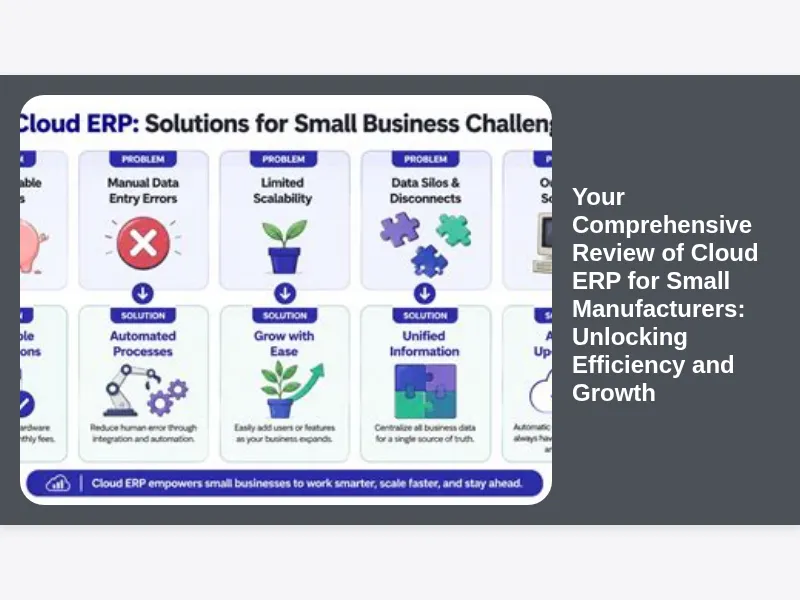
Welcome to a deep dive into one of the most transformative technologies available to today’s small manufacturers: Cloud ERP. In a world where agility, data-driven decisions, and cost-effectiveness are paramount, the traditional ways of managing a manufacturing business often fall short. This comprehensive review aims to shed light on how adopting a Cloud Enterprise Resource Planning (ERP) system can not only solve existing pain points but also pave the way for unprecedented growth and operational excellence in your small manufacturing enterprise. We’ll explore everything from its core definitions and undeniable benefits to the intricacies of implementation and future implications, ensuring you have all the insights needed to make an informed decision for your business.
Understanding the Landscape: What Exactly is Cloud ERP for Manufacturers?
Before we delve into the myriad benefits, it’s crucial to establish a clear understanding of what Cloud ERP entails, especially in the context of a manufacturing environment. At its heart, ERP is an integrated suite of business management software that allows an organization to use a system of integrated applications to manage the business and automate many back-office functions related to technology, services, and human resources. When we add “Cloud” to the mix, it means this powerful software is hosted on a vendor’s servers and delivered over the internet, typically on a subscription basis, rather than being installed and run directly on your company’s own servers and computers.
For small manufacturers, this distinction is profound. Unlike traditional on-premise ERP systems, which demand significant upfront investment in hardware, software licenses, and dedicated IT staff for maintenance and updates, Cloud ERP minimizes these burdens dramatically. It consolidates all critical functions—from production planning and inventory control to financial management, supply chain operations, and customer relationship management—into a single, unified platform accessible from anywhere, at any time, via an internet connection. This accessibility and reduced infrastructure requirement are game-changers for smaller operations often constrained by budget and IT resources.
The Unique Challenges Facing Small Manufacturers Today
Small manufacturers operate in a highly competitive landscape, often grappling with unique challenges that larger enterprises might navigate with greater ease. These businesses frequently face tight margins, volatile demand, complex supply chains, and the constant pressure to innovate while maintaining product quality. Managing inventory accurately, optimizing production schedules, tracking costs effectively, and ensuring timely deliveries can become a convoluted patchwork of spreadsheets, disparate software solutions, and manual processes, leading to inefficiencies and errors.
Without a centralized system, critical data often resides in silos across different departments, making it difficult to gain a holistic view of operations or react quickly to market changes. For instance, a sales team might promise a delivery date without real-time insight into production capacity or raw material availability, leading to customer dissatisfaction. Similarly, inefficient inventory management can result in costly stockouts or excessive carrying costs, directly impacting profitability. These operational hurdles highlight the urgent need for a robust, integrated solution that can bring order and clarity to the often chaotic world of small-scale manufacturing.
Why a Cloud-Based Solution is a Game-Changer for Production Agility
The inherent flexibility and agility offered by Cloud ERP systems make them particularly attractive to small manufacturers aiming to enhance their production processes. Unlike rigid, on-premise systems that can be cumbersome to modify or scale, cloud solutions are designed for adaptability. This means your manufacturing operations can respond swiftly to changes in customer demand, raw material availability, or even new product introductions without significant IT overhead or delays.
Imagine being able to adjust production schedules dynamically, re-prioritize orders based on material availability, or even simulate different production scenarios directly from your ERP system, all in real-time. This level of responsiveness is crucial for maintaining a competitive edge and meeting evolving market expectations. Cloud ERP provides the tools to achieve this agility, empowering small manufacturers to optimize their shop floor, reduce lead times, and deliver products with greater precision and speed, ultimately boosting customer satisfaction and operational efficiency.
Core Modules of Cloud ERP Essential for Manufacturing Operations
A truly comprehensive Cloud ERP system designed for manufacturers is much more than just a financial tool; it’s an operational backbone. It typically comprises several integrated modules, each addressing a specific facet of the manufacturing process, working in concert to provide a unified view of your business. Understanding these core components is key to appreciating the full power of such a system.
At the heart of it, you’ll find modules for Production Planning and Control, which manage everything from forecasting and scheduling to capacity planning and work order management. Inventory Management is another critical module, tracking raw materials, work-in-progress, and finished goods, optimizing stock levels, and reducing carrying costs. Supply Chain Management (SCM) capabilities help you manage supplier relationships, procurement, and logistics, ensuring a smooth flow of materials. Financial Management and Accounting modules handle general ledger, accounts payable, accounts receivable, and cost accounting, providing real-time financial insights. Finally, Customer Relationship Management (CRM) often integrates to manage sales, customer orders, and after-sales service, connecting the entire value chain.
Overcoming Common Misconceptions About Cloud ERP Implementation
Many small manufacturers harbor reservations about adopting new technology, and Cloud ERP is no exception. Common misconceptions often revolve around data security, implementation complexity, and perceived high costs. Some business owners worry that entrusting their sensitive data to a third-party cloud provider poses an unacceptable risk, fearing breaches or loss of control. Others are intimidated by the thought of a lengthy, disruptive implementation process, recalling horror stories from larger companies.
It’s important to address these concerns head-on. Modern Cloud ERP providers invest heavily in robust security measures, often exceeding what a small manufacturer could afford for an on-premise solution, including encryption, regular backups, and compliance certifications. As for complexity, while any ERP implementation requires careful planning, cloud solutions often offer a faster deployment time and are designed for user-friendliness, with many vendors specializing in the needs of SMBs. Moreover, the subscription model of Cloud ERP can actually be more cost-effective in the long run, eliminating large upfront capital expenditures and shifting costs to a predictable operational expense.
Key Considerations Before Embracing a Cloud ERP Solution
Embarking on the journey of adopting a Cloud ERP system is a significant strategic decision that requires careful forethought and planning. Before committing to a particular solution, small manufacturers must undertake a thorough internal assessment of their current processes, pain points, and future growth aspirations. This initial step involves identifying which areas of your business are most inefficient, where data silos exist, and what key metrics you aim to improve with an integrated system.
Beyond internal introspection, it’s crucial to define your budget, both for the software subscription and potential implementation services, and understand the total cost of ownership over several years. Consider the resources available within your team for the implementation process and ongoing management, as well as the level of change management required to ensure successful user adoption. Answering these questions upfront will help shape your requirements and guide you toward a Cloud ERP solution that truly aligns with your specific operational needs and strategic objectives.
Evaluating Cloud ERP Vendors: Beyond the Feature List
Choosing the right Cloud ERP vendor is arguably as critical as the decision to adopt the technology itself. With a multitude of providers in the market, each offering a distinct set of features and specializations, the evaluation process can feel overwhelming. While a detailed feature comparison is undoubtedly important, small manufacturers must look beyond the bullet points and delve deeper into aspects that define a true partnership.
Consider the vendor’s track record and reputation, particularly their experience working with businesses of a similar size and within the manufacturing sector. Investigate the quality of their customer support and ongoing maintenance; a robust support system is invaluable during implementation and beyond. Additionally, assess the vendor’s commitment to continuous innovation and their roadmap for future updates and functionalities. A strong partnership with a reliable and forward-thinking vendor ensures that your Cloud ERP system remains a relevant and powerful tool as your manufacturing business evolves and grows.
Streamlining Manufacturing Operations with Integrated Software
The true power of Cloud ERP for small manufacturers lies in its ability to streamline and connect disparate operational processes that have historically been managed in isolation. From the moment a customer places an order to the final delivery of a finished product, every step can be managed, monitored, and optimized within a single, integrated platform. This eliminates manual data entry, reduces errors, and provides real-time visibility across the entire value chain.
Consider how an integrated system can transform your production floor. Orders flow directly from sales into production planning, automatically checking inventory levels and scheduling work orders based on available capacity and materials. Any delays or issues on the shop floor can be immediately flagged and addressed, preventing bottlenecks. This level of integration ensures that everyone, from sales to procurement to production, is working with the same, up-to-date information, leading to more efficient operations, reduced waste, and a significant boost in overall productivity for your small manufacturing enterprise.
The Transformative Impact on Inventory Management and Control
For small manufacturers, inefficient inventory management can be a silent killer of profitability. Holding too much stock ties up valuable capital, incurs storage costs, and risks obsolescence, while holding too little can lead to costly stockouts, production delays, and missed sales opportunities. Cloud ERP systems offer sophisticated tools to transform inventory management from a guessing game into a precise science.
By providing real-time visibility into inventory levels across all stages—raw materials, work-in-progress, and finished goods—Cloud ERP enables accurate demand forecasting and optimized ordering. Automated reorder points, lot tracking, and warehouse management capabilities ensure that materials are always available when needed, but without excess. This precise control reduces carrying costs, minimizes waste, and ensures that your production lines run smoothly, directly impacting your bottom line and improving the overall efficiency of your manufacturing operations.
Enhancing Supply Chain Visibility for Small Businesses
In today’s globalized economy, a robust and resilient supply chain is non-negotiable for small manufacturers. However, managing complex supplier relationships, tracking inbound materials, and coordinating logistics can be a daunting task without the right tools. Cloud ERP significantly enhances supply chain visibility, providing a holistic view of your entire network, from raw material suppliers to final product distributors.
With integrated supply chain management (SCM) modules, small manufacturers can better manage supplier performance, track purchase orders in real-time, and identify potential disruptions before they impact production. This enhanced visibility allows for proactive decision-making, enabling you to mitigate risks, negotiate better terms with suppliers, and ensure a more predictable flow of materials. The ability to monitor every stage of your supply chain provides a critical advantage, safeguarding your production schedules and ultimately improving customer satisfaction through more reliable deliveries.
Financial Management and Real-Time Reporting for Decision Making
For any business, sound financial management is the bedrock of sustainability and growth. For small manufacturers, the ability to accurately track costs, analyze profitability, and generate insightful financial reports in real-time is crucial for making informed strategic decisions. Cloud ERP systems fundamentally transform financial oversight by integrating all operational data directly into the accounting system.
This integration means that every transaction—from a raw material purchase to a finished product sale—is immediately reflected in the financial ledgers. This eliminates the need for manual data entry and reconciliation, drastically reducing errors and speeding up month-end closes. With Cloud ERP, small manufacturers gain access to comprehensive dashboards and customizable reports that provide instant insights into cash flow, cost of goods sold, profit margins, and departmental expenditures. This real-time financial visibility empowers business owners to identify trends, pinpoint areas for cost reduction, and make agile financial decisions that drive profitability and secure long-term success.
Bolstering Customer Relationships with Integrated CRM
While production and financials are often at the forefront for manufacturers, neglecting customer relationships can be detrimental. Cloud ERP systems, especially those with integrated CRM (Customer Relationship Management) modules, bridge the gap between your manufacturing capabilities and your customer-facing activities. This integration ensures that sales, marketing, and customer service teams have immediate access to critical production and inventory data.
Imagine your sales team being able to provide accurate lead times based on real-time production schedules and available inventory, or your customer service team having instant access to order status, shipping details, and even historical product information. This seamless flow of information leads to more accurate quotes, improved order fulfillment, and proactive customer support. By connecting customer interactions directly to your operational data, Cloud ERP helps small manufacturers build stronger customer relationships, enhance satisfaction, and ultimately drive repeat business and referrals, fostering sustainable growth.
Data Security and Compliance: Addressing Cloud Concerns Proactively
One of the most persistent concerns for small manufacturers contemplating Cloud ERP adoption is the security of their sensitive business data. The idea of entrusting proprietary manufacturing processes, customer information, and financial records to an external cloud provider can be daunting. However, reputable Cloud ERP vendors recognize these concerns and invest heavily in advanced security measures that often surpass what individual small businesses can afford or implement on their own.
These measures include robust data encryption, multi-factor authentication, regular security audits, redundant backups, and physical security for data centers. Moreover, leading Cloud ERP providers adhere to strict industry compliance standards and certifications, such as ISO 27001, SOC 1/2/3, and GDPR, ensuring that data handling practices meet international regulatory requirements. By partnering with a trusted vendor, small manufacturers can often achieve a higher level of data security and regulatory compliance in the cloud than they could with an in-house system, transforming potential concerns into a significant advantage.
Scalability and Future Growth: A Foundation for Expansion
For small manufacturers with ambitions for growth, the ability of their core business systems to scale alongside their evolving needs is paramount. Traditional on-premise ERP solutions often require significant hardware upgrades, licensing changes, and complex reconfigurations to accommodate expansion, which can be costly, time-consuming, and disruptive. Cloud ERP, by its very nature, offers unparalleled scalability, making it an ideal foundation for businesses planning future growth.
Cloud platforms are designed to handle fluctuating workloads and increased data volumes seamlessly. As your manufacturing business expands—adding new production lines, increasing output, entering new markets, or acquiring other businesses—your Cloud ERP can typically scale up or down with minimal effort. You can easily add more users, integrate new modules, or leverage additional computing power on demand, without the need for hefty capital expenditures or extended IT projects. This inherent flexibility ensures that your ERP system remains a growth enabler, not a bottleneck, as your small manufacturing enterprise thrives and expands.
Measuring the Return on Investment (ROI) of Cloud ERP for Manufacturers
While the qualitative benefits of adopting Cloud ERP—like improved efficiency and enhanced data visibility—are compelling, small manufacturers also need to understand the tangible financial returns. Measuring the Return on Investment (ROI) of a Cloud ERP implementation is crucial for justifying the investment and demonstrating its long-term value to stakeholders. The ROI typically manifests in several key areas, both direct and indirect.
Direct savings often come from reduced IT infrastructure costs, lower maintenance expenses, and the elimination of expensive software licenses for disparate systems. More significantly, significant ROI is generated through operational efficiencies: reduced inventory carrying costs, minimized waste, optimized production schedules leading to higher output, and decreased labor costs due to automation. Improved forecasting and streamlined supply chains also contribute to profitability by preventing stockouts and ensuring timely deliveries. By carefully tracking these metrics before and after implementation, small manufacturers can clearly quantify the significant financial benefits and the positive impact of their Cloud ERP investment.
Navigating Implementation Challenges and Ensuring User Adoption
Even with the most robust Cloud ERP system, a successful implementation hinges on careful planning and effective change management. Small manufacturers, despite their size, can still encounter significant challenges during the transition period. Common hurdles include data migration from legacy systems, ensuring data quality, and, perhaps most critically, securing enthusiastic user adoption across all departments.
To mitigate these challenges, it’s essential to approach implementation systematically. Begin with a clear project plan, defined roles, and realistic timelines. Thorough data cleansing and migration strategies are vital to ensure the accuracy and integrity of your historical information in the new system. Crucially, invest heavily in comprehensive user training tailored to specific roles and workflows. Involve key employees early in the process, communicate the benefits clearly, and provide ongoing support to address concerns and foster a positive attitude towards the new system. A well-managed implementation, focused on both technology and people, is the cornerstone of unlocking the full potential of your Cloud ERP investment.
The Future Landscape: AI, IoT, and Advanced Analytics in Cloud ERP
The evolution of Cloud ERP for small manufacturers is far from over; it’s a dynamic field continuously integrating cutting-edge technologies. Looking ahead, the convergence of Artificial Intelligence (AI), the Internet of Things (IoT), and advanced analytics is poised to revolutionize how manufacturing businesses operate, making Cloud ERP even more powerful and indispensable.
Imagine AI-driven predictive maintenance capabilities that anticipate equipment failures before they occur, optimizing uptime and reducing costly repairs. Or IoT sensors on your shop floor feeding real-time production data directly into your ERP system, enabling hyper-accurate scheduling and quality control. Advanced analytics, powered by the cloud’s vast computing capabilities, will move beyond simple reporting to offer deep insights into market trends, customer behavior, and operational efficiencies, allowing small manufacturers to make proactive, data-driven decisions that were once the exclusive domain of large corporations. Embracing Cloud ERP today positions your business to readily integrate these future innovations, ensuring you remain at the forefront of manufacturing excellence.
Choosing the Right Cloud ERP Partner for Your Small Manufacturing Business
The decision to implement Cloud ERP is a strategic one, but equally important is the choice of your long-term partner. For small manufacturers, the right vendor goes beyond simply providing software; they become an extension of your team, understanding your unique challenges and helping you leverage the technology to its fullest potential. This isn’t just about the initial sale but about ongoing support, training, and a shared vision for your success.
When evaluating partners, look for those with a proven track record specifically within the manufacturing sector and experience with businesses of your size. Assess their implementation methodology, their post-go-live support structure, and their commitment to ongoing product development. A strong partnership means access to expert guidance, timely problem-solving, and a relationship built on trust and mutual understanding. This symbiotic relationship with your Cloud ERP provider is what will truly unlock sustained value, helping your small manufacturing business not just survive, but thrive and innovate in a competitive marketplace.
Conclusion: Embracing Cloud ERP for a Competitive Manufacturing Edge
In conclusion, for small manufacturers navigating the complexities of today’s market, embracing a Cloud ERP system is no longer a luxury but a strategic imperative. This comprehensive review has illuminated how a well-chosen Cloud ERP solution can revolutionize nearly every aspect of your operations, from streamlining production and optimizing inventory to enhancing financial visibility and strengthening customer relationships. It offers the agility, scalability, and cost-effectiveness that perfectly align with the unique demands and growth ambitions of smaller enterprises.
By providing real-time data, automating tedious manual tasks, and fostering seamless communication across departments, Cloud ERP empowers small manufacturers to make smarter decisions, respond faster to market changes, and ultimately achieve a significant competitive advantage. While implementation requires careful planning and commitment, the long-term benefits in terms of efficiency, profitability, and future-proofing your business are undeniable. The journey to digital transformation through Cloud ERP is a significant step towards unlocking the full potential of your manufacturing capabilities and ensuring sustained growth in an ever-evolving industrial landscape.