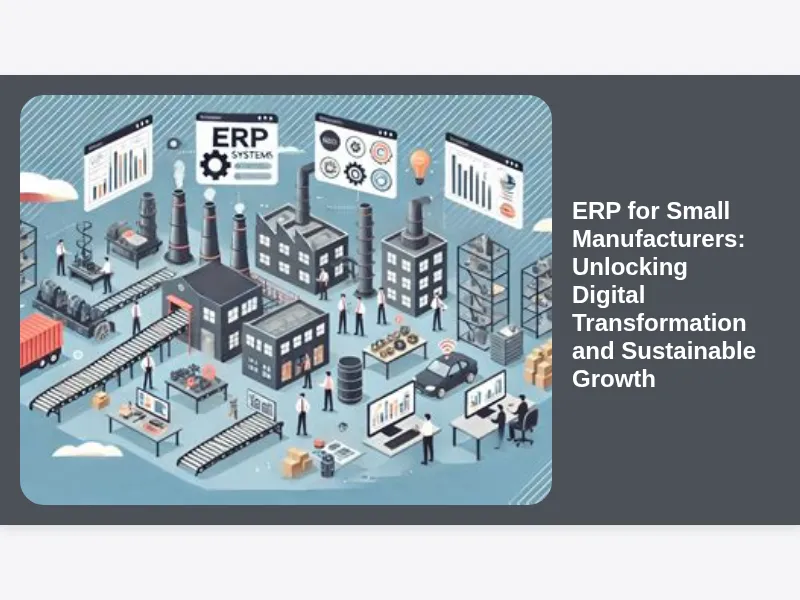
The manufacturing world, once dominated by large industrial giants, is undergoing a profound transformation. Small manufacturers, the agile engines of innovation and local economies, are finding themselves at a critical juncture. The days of relying on spreadsheets, disparate software, and manual processes are swiftly drawing to a close. To survive, compete, and thrive in this rapidly evolving landscape, ERP for small manufacturers: a path to digital transformation is not merely an option, but an absolute necessity.
This comprehensive guide delves deep into how Enterprise Resource Planning (ERP) systems are becoming the backbone for small manufacturing businesses seeking to modernize their operations, enhance efficiency, and achieve sustainable growth. We’ll explore the ‘why,’ the ‘what,’ and the ‘how’ of implementing ERP, debunk common myths, and illuminate the tangible benefits that await those who embrace this powerful technological shift. Get ready to discover how a well-chosen ERP system can be the cornerstone of your company’s future success, paving the way for unprecedented operational excellence and strategic foresight.
Decoding ERP: More Than Just Software for Small Manufacturing Enterprises
When you hear “Enterprise Resource Planning” (ERP), your mind might immediately conjure images of sprawling multinational corporations with complex, multi-million dollar software installations. However, this perception, while historically rooted, is increasingly outdated, especially concerning ERP for small manufacturers. At its core, an ERP system is an integrated suite of business management tools designed to connect and streamline an organization’s core processes, from finance and human resources to manufacturing and supply chain operations.
For a small manufacturer, this means bringing together all the critical functions of your business under one digital roof. Imagine having your production schedule, inventory levels, customer orders, financial accounts, and supplier information all communicating with each other in real-time. This isn’t just about consolidating data; it’s about creating a single source of truth that eliminates silos, reduces manual data entry, and provides an unparalleled level of visibility into every facet of your operations. It’s about replacing fragmentation with seamless integration, allowing you to focus on what you do best: making great products.
Unlike the monolithic systems of yesteryear, modern ERP solutions tailored for small manufacturing businesses are designed to be agile, scalable, and often more cost-effective. They focus on providing the essential functionalities without overwhelming complexity, recognizing that small manufacturers need practical tools that drive immediate value. The “resource planning” aspect is particularly crucial here, as it empowers these businesses to optimize the utilization of their labor, materials, machinery, and capital, ensuring that every resource contributes maximally to productivity and profitability.
Ultimately, understanding ERP isn’t about grasping a technical definition; it’s about recognizing its transformative potential. It’s the digital backbone that enables small manufacturers to move beyond reactive problem-solving to proactive, data-driven decision-making. By centralizing information and automating routine tasks, an ERP system frees up valuable time and resources, allowing you to innovate, expand, and strategically navigate the challenges of today’s competitive market.
Why Small Manufacturers Can No Longer Afford to Wait: The Imperative for Digital Transformation
The landscape for small manufacturers has shifted dramatically. What was once a relatively stable environment where traditional methods sufficed is now a dynamic, global arena demanding agility, precision, and rapid response. The imperative for digital transformation, spearheaded by solutions like ERP for small manufacturers, isn’t a luxury; it’s a matter of survival and growth. Sticking to outdated processes isn’t just inefficient; it’s actively detrimental to your bottom line and your ability to compete.
Consider the common pain points that plague many small manufacturing operations today: disjointed spreadsheets attempting to track inventory, manual purchase orders leading to delays and errors, opaque production schedules that frustrate shop floor managers, and accounting systems that don’t talk to sales. These fragmented processes create an environment ripe for inefficiency, rework, wasted materials, and missed opportunities. Without a unified system, critical decisions are often made based on incomplete or outdated information, leading to suboptimal outcomes and preventable costs.
Beyond internal inefficiencies, external pressures are mounting. Customer expectations have soared; they demand faster lead times, higher quality, more customization, and transparent communication. Competitors, both local and global, are increasingly leveraging technology to deliver on these demands, widening the gap for those who lag. Supply chains have become more complex and fragile, highlighted by recent global events, making real-time visibility and agile planning absolutely essential.
Furthermore, the digital age offers unprecedented opportunities for growth. E-commerce, advanced analytics, and integrated marketing channels open new avenues for reaching customers and understanding market trends. However, without a robust digital foundation like an ERP system, small manufacturers are ill-equipped to capitalize on these opportunities. They struggle to scale production to meet increased demand, manage complex order configurations, or even understand which products are most profitable.
Therefore, the decision to embrace digital transformation through an ERP system is not about adopting technology for technology’s sake. It’s a strategic move to address immediate operational inefficiencies, meet evolving customer and market demands, and position your business for future growth and resilience. It’s about empowering your small manufacturing operation with the tools it needs to navigate complexity, seize opportunities, and ultimately, secure its place in the modern industrial economy.
Busting Myths: Addressing Common Misconceptions About ERP for Small Manufacturers
For many small manufacturers, the concept of implementing an ERP system is often shrouded in misconceptions, acting as a barrier to realizing its transformative potential. These myths, while understandable given ERP’s history, often prevent businesses from exploring solutions that are now perfectly tailored to their needs. Let’s tackle some of the most prevalent myths surrounding ERP for small manufacturers head-on and reveal the truth behind these powerful systems.
The most common myth is that “ERP is too expensive for a small manufacturer.” While large-scale ERP implementations can indeed carry a hefty price tag, the market has evolved dramatically. Today, there are numerous cloud-based ERP solutions specifically designed for small and medium-sized businesses (SMBs) that operate on a subscription model, significantly reducing upfront costs. These solutions offer modularity, allowing businesses to start with essential functionalities and scale as they grow, making ERP an accessible investment with a strong return for even the leanest operations.
Another widespread belief is that “ERP is too complex and only for large enterprises with dedicated IT departments.” This couldn’t be further from the truth. Modern ERP systems, especially those developed for SMBs, prioritize user-friendliness and intuitive interfaces. Cloud ERP eliminates much of the IT burden, as the vendor manages infrastructure, updates, and maintenance. Small manufacturers don’t need an army of IT specialists; they need a system that simplifies their processes, not complicates them. The goal is to make business easier, not harder.
Many also fear that “ERP implementation is too disruptive and will halt our production.” While any significant system change requires planning and effort, modern implementation methodologies focus on minimizing disruption. Phased rollouts, thorough testing, and robust training programs are standard practice. Reputable ERP vendors understand the critical need for continuous operation in manufacturing and work closely with businesses to ensure a smooth transition, often allowing partial or parallel operations during key phases. The short-term adjustment is a small price for long-term stability and efficiency.
Then there’s the idea that “my small operation is too simple for ERP; spreadsheets are fine.” While spreadsheets might suffice for very basic tracking, they quickly become unmanageable as a business grows, introduces new products, or manages more complex orders. Spreadsheets are prone to errors, lack real-time data, and cannot integrate disparate functions. They create data silos and hinder effective decision-making. ERP provides the structure, automation, and real-time insights that spreadsheets simply cannot offer, transforming a “simple” operation into a streamlined, highly efficient one.
Finally, some might mistakenly believe that “ERP is just fancy accounting software.” While financial management is a core component, ERP encompasses a far broader spectrum of functionalities crucial to manufacturing. It integrates production planning, inventory management, supply chain, sales, customer relations, and more. It’s a holistic business management system designed to optimize the entire value chain, not just the financial aspects. By dispelling these myths, small manufacturers can approach the topic of ERP with a clearer understanding and an open mind, ready to embrace the proven benefits it offers.
Core Functionalities: What an ERP System Brings to Your Manufacturing Floor
For small manufacturers looking to modernize, understanding the specific capabilities an ERP system offers is crucial. It’s not just a single piece of software; it’s an integrated suite of modules, each designed to optimize a different aspect of your business, all working together seamlessly. These core functionalities are precisely what make ERP for small manufacturers a true path to digital transformation. Let’s break down the essential components that typically comprise a manufacturing-focused ERP system.
Production Planning & Scheduling is often considered the heart of a manufacturing ERP. This module allows you to accurately forecast demand, create master production schedules, and generate detailed work orders. It helps in optimizing resource allocation, managing machine capacity, and scheduling labor effectively. By providing real-time visibility into production progress, it enables shop floor control, helps identify bottlenecks, and ensures that your manufacturing process runs as smoothly and efficiently as possible, leading to improved on-time delivery rates and reduced lead times.
Inventory Management Systems are another cornerstone. For small manufacturers, controlling inventory is paramount to profitability. This module provides accurate, real-time tracking of raw materials, work-in-progress (WIP), and finished goods across multiple locations. It helps optimize inventory levels, reducing carrying costs and preventing stockouts or overstocking. Features like lot tracking, serial number tracking, and automated reorder points ensure that you always have what you need, when you need it, minimizing waste and improving cash flow.
Purchasing & Supplier Management streamlines the procurement process. From generating purchase requisitions and orders to managing supplier relationships and tracking inbound shipments, this module automates many tedious tasks. It helps negotiate better prices, identify reliable suppliers, and ensure that materials arrive on schedule. By integrating with inventory and production planning, it ensures that purchasing decisions are always aligned with production needs, avoiding delays caused by material shortages.
Financial Management & Accounting is foundational to any ERP system. This module handles general ledger, accounts payable, accounts receivable, payroll, and fixed asset management. For small manufacturers, it provides accurate financial reporting, robust budgeting tools, and improved cash flow management. Integration with other modules means that every transaction, from a raw material purchase to a finished good sale, is automatically reflected in your financials, providing real-time financial visibility and eliminating the need for separate accounting software.
Sales & Customer Order Management helps streamline the entire sales cycle, from quotation to order fulfillment. It allows you to manage customer information, process orders efficiently, track sales performance, and handle customer service inquiries. Integration with inventory and production helps in providing accurate lead times to customers, managing custom orders, and improving overall customer satisfaction. It empowers your sales team with real-time data on product availability and pricing, enhancing their effectiveness.
Finally, Quality Control & Compliance is becoming increasingly vital for small manufacturers. This module helps establish and enforce quality standards throughout the production process. It facilitates tracking non-conformances, managing corrective and preventive actions (CAPA), and maintaining audit trails. For industries with strict regulatory requirements, it ensures compliance, reduces risks, and protects your brand’s reputation, demonstrating a commitment to excellence that can differentiate your business in the market. Each of these modules contributes to a holistic view of your operations, enabling greater control, efficiency, and informed decision-making.
Unleashing Efficiency: Tangible Benefits of ERP for Small Manufacturers
Embracing ERP for small manufacturers isn’t just about implementing new software; it’s about unlocking a cascade of tangible benefits that directly impact profitability, operational excellence, and competitive advantage. The digital transformation enabled by a well-chosen ERP system translates into real-world improvements that drive growth and solidify your market position. Let’s delve into the key advantages that small manufacturers can expect to realize.
Firstly, a significant benefit is improved operational efficiency. By integrating disparate processes and automating manual tasks, ERP drastically reduces the time and effort spent on administrative work. This means fewer errors from manual data entry, faster processing of orders, and streamlined workflows across departments. From the moment an order is placed to its final delivery, every step is optimized, freeing up your team to focus on higher-value activities rather than chasing information or correcting mistakes. The elimination of redundant data entry alone can save countless hours and prevent costly errors.
Secondly, ERP provides enhanced decision-making through data-driven insights. With all your critical business data centralized in one system, you gain unparalleled visibility into every aspect of your operations. Real-time dashboards and comprehensive reports provide insights into inventory levels, production bottlenecks, sales performance, and financial health. This data empowers owners and managers to make informed, proactive decisions based on accurate information, rather than relying on gut feelings or outdated spreadsheets. Understanding true production costs, identifying profitable product lines, and forecasting demand with greater accuracy become standard practice.
Thirdly, small manufacturers experience significant cost reduction. Optimized inventory management reduces carrying costs, minimizes waste from expired or obsolete materials, and prevents costly stockouts that can halt production. Improved production scheduling minimizes idle machine time and optimizes labor utilization. Streamlined purchasing processes can lead to better negotiation power with suppliers and reduced freight costs. The cumulative effect of these efficiencies is a healthier bottom line, allowing resources to be reinvested into growth or innovation.
Moreover, an ERP system leads to better customer satisfaction. By improving order accuracy, reducing lead times, and providing clearer communication about order status, you can meet and exceed customer expectations. Having a complete view of customer interactions and order history helps in delivering personalized service and resolving issues more quickly. In today’s competitive market, superior customer experience is a powerful differentiator, and ERP provides the foundation for building strong, lasting customer relationships.
Fifthly, ERP fosters scalability and growth enablement. As your small manufacturing business grows, an ERP system can seamlessly scale with you, handling increased volumes, more complex product lines, and additional locations without requiring a complete overhaul of your systems. It provides the structured environment necessary to support expansion, allowing you to confidently pursue new markets or product opportunities. This robust foundation ensures that growth doesn’t lead to chaos, but rather to controlled, sustainable expansion.
Finally, ERP significantly aids in compliance and risk management. For industries with strict regulations, an ERP system can help ensure traceability, maintain audit trails, and enforce quality control standards. By centralizing data and standardizing processes, it reduces the risk of human error, facilitates faster responses to audits, and helps maintain a strong reputation for quality and accountability. These tangible benefits collectively underscore why investing in ERP for small manufacturers is not just an expense, but a strategic investment in long-term success.
Choosing Wisely: Key Considerations for Selecting an ERP for Small Manufacturers
The decision to implement an ERP system is a significant one, and choosing the right solution is paramount to the success of your digital transformation journey. For ERP for small manufacturers, the selection process requires careful consideration of several key factors to ensure the chosen system aligns perfectly with your unique business needs and future aspirations. It’s not about picking the most feature-rich or the cheapest option, but the one that offers the best fit and value.
One of the foremost considerations is industry-specific needs. Manufacturing is a broad sector, and the requirements of a custom job shop differ significantly from those of a batch process food manufacturer or a discrete assembly operation. Look for ERP solutions that have proven experience and functionalities tailored to your specific industry vertical. Does the system support lot traceability if that’s critical for your compliance? Can it handle complex bills of materials (BOMs) or unique routing requirements? An industry-specific solution will understand your challenges implicitly and offer out-of-the-box functionalities that minimize customization needs.
Another critical decision point revolves around Cloud vs. On-Premise deployment. Cloud ERP solutions, hosted by the vendor and accessed via the internet, typically offer lower upfront costs, faster implementation, and reduced IT maintenance burden, making them highly attractive for small manufacturers without extensive IT resources. They also provide greater accessibility from anywhere and automatic updates. On-premise solutions, installed and managed on your own servers, offer greater control over data and customization options, but come with higher upfront infrastructure costs and ongoing IT responsibilities. Evaluate your budget, IT capabilities, security concerns, and customization requirements to determine which model is best suited for your business.
Scalability and future growth must also be a central part of your decision-making. Your small manufacturing business today might be significantly different five years from now. Will the chosen ERP system be able to accommodate increased transaction volumes, new product lines, additional users, or even multiple locations without requiring a complete system overhaul? A truly effective ERP solution for small manufacturers should be capable of growing with you, adapting to evolving business processes and strategic shifts without becoming a bottleneck.
User-friendliness is often underestimated but profoundly impacts adoption rates and overall success. An ERP system, no matter how powerful, is only effective if your team can and will use it. Look for intuitive interfaces, logical workflows, and easy-to-understand navigation. Request demonstrations and involve key users from different departments in the evaluation process to gather their feedback on the system’s usability. A system that is difficult to learn or cumbersome to use will face significant resistance and undermine your investment.
Finally, delve into the vendor reputation and support. The relationship with your ERP vendor doesn’t end after the sale; it’s a long-term partnership. Research the vendor’s track record, customer testimonials, and their commitment to ongoing support, training, and software updates. What kind of support channels do they offer? What are their service level agreements (SLAs)? A responsive and knowledgeable vendor can be invaluable during implementation and beyond, helping you maximize the value of your ERP investment. By carefully weighing these considerations, small manufacturers can confidently select an ERP system that truly drives their digital transformation.
The Implementation Journey: A Roadmap to Digital Transformation Success
Implementing an ERP system, especially ERP for small manufacturers, is a journey, not a singular event. It’s a strategic project that requires careful planning, dedicated resources, and a structured approach to ensure a successful digital transformation. While every implementation has its unique nuances, following a well-defined roadmap can significantly mitigate risks and pave the way for a smooth transition and maximal benefits.
The first crucial step is Phase 1: Planning and Discovery. This involves defining your project goals, identifying key stakeholders (including an executive sponsor), assembling an internal project team, and selecting an ERP vendor and implementation partner. During discovery, you’ll meticulously map your current business processes (“as-is” state) and envision your desired future processes (“to-be” state) with the ERP system. This phase is critical for establishing a clear scope, setting realistic timelines, and defining key performance indicators (KPIs) for success. A thorough understanding of your current challenges and future aspirations will guide all subsequent steps.
Following discovery, Phase 2: Data Migration and Configuration begins. This is where the actual system build takes shape. Your implementation partner will configure the ERP software to align with your business processes, setting up modules, workflows, and access permissions. Simultaneously, a significant effort is dedicated to data migration – extracting, cleaning, transforming, and loading your historical data (customer information, product catalogs, inventory levels, financial records) from legacy systems into the new ERP. Data quality is paramount here; “garbage in, garbage out” applies emphatically to ERP, so rigorous data cleansing is non-negotiable.
Phase 3 focuses on Testing and Training. Before the system goes live, it must be thoroughly tested. This involves user acceptance testing (UAT), where end-users perform real-world scenarios in a test environment to ensure the system functions as expected and meets business requirements. Alongside testing, comprehensive training programs are rolled out to all users. Effective training is vital for user adoption; it ensures your team understands how to use the new system confidently and efficiently, minimizing post-go-live disruptions. Training should be tailored to different roles and responsibilities within your small manufacturing operation.
Then comes Phase 4: Go-Live. This is the moment your business transitions from old systems to the new ERP. While exciting, it’s also a period that requires heightened support. Your project team and implementation partner will be on standby to address any immediate issues, provide hands-on assistance, and help users navigate the initial learning curve. Go-live can be either a “big bang” approach (switching everything over at once) or a “phased” approach (rolling out modules department by department), depending on the complexity of your operations and your risk tolerance. For small manufacturers, a phased approach is often less disruptive.
Finally, Phase 5 involves Post-Implementation Support and Optimization. The journey doesn’t end at go-live. This phase focuses on ongoing support, addressing any remaining issues, and fine-tuning the system to continuously improve performance. It also involves regular reviews to ensure the ERP is delivering the expected benefits and making adjustments as your business evolves. Continuous improvement is key; an ERP system is a living tool that should adapt with your small manufacturing business, not become static. Throughout the entire journey, effectively managing expectations and embracing change management strategies are crucial for overcoming resistance and fostering a positive environment for digital transformation.
Data Migration Strategies: Ensuring a Smooth Transition for Your Manufacturing Operations
Data is the lifeblood of any manufacturing operation, and the process of migrating it to a new ERP system is often one of the most critical and challenging aspects of implementation. A successful ERP for small manufacturers relies heavily on clean, accurate, and properly mapped data. Without a robust data migration strategy, you risk compromising the integrity of your new system and undermining the very benefits you seek to achieve.
The absolute first step is understanding the importance of clean data. Many small manufacturers have accumulated years, even decades, of data in disparate systems, spreadsheets, or even physical files. This data often contains duplicates, inaccuracies, inconsistencies, and obsolete information. Migrating “dirty” data into your new ERP system will perpetuate and amplify these problems, leading to erroneous reports, incorrect production schedules, and unreliable inventory counts. Before any migration, invest significant time in data cleansing – auditing, correcting, and standardizing your existing data. This is a labor-intensive but non-negotiable prerequisite for success.
Next is mapping legacy data to the new ERP structure. Your old systems likely have different fields, formats, and relationships compared to the new ERP. Data mapping involves systematically identifying where each piece of information from your old system will reside in the new one. For example, ensuring that your old “Part Number” field correctly maps to the new ERP’s “Item ID,” or that customer addresses are parsed into the correct street, city, state, and zip code fields. This process requires a deep understanding of both your existing data and the new ERP’s schema, often involving collaboration between your internal team and your ERP implementation partner.
Testing data integrity is paramount after migration. Once a subset of cleansed and mapped data has been loaded into the new ERP’s test environment, rigorous testing must occur. This involves comparing reports and transaction outcomes in the new system against your old data to ensure accuracy. Can you pull up a customer’s full order history? Are inventory levels correct? Does the financial balance sheet match? This iterative process of migrating, testing, and refining helps catch errors before the system goes live with all your operational data, preventing costly mistakes down the line.
Finally, consider the different approaches to data migration: Phased vs. Big Bang. In a “Big Bang” migration, all data is migrated, and the new ERP system goes live across all modules simultaneously. While this offers a clean break, it carries higher risk and can be disruptive, particularly for small manufacturers with limited resources. A “Phased” approach involves migrating data and rolling out modules incrementally, department by department or by geographical location. This allows for a more controlled transition, provides opportunities to learn and adjust, and reduces the immediate impact on your operations. For many small manufacturers, a phased data migration strategy often provides a smoother, less intimidating path to digital transformation, ensuring that your valuable manufacturing data transitions seamlessly and accurately into its new digital home.
Training and User Adoption: Empowering Your Team with Manufacturing ERP Solutions
The most sophisticated ERP system is useless if your team doesn’t adopt and utilize it effectively. For ERP for small manufacturers, successful implementation hinges not just on the software itself, but critically on the human element – how well your employees are trained and how readily they embrace the new system. Ignoring user adoption is a common pitfall that can derail even the most meticulously planned digital transformation.
Effective training programs are fundamental to driving user adoption. Training should not be a one-time event just before go-live; it needs to be an ongoing process tailored to different user groups. For example, a production manager will need different training modules than an accountant or a sales representative. Focus on hands-on exercises, real-world scenarios, and clearly explain how the new system will make their specific jobs easier and more efficient. Highlighting the “what’s in it for me” factor can significantly increase engagement. Small, focused training sessions followed by practice periods are often more effective than lengthy, generic seminars.
Beyond formal training, identifying and nurturing champions and super-users within your organization can be incredibly beneficial. These are enthusiastic employees who quickly grasp the new ERP system and can become internal experts and advocates. They can assist their colleagues, answer basic questions, and provide peer-to-peer support, thereby reducing the burden on your core project team and fostering a sense of collective ownership. Empowering these individuals can create a positive ripple effect throughout your small manufacturing team, making the transition feel less daunting.
Continuous learning and support are also vital. Technology evolves, and so do business processes. Provide easy access to training materials, FAQs, and a clear support channel (e.g., a dedicated internal contact or a helpdesk) for ongoing questions and issues. Regular refresher courses or advanced training sessions for specific modules can help users deepen their understanding and uncover more efficient ways of working with the ERP. This continuous support reinforces the message that the ERP is a tool for continuous improvement, not just a one-off project.
Crucially, addressing resistance to change proactively is essential. People are naturally wary of new systems and processes, especially if they perceive it as a threat to their job security or simply an unnecessary complication. Communicate openly and honestly about the reasons for implementing the ERP, the benefits it will bring to both the company and individual roles, and involve employees in the process from the outset. Listen to their concerns, address their fears, and celebrate small victories during the implementation. Demonstrating management’s commitment and providing positive reinforcement can transform hesitant users into enthusiastic adopters, ultimately maximizing the return on your investment in manufacturing ERP solutions.
Measuring Success: Key Performance Indicators (KPIs) for Your ERP Investment
Implementing an ERP system is a significant investment for any business, especially for ERP for small manufacturers embarking on their digital transformation. To truly understand the value and impact of this investment, it’s crucial to establish clear metrics for success from the outset. Without well-defined Key Performance Indicators (KPIs), you’re essentially flying blind, unable to quantify the return on your ERP system. Let’s explore the types of KPIs that small manufacturers should monitor to gauge the effectiveness of their ERP.
Operational KPIs are at the heart of manufacturing efficiency. One of the most important is cycle time reduction – the time it takes to complete a product from raw materials to finished goods. A successful ERP implementation should significantly streamline production processes, leading to shorter cycle times. Another critical metric is Overall Equipment Effectiveness (OEE), which measures machine availability, performance, and quality. Improved OEE indicates better utilization of assets, a direct benefit of optimized scheduling and real-time shop floor data provided by ERP. Also track on-time delivery rates; an ERP system should enable better planning and execution, leading to fewer missed deadlines and happier customers.
From a financial perspective, Financial KPIs are essential for demonstrating the return on investment (ROI). Cost reduction is a primary goal for many ERP projects. Track reductions in inventory carrying costs, labor costs associated with manual data entry, and material waste. Measuring the payback period for your ERP investment is also critical. Beyond direct cost savings, look for improvements in cash flow management and profitability margins. A well-integrated ERP provides clearer insights into true product costs, allowing for more accurate pricing and better profit planning.
Inventory KPIs are specifically important for manufacturers. Monitor inventory accuracy rates; a robust ERP should eliminate discrepancies between physical and recorded inventory. Inventory turnover ratio indicates how efficiently you’re selling and replacing stock, with an improved ratio suggesting optimized inventory levels. Reduced obsolete or slow-moving inventory is another direct benefit, freeing up valuable capital and storage space. These metrics directly reflect the ERP’s ability to provide real-time visibility and control over your materials.
Customer KPIs reflect the external impact of your improved operations. Enhanced on-time delivery rates (as mentioned under operational KPIs) directly translate to customer satisfaction. Track customer complaints related to order accuracy or delivery delays; these should significantly decrease post-ERP implementation. An increase in customer retention rates and even new business acquisition can indirectly be attributed to the improved efficiency and responsiveness enabled by your ERP system. Happy customers are repeat customers.
Finally, don’t overlook Employee KPIs. While sometimes harder to quantify, improvements in employee productivity (e.g., output per employee) and employee satisfaction (due to reduced frustration from manual tasks or data chasing) are strong indicators of success. A system that empowers employees with better tools and information can lead to higher morale and reduced employee turnover. By consistently monitoring these diverse KPIs, small manufacturers can clearly articulate the value of their ERP investment, continually optimize their operations, and demonstrate a clear path of digital transformation and growth.
Cloud ERP vs. On-Premise: Which Deployment Model Suits Your Small Manufacturing Business?
One of the most fundamental decisions faced by small manufacturers when considering an ERP system is the deployment model: Cloud ERP or On-Premise ERP. Each approach offers distinct advantages and disadvantages, and the “best” choice for ERP for small manufacturers largely depends on your specific budget, IT infrastructure, customization needs, and long-term strategy. Understanding these differences is crucial for making an informed decision that truly aligns with your digital transformation goals.
Cloud ERP, also known as Software-as-a-Service (SaaS), is hosted by the ERP vendor and accessed over the internet through a web browser. The primary advantage for small manufacturers is its lower upfront cost. Instead of a large capital expenditure for software licenses and servers, Cloud ERP typically operates on a subscription model, converting a capital expense into a predictable operational expense. This makes it more financially accessible for businesses with limited IT budgets. Cloud solutions also offer greater accessibility, allowing users to access the system from anywhere, at any time, on any device with an internet connection – a significant boon for remote work or mobile teams. Furthermore, the vendor handles all maintenance, upgrades, and security, reducing your internal IT burden and ensuring you always have the latest features and security patches.
However, Cloud ERP also comes with potential drawbacks. Internet dependency means that if your internet connection goes down, so does access to your ERP. While rare, this is a consideration for regions with unreliable connectivity. Customization options can sometimes be more limited compared to on-premise solutions, as the vendor maintains a standardized platform. While most modern cloud ERPs offer robust configuration options, deep, bespoke customizations might be more challenging or costly. Finally, some businesses have concerns about data security and privacy when their data is hosted by a third party, though reputable cloud providers employ advanced security measures often superior to what a small manufacturer could implement in-house.
On-Premise ERP, conversely, involves purchasing the software license and installing it on your own servers within your physical facility. The main advantage here is complete control. You own the software, the data, and the infrastructure, allowing for extensive customization to fit highly specific business processes. This level of control can be appealing to small manufacturers with unique operational requirements or those in highly regulated industries. It also means your data is housed internally, which can alleviate some data security concerns for those wary of cloud solutions.
The disadvantages of On-Premise ERP typically revolve around higher upfront costs for software licenses, servers, and other hardware. There’s also a significant IT overhead; your business is responsible for all installation, maintenance, updates, security, and troubleshooting, which requires dedicated IT staff or external consultants. Upgrades can be complex, time-consuming, and costly, often leading businesses to postpone them and fall behind on new features and security. Ultimately, the choice boils down to striking a balance between cost, control, flexibility, IT capabilities, and your comfort level with external hosting. For many small manufacturers, the cost-effectiveness, reduced IT burden, and scalability of Cloud ERP make it a compelling and increasingly popular path to digital transformation.
Integrating ERP with Your Digital Ecosystem: Beyond the Core System
While a core ERP system provides a powerful foundation for ERP for small manufacturers, its true potential for digital transformation is often unlocked through seamless integration with other specialized digital tools. Your manufacturing business doesn’t operate in a vacuum; it interacts with customers, partners, and various technologies. Integrating your ERP system with these external and internal components creates a holistic digital ecosystem, amplifying efficiency, enhancing data flow, and providing a truly unified view of your business.
One of the most common and beneficial integrations is with Customer Relationship Management (CRM) systems. While ERP handles the “back office” of production and finance, CRM manages the “front office” of sales, marketing, and customer service. Integrating the two ensures that your sales team has real-time access to product availability, pricing, and order status from the ERP, while your ERP system can leverage customer data from the CRM for better forecasting and production planning. This eliminates data silos between sales and operations, leading to more accurate quotes, faster order processing, and improved customer satisfaction.
Integration with CAD (Computer-Aided Design) and PLM (Product Lifecycle Management) systems is critical for manufacturers dealing with product design and engineering. This allows for automated transfer of Bill of Materials (BOMs), engineering change orders (ECOs), and product specifications directly from design to production planning within the ERP. This drastically reduces manual data entry errors, accelerates the product development cycle, and ensures that what is designed is accurately what is produced, improving quality and consistency.
For small manufacturers engaging in direct sales, integrating with E-commerce platforms is indispensable. This connection automates the transfer of online orders directly into the ERP system, updating inventory levels in real-time and triggering production or fulfillment processes. It also allows for automatic updates of product information, pricing, and availability from the ERP to your online store, ensuring customers always see accurate information. This integration streamlines the order-to-cash cycle and enables scalable growth through online channels.
Moreover, integrating with specialized Shop Floor Control (SFC) systems or Machine Monitoring solutions can bring granular detail from your production line directly into the ERP. This real-time data on machine performance, production output, and actual labor times allows for highly accurate costing, precise scheduling adjustments, and proactive maintenance planning. It closes the loop between planned production in ERP and actual execution on the shop floor, providing invaluable insights for continuous process improvement.
The power of a truly connected ecosystem lies in the elimination of manual data transfer, the reduction of errors, and the provision of real-time, comprehensive data for decision-making. By allowing your ERP system to communicate seamlessly with other vital business tools, small manufacturers can achieve a level of operational synchronization and strategic insight that was once only available to larger enterprises. This holistic approach ensures that your digital transformation is not just about a single system, but about creating an intelligent, interconnected business environment that drives efficiency and growth across all functions.
Cybersecurity and Data Integrity: Protecting Your Valuable Manufacturing Data with ERP
In an increasingly digital world, the integrity and security of your business data are paramount. For ERP for small manufacturers, implementing a comprehensive system means centralizing vast amounts of sensitive information, from intellectual property and production processes to customer data and financial records. This centralization, while beneficial for efficiency, also makes the ERP system a prime target for cyber threats. Therefore, robust cybersecurity measures and strategies for maintaining data integrity are not optional, but essential components of your digital transformation.
The importance of data security cannot be overstated. A cyberattack – whether it’s a ransomware attack locking you out of your systems, a data breach exposing customer information, or industrial espionage stealing your proprietary designs – can have devastating consequences for a small manufacturer. These consequences can range from financial losses and operational downtime to severe reputational damage and legal liabilities. An ERP system, being the nerve center of your operations, must be fortified against these threats to protect your business assets and ensure continuity.
Modern ERP systems, especially cloud-based solutions, come with built-in security features designed to protect your data. These typically include encryption for data at rest and in transit, multi-factor authentication (MFA) for user access, role-based access controls (RBAC) to ensure employees only see data relevant to their job functions, and regular security audits. Reputable cloud ERP vendors invest heavily in cutting-edge cybersecurity infrastructure and expertise, often exceeding what a small manufacturer could manage internally. They operate secure data centers, employ intrusion detection systems, and constantly monitor for vulnerabilities.
However, vendor responsibilities must be complemented by internal best practices. No matter how secure your ERP system is, human error remains a significant vulnerability. Train your employees on cybersecurity awareness, including recognizing phishing attempts, using strong, unique passwords, and understanding data handling protocols. Implement clear policies for data access, backup, and disaster recovery. Regularly review user permissions to ensure they are appropriate and revoke access for departed employees immediately. Physical security of any on-premise components or devices accessing the ERP is also crucial.
Maintaining data integrity goes hand-in-hand with security. It means ensuring that your data is accurate, consistent, and reliable throughout its lifecycle within the ERP system. This is achieved through rigorous data validation rules at the point of entry, automated checks for consistency, and audit trails that record every change made to data, along with who made it and when. Regular data backups and robust recovery plans are also critical to ensure that even if data is compromised or lost, it can be restored quickly and accurately. By prioritizing both cybersecurity and data integrity, small manufacturers can harness the power of their ERP system with confidence, knowing their valuable digital assets are well-protected on their path to digital transformation.
The ROI of ERP: Demonstrating Financial Value for Small Manufacturers
For any investment in technology, particularly one as significant as an ERP system, small manufacturers rightly demand a clear demonstration of financial value. The Return on Investment (ROI) of ERP for small manufacturers is not always immediately apparent in a single line item, but rather emerges from a cumulative effect of numerous improvements across the organization. Quantifying this ROI requires looking beyond direct cost savings to encompass enhanced revenue opportunities and invaluable intangible benefits.
One of the most straightforward ways to demonstrate ROI is through quantifying cost savings. As discussed in earlier sections, an ERP system reduces operational inefficiencies. This includes lower inventory holding costs due to optimized stock levels, decreased material waste from better planning and quality control, and reduced administrative labor costs through automation. For example, if your ERP helps reduce stockouts by 10% and inventory carrying costs by 5%, these tangible savings can be calculated. Similarly, if automated data entry saves 20 hours of manual work per week, that translates directly into labor cost savings.
Beyond cost reduction, ERP enables improved revenue opportunities. By enhancing operational efficiency and improving customer satisfaction, your small manufacturing business can take on more orders, deliver them faster, and potentially command higher prices for superior service or quality. Better production planning can help you identify and capitalize on peak demand periods. Real-time data on profitability per product line can guide strategic decisions, allowing you to focus resources on your most profitable offerings and even identify opportunities for new product development that meet market needs more effectively.
However, the ROI of ERP also includes significant intangible benefits that, while harder to put a dollar figure on, are undeniably valuable. These include improved employee morale stemming from reduced frustration with manual, error-prone tasks. Empowered employees with better tools are often more productive and engaged. Enhanced agility and responsiveness to market changes allow your business to adapt more quickly to new challenges or opportunities, preventing potential losses or seizing new revenue streams. The improved visibility and control provided by ERP also lead to better compliance and reduced risk, which can prevent costly fines or legal issues.
Calculating the payback period is a common method for assessing ROI. This involves comparing the total cost of the ERP implementation (software, hardware, training, implementation services) against the cumulative financial benefits and savings achieved. While initial costs might seem substantial, many small manufacturers find that the system pays for itself within a relatively short period, often 1-3 years, due to the rapid realization of efficiencies and cost reductions.
Ultimately, the long-term strategic value of ERP extends beyond immediate financial returns. It positions your small manufacturing business for sustainable growth, providing the data-driven foundation for informed decisions, scalable operations, and continuous improvement. It transforms your business from reactive to proactive, equipping you with the tools to navigate a complex marketplace and build a resilient, competitive enterprise. By carefully tracking both tangible and intangible gains, small manufacturers can confidently demonstrate that an ERP system is not just an expense, but a strategic investment that delivers substantial and enduring financial value.
Future-Proofing Your Operations: Scalability and Agility with an ERP System
The manufacturing world is in a constant state of flux, driven by technological advancements, evolving customer demands, and global economic shifts. For ERP for small manufacturers, one of the most compelling advantages of implementing a modern ERP system is its ability to future-proof your operations, providing the scalability and agility needed to thrive in an unpredictable environment. An ERP isn’t just a solution for today’s problems; it’s an investment in your business’s enduring relevance and growth.
Growing with your ERP is a fundamental aspect of its design. Unlike disparate systems that quickly break down under increased volume or complexity, a well-chosen ERP system is built to scale. As your small manufacturing business expands – whether by increasing production volume, introducing new product lines, adding more users, or even opening new facilities – the ERP can seamlessly accommodate these changes. It provides the structured framework and robust data handling capacity to manage growth without encountering the bottlenecks and inefficiencies that plague businesses reliant on manual or fragmented systems. This scalability ensures that your technology keeps pace with your ambition, rather than becoming a constraint.
Beyond mere growth, ERP fosters adapting to market changes. The ability to pivot quickly in response to new trends, customer preferences, or supply chain disruptions is a hallmark of an agile manufacturer. An ERP system, with its real-time data and integrated processes, empowers this agility. For example, if demand suddenly shifts for a particular product, the ERP can quickly re-optimize production schedules, adjust inventory orders, and reallocate resources. This rapid responsiveness minimizes losses and allows your business to capitalize on emerging opportunities, turning potential threats into competitive advantages.
Furthermore, a modern ERP system serves as the foundational platform for embracing new technologies as they emerge. As advancements like Artificial Intelligence (AI), Internet of Things (IoT), and advanced robotics become more accessible and relevant to small manufacturers, your ERP can integrate with these innovations. IoT sensors on the shop floor can feed real-time performance data directly into the ERP for predictive maintenance. AI-driven analytics within the ERP can enhance forecasting accuracy or optimize routing. This interoperability ensures that your business can continuously adopt cutting-edge tools, staying at the forefront of manufacturing innovation without needing to rip and replace your core system.
The ERP system facilitates a culture of continuous improvement. By providing granular data on every aspect of your operations, it highlights inefficiencies, bottlenecks, and areas ripe for optimization. This data-driven insight allows your team to identify root causes of problems, implement corrective actions, and measure the impact of changes, fostering an environment where processes are constantly refined and enhanced. This relentless pursuit of excellence ensures your business remains lean, efficient, and competitive.
Ultimately, by embracing an ERP system, small manufacturers gain a significant competitive advantage through agility. They can respond faster, produce more efficiently, make smarter decisions, and offer a superior customer experience. This translates into a stronger market position, increased profitability, and greater resilience in the face of future challenges. The ERP system is not just a tool for today; it’s the strategic asset that empowers your small manufacturing business to navigate the future with confidence and sustained success.
Vendor Selection: Finding the Right Partner for Your ERP for Small Manufacturers Journey
Choosing the right ERP vendor is arguably as critical as selecting the ERP software itself. For ERP for small manufacturers, the vendor isn’t just a software provider; they become a long-term strategic partner whose expertise, support, and vision will significantly influence the success of your digital transformation journey. A careful and thorough vendor selection process is paramount to ensuring a successful implementation and a robust, sustainable solution.
Start by evaluating vendor experience, particularly within the manufacturing sector and with businesses of your size. Does the vendor specialize in manufacturing ERP solutions? Do they have a proven track record of successful implementations for small manufacturers? A vendor with deep industry knowledge will understand your specific challenges – from complex BOMs and production scheduling to quality control and compliance – and will offer solutions tailored to those needs, minimizing the need for extensive customization. Request case studies and references from similar businesses.
Crucially, scrutinize the vendor’s commitment to support and service level agreements (SLAs). What kind of ongoing support do they offer after implementation? What are their response times for critical issues? Do they provide access to a knowledge base, online forums, or dedicated account managers? Reliable and responsive support is essential, especially for small manufacturers who may not have in-house IT expertise. A strong SLA provides assurance regarding uptime, performance, and problem resolution, ensuring your business operations are not unnecessarily disrupted.
Pricing models and transparency are also key considerations. Beyond the initial software cost, inquire about implementation fees, training costs, annual maintenance or subscription fees, and any potential hidden costs. Cloud ERP typically offers a subscription model, which can be more predictable, but ensure you understand what’s included and what might incur additional charges. Seek transparent pricing and avoid vendors that are vague about the total cost of ownership over several years. A clear understanding of the financial commitment is vital for budget planning and ROI calculations.
Don’t overlook the importance of references and case studies. Speaking directly with other small manufacturers who have implemented the vendor’s ERP solution can provide invaluable insights into their experience. Ask about the implementation process, the quality of support, the challenges encountered, and the actual benefits realized. Look for testimonials that specifically highlight how the ERP helped them achieve digital transformation and growth. A vendor confident in their product and service will be eager to provide relevant references.
Ultimately, your chosen ERP vendor should be viewed as a true partnership approach. This means they are committed to your long-term success, not just making a sale. Look for a vendor who actively listens to your needs, provides strategic guidance, and demonstrates a willingness to collaborate. The ideal partner will offer continuous innovation, provide regular software updates, and genuinely strive to understand and adapt to your evolving business requirements. By carefully assessing these factors, small manufacturers can forge a strong partnership that ensures their ERP journey is a resounding success, leading to significant advancements in their manufacturing operations.
Navigating the Challenges: Overcoming Obstacles in Your Digital Transformation
Embarking on a digital transformation journey with ERP for small manufacturers is an ambitious and rewarding endeavor, but it’s rarely without its challenges. Recognizing and proactively addressing potential obstacles is key to ensuring a smooth implementation and maximizing the benefits of your investment. Understanding these hurdles beforehand can help small manufacturers prepare strategies to navigate them successfully.
One of the most common challenges is budget constraints. Small manufacturers often operate with tighter margins and less capital than their larger counterparts. The perceived cost of ERP can be a significant deterrent. However, as discussed, modern cloud ERP solutions have made systems more accessible and affordable, often converting large capital expenditures into manageable operational expenses. To overcome this, focus on a clear ROI calculation, consider phased implementations, and prioritize essential modules initially to manage costs. Seek out ERP solutions specifically designed for SMBs, which tend to be more cost-effective and tailored to smaller budgets.
Resistance to change from employees is another prevalent obstacle. People naturally prefer familiar routines, and the introduction of a new system can be met with skepticism, fear, or even outright opposition. This resistance can stem from a fear of the unknown, concern about job security, or simply an unwillingness to learn new processes. Overcoming this requires strong leadership, transparent communication from the outset, involving employees in the process (e.g., through user acceptance testing), and providing comprehensive, role-specific training. Emphasize the “what’s in it for me” – how the new system will make their jobs easier, more efficient, and more rewarding. Celebrating early successes and having management champion the change are also crucial.
Scope creep is a silent project killer. This occurs when the initial project objectives expand beyond what was originally agreed upon, often leading to budget overruns, missed deadlines, and increased complexity. For small manufacturers, it’s vital to clearly define the scope of your ERP implementation during the planning phase and stick to it. While flexibility is important, every new requirement or “nice-to-have” should be carefully evaluated against its impact on cost, timeline, and resources. Prioritize core functionalities first, and defer less critical enhancements to a post-implementation phase. A disciplined approach to scope management keeps the project focused and on track.
Finally, data quality issues can significantly hamper an ERP implementation. As mentioned, migrating “dirty” data (inaccurate, inconsistent, or duplicate records) into a new system will only perpetuate and magnify existing problems. The challenge for many small manufacturers is that their legacy data is often fragmented across multiple spreadsheets, outdated systems, or even paper records, making cleansing a substantial undertaking. Allocate sufficient time and resources for data extraction, cleansing, and validation before migration. This might involve manual effort, but it is a critical investment that ensures the accuracy and reliability of your new ERP system from day one. By proactively addressing these common challenges, small manufacturers can significantly increase their chances of a successful digital transformation with ERP.
Real-World Impact: Illustrative Scenarios of Small Manufacturers Thriving with ERP
To truly grasp the power of ERP for small manufacturers, it’s helpful to visualize its real-world impact through illustrative scenarios. While specific company names aren’t used, these examples paint a vivid picture of how diverse small manufacturing operations leverage ERP to overcome challenges and achieve significant growth, moving beyond manual inefficiencies to embrace digital transformation.
Consider Scenario 1: A custom job shop improving lead times and profitability. Let’s imagine “Precision Parts Co.,” a small job shop specializing in custom metal components. Before ERP, their process was chaotic: customer orders were tracked on whiteboards, material requisitions were manual, and production schedules were constantly changing due to lack of real-time visibility. This led to missed deadlines, inefficient machine utilization, and difficulty quoting accurate lead times. With an ERP system tailored for job shops, Precision Parts implemented integrated production planning, real-time shop floor control, and robust inventory management. Result? They now have clear visibility into machine capacity, can accurately quote lead times, track job progress in real-time, and significantly reduced material waste. Their on-time delivery rate soared from 70% to 95%, leading to higher customer satisfaction and a 15% increase in profitability due to improved efficiency and better resource allocation.
Next, imagine Scenario 2: A component manufacturer optimizing inventory and reducing carrying costs. “Electro-Connect Inc.” produces electronic connectors for various industries. Their biggest challenge was managing thousands of small components, leading to frequent stockouts of critical parts that halted production, and simultaneously, overstocking of slow-moving items that tied up capital. With an ERP system, Electro-Connect implemented advanced inventory management with automated reorder points, demand forecasting, and lot traceability. The ERP provided real-time visibility into every component’s location and usage rate. Within a year, they reduced inventory carrying costs by 20%, virtually eliminated stockouts, and improved their inventory turnover ratio by 30%. This freed up significant working capital, which they reinvested into new machinery, expanding their production capabilities.
Finally, consider Scenario 3: A small food processor achieving better traceability and compliance. “Harvest Fresh Foods” processes specialty organic food products, facing strict regulatory requirements for ingredient traceability and quality control. Before ERP, tracking ingredients from farm to finished product was a cumbersome, paper-based process, making audits stressful and recalls potentially catastrophic. Implementing an ERP system with dedicated quality control and lot traceability modules transformed their operations. Now, every ingredient batch is tracked digitally from receiving to processing to packaging. In the event of an issue, they can pinpoint the exact origin and destination of affected products within minutes, not days. This not only ensured seamless compliance and passed audits with flying colors but also bolstered consumer trust and enhanced their brand’s reputation for quality and safety.
The common thread in these scenarios is clear: data-driven decisions. Each of these small manufacturers, by embracing ERP, moved away from guesswork and manual errors to a system that provided accurate, real-time information. This empowerment allowed them to optimize their unique operations, cut costs, improve customer service, and ultimately, empower growth. These examples demonstrate that ERP is not just for the giants; it is a proven, transformative tool that enables small manufacturers across diverse industries to achieve unprecedented levels of efficiency, control, and sustained success in the digital age.
Conclusion: Embracing the Future with ERP for Small Manufacturers: A Path to Digital Transformation
As we’ve explored throughout this extensive guide, the manufacturing sector is undergoing an irreversible shift towards digitization. For ERP for small manufacturers, this is not merely a trend to observe, but an essential journey to embark upon. The days of relying on antiquated spreadsheets, disconnected systems, and manual processes are rapidly fading, giving way to an era where integrated data, automated workflows, and real-time insights are the benchmarks of success and competitiveness.
We’ve delved into the fundamental nature of ERP, debunked pervasive myths that often deter small businesses, and illuminated the core functionalities that empower manufacturers to take precise control of their operations. From enhancing operational efficiency and making data-driven decisions to reducing costs and improving customer satisfaction, the tangible benefits of a well-implemented ERP system are profound and far-reaching. It provides the solid foundation necessary for sustained growth, scalability, and resilience in a dynamic marketplace.
The path to digital transformation through ERP, while requiring careful planning and commitment, is now more accessible than ever. Modern cloud-based solutions offer flexibility, affordability, and reduced IT overhead, making sophisticated business management tools available to small manufacturers who might once have considered them out of reach. By addressing challenges proactively, carefully selecting the right vendor, and fostering a culture of adoption, small businesses can navigate this transition successfully, turning potential obstacles into stepping stones for advancement.
Ultimately, the choice to embrace ERP is a strategic decision to future-proof your small manufacturing business. It’s a commitment to continuous improvement, to harnessing the power of technology for greater efficiency, and to positioning your company at the forefront of innovation. The promise of a digitally transformed future is one where your operations are streamlined, your decisions are informed, your customers are delighted, and your growth is empowered. Don’t wait; the time for ERP for small manufacturers: a path to digital transformation is now, and it holds the key to unlocking unparalleled success and securing your place in the modern industrial landscape.