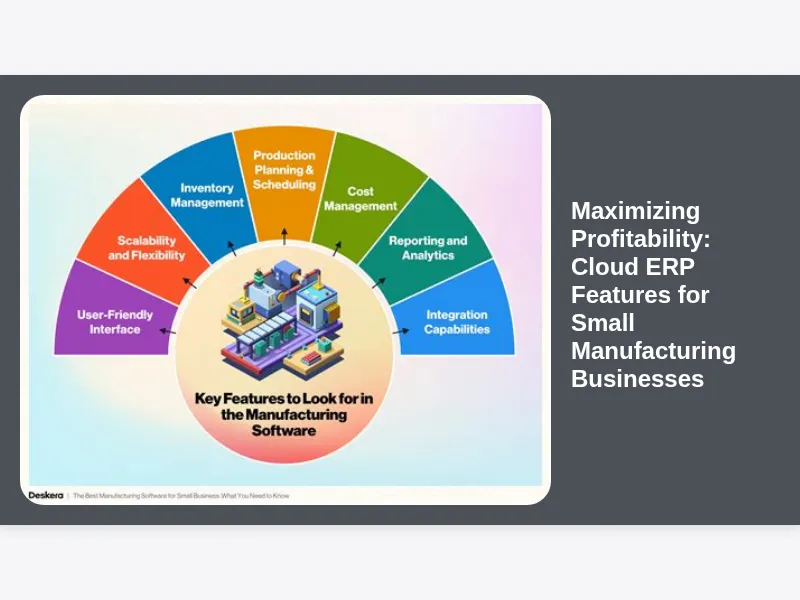
The world of manufacturing, especially for small businesses, is a delicate dance between innovation, efficiency, and market demands. For too long, many small manufacturers have grappled with disjointed systems, manual processes, and a lack of real-time visibility, often leading to missed opportunities and a stagnation in growth. In today’s highly competitive landscape, merely staying afloat isn’t enough; the goal is, and always should be, to thrive and achieve sustainable profitability.
Imagine a scenario where every aspect of your manufacturing operation – from the moment a raw material enters your facility to the point a finished product leaves for a customer – is seamlessly connected, transparent, and optimized. This isn’t a futuristic dream for large corporations; it’s a tangible reality achievable right now for small manufacturing businesses through the strategic adoption of Cloud ERP features. This comprehensive guide will explore how embracing a modern Cloud ERP system can revolutionize your operations, empowering you to make smarter decisions, reduce costs, enhance customer satisfaction, and ultimately, embark on a clear path towards maximizing profitability.
The Evolving Landscape of Small Manufacturing: Navigating Modern Challenges
Small manufacturing businesses operate at the heart of innovation and local economies, but they face a unique set of challenges that can often hinder their growth trajectory. Unlike their larger counterparts, they frequently contend with limited capital, smaller workforces, and fewer resources to invest in advanced technologies. This often translates into reliance on outdated legacy systems or, worse, a patchwork of spreadsheets and manual processes to manage critical operations.
These traditional methods, while seemingly cost-effective in the short term, inevitably lead to inefficiencies, data silos, and a lack of accurate, real-time information. Inventory discrepancies become common, production bottlenecks emerge unexpectedly, and financial reporting lags behind, making agile decision-making nearly impossible. The cumulative effect of these challenges is a significant drag on productivity and, consequently, a direct impact on the profitability of small manufacturing businesses. To truly compete and flourish, these enterprises need a robust, integrated solution that can consolidate operations and provide a single source of truth.
What is Cloud ERP and Why it Matters for Manufacturing Efficiency?
Before diving into the specific features, it’s crucial to understand what Cloud ERP entails and why it has become such a game-changer, particularly for small manufacturing businesses. Enterprise Resource Planning (ERP) systems are integrated software solutions designed to manage all core business processes, from finance and human resources to manufacturing and supply chain management. The “Cloud” aspect simply means that the software and its associated data are hosted and managed by a third-party provider over the internet, rather than being installed and maintained on local servers within your own facility.
This fundamental shift from on-premise to cloud deployment brings a host of immediate advantages. Small manufacturers no longer need to bear the hefty upfront costs of hardware, software licenses, or dedicated IT personnel to maintain the system. Instead, they typically pay a subscription fee, transforming a significant capital expenditure into a manageable operational expense. This accessibility and reduced entry barrier make Cloud ERP an incredibly attractive and viable option for small manufacturing businesses eager to modernize their operations without breaking the bank, directly contributing to their ability to maximize profitability.
Unlocking Efficiency with Advanced Inventory Management Features
Effective inventory management is often the linchpin of profitability for any manufacturing business, and small manufacturers are no exception. Holding too much inventory ties up valuable capital, incurs storage costs, and risks obsolescence. Conversely, holding too little can lead to stockouts, delayed production, missed sales opportunities, and ultimately, dissatisfied customers. This delicate balance is precisely where Cloud ERP features shine, offering sophisticated tools that move beyond basic stock counts.
A robust Cloud ERP provides real-time visibility into inventory levels across all locations, including raw materials, work-in-progress, and finished goods. This means production managers can instantly see what’s available, what’s on order, and what needs to be replenished. Advanced forecasting capabilities, often leveraging historical data and current sales trends, help small manufacturing businesses predict future demand more accurately, enabling them to optimize purchasing and production schedules. This precision significantly reduces carrying costs, minimizes waste from expired or obsolete materials, and ensures that the right components are always available at the right time, thereby directly supporting the goal of maximizing profitability.
Streamlining Production Planning and Scheduling for Optimal Output
For small manufacturing businesses, inefficient production planning and scheduling can quickly erode profits through wasted time, idle machinery, and missed delivery deadlines. Manual scheduling often involves complex spreadsheets and gut feelings, which are prone to errors and difficult to adjust quickly in response to unforeseen events. Cloud ERP features fundamentally transform this process, bringing order, precision, and agility to the factory floor.
Modern Cloud ERP systems offer advanced planning and scheduling (APS) modules that take into account machine capacities, labor availability, material constraints, and customer order priorities. This allows for the creation of optimized production schedules that minimize downtime, maximize throughput, and ensure on-time delivery. When an unexpected issue arises, such as a machine breakdown or a sudden rush order, the system can quickly recalculate and suggest alternative schedules, enabling small manufacturing businesses to adapt swiftly without major disruption. This level of control over production flow is invaluable for cutting operational costs and enhancing output, both critical components of maximizing profitability.
Enhancing Supply Chain Visibility and Vendor Collaboration
A strong, resilient supply chain is paramount for small manufacturing businesses seeking to maintain consistent production and control costs. Yet, many struggle with fragmented communication, delayed information from suppliers, and a lack of overall transparency into their procurement processes. This often leads to reactive decision-making, expediting fees, and supply disruptions that can bring production to a grinding halt.
Cloud ERP features extend their reach beyond internal operations to offer significant improvements in supply chain management. By integrating with supplier portals and providing centralized dashboards, manufacturers can gain real-time insights into the status of purchase orders, material lead times, and supplier performance. This enhanced visibility allows for proactive risk management, helping businesses identify potential delays before they impact production. Furthermore, streamlined communication and automated processes for issuing purchase orders and managing invoices reduce administrative overhead, fostering stronger vendor relationships and potentially securing better terms, all of which contribute positively to the overall profitability of small manufacturing businesses.
Mastering Financial Operations with Integrated Cloud ERP
At the core of any profitable business lies robust financial management, and for small manufacturing businesses, this means more than just balancing the books. It involves meticulous cost tracking, accurate revenue recognition, efficient cash flow management, and insightful financial reporting. Without a unified system, financial data often resides in separate applications or spreadsheets, leading to reconciliation nightmares and delayed insights.
Cloud ERP brings all financial processes under one umbrella, integrating general ledger, accounts payable, accounts receivable, budgeting, and cost accounting functions. This integration ensures that every transaction, from raw material purchase to finished goods sale, is automatically captured and reflected in the financial records. Manufacturers can gain granular control over production costs, analyze profitability by product line, and generate accurate financial statements with ease. The ability to forecast cash flow with greater precision and automate routine financial tasks frees up valuable time for strategic analysis, empowering small manufacturing businesses to make informed decisions that directly impact and enhance their ability to maximize profitability.
Boosting Customer Relationships and Sales Order Management
Customer satisfaction is a key driver of repeat business and long-term profitability, even for small manufacturing businesses primarily focused on B2B operations. However, managing customer expectations, processing sales orders accurately, and providing timely updates can be challenging when information is scattered across different departments and systems. Disjointed processes often lead to order entry errors, delayed responses, and a less-than-stellar customer experience.
Many Cloud ERP systems include or seamlessly integrate with robust Customer Relationship Management (CRM) functionalities and comprehensive sales order management tools. This means sales teams have immediate access to customer history, order status, and available-to-promise inventory levels. Orders can be entered quickly and accurately, automatically triggering production and shipping processes. Customers can receive automated updates, improving transparency and trust. By streamlining the entire order-to-cash cycle and ensuring a consistent, positive customer experience, Cloud ERP features help small manufacturing businesses not only retain existing customers but also attract new ones, directly contributing to increased sales and sustained profitability.
Ensuring Quality Control and Regulatory Compliance
In manufacturing, quality isn’t just a buzzword; it’s a critical factor that directly impacts brand reputation, customer loyalty, and ultimately, profitability. Small manufacturing businesses cannot afford product recalls, excessive rework, or regulatory penalties, which can be devastating. However, implementing consistent quality control measures and tracking compliance manually can be an arduous and error-prone process.
Cloud ERP systems often incorporate robust quality management modules designed to address these critical needs. These features allow manufacturers to define and track quality standards at various stages of the production process, from incoming raw materials inspection to final product testing. Non-conformance issues can be logged, investigated, and resolved systematically, providing a clear audit trail. Furthermore, the system can help ensure compliance with industry-specific regulations and certifications by managing documentation, procedures, and training records. By embedding quality control directly into the operational workflow, Cloud ERP helps small manufacturing businesses minimize defects, reduce scrap, and avoid costly compliance failures, all of which are vital for maximizing profitability and maintaining a competitive edge.
The Power of Real-time Reporting and Business Intelligence
One of the most profound advantages that Cloud ERP features offer to small manufacturing businesses is the ability to transform raw operational data into actionable business intelligence. In traditional environments, critical insights are often delayed, incomplete, or require extensive manual compilation, making it difficult for management to react quickly to changing market conditions or internal performance issues.
Modern Cloud ERP solutions provide integrated, real-time reporting and analytics dashboards that offer a comprehensive view of the entire business. Managers can drill down into key performance indicators (KPIs) such as production efficiency, inventory turnover, sales performance, and financial metrics with just a few clicks. This immediate access to accurate, up-to-date information empowers proactive decision-making. Whether it’s identifying an underperforming product line, optimizing a bottlenecked production step, or re-evaluating pricing strategies, the ability to make data-driven decisions swiftly and confidently is a powerful tool for small manufacturing businesses looking to maximize profitability and gain a significant competitive advantage in their market.
Scalability and Flexibility for Sustained Business Growth
Small manufacturing businesses are, by definition, aiming for growth. However, a common pitfall is outgrowing their existing IT infrastructure, leading to painful and costly system overhauls every few years. This lack of scalability can become a significant barrier to expansion, hindering a company’s ability to capitalize on new opportunities. This is another area where Cloud ERP features present a compelling argument.
The inherent design of Cloud ERP offers unparalleled scalability and flexibility. As a small manufacturing business grows, adding new users, expanding to new locations, or incorporating additional modules (like advanced warehousing or project management) is often a straightforward process, managed by the cloud provider. There’s no need to purchase new servers or dramatically upgrade hardware. This elastic infrastructure ensures that the ERP system can seamlessly adapt to increased transaction volumes and evolving business needs without major disruptions or significant capital expenditure. This future-proofing aspect allows small manufacturing businesses to focus their resources on innovation and market expansion, confident that their foundational system can keep pace with their ambitions for maximizing profitability.
Fortifying Data Security in the Cloud Era: A Top Priority
For many small manufacturing businesses considering a move to the cloud, data security often emerges as a primary concern. The idea of business-critical information being hosted off-site can feel daunting, leading some to stick with less secure, on-premise solutions. However, modern Cloud ERP providers have invested heavily in robust security measures that often surpass what a small business could realistically implement on its own.
Reputable Cloud ERP vendors employ multi-layered security protocols, including advanced encryption, regular backups, disaster recovery plans, and stringent access controls. They adhere to industry compliance standards (like ISO 27001) and often have dedicated security teams monitoring their infrastructure 24/7. This level of professional security management means that a small manufacturing business gains access to enterprise-grade protection against cyber threats, data loss, and unauthorized access, without the need for extensive internal IT resources. Trusting your data to a secure Cloud ERP provider not only safeguards your valuable information but also allows you to focus on your core manufacturing operations, contributing to peace of mind and, indirectly, to maximizing profitability.
The Mobile Advantage: ERP at Your Fingertips, Anywhere, Anytime
In today’s fast-paced manufacturing environment, decision-making and operational oversight are no longer confined to the office desk. Small manufacturing businesses, particularly those with dynamic production floors, multiple facilities, or mobile sales teams, benefit immensely from the ability to access critical business information on the go. This is a significant advantage that modern Cloud ERP features inherently offer.
Mobile ERP applications, accessible via smartphones and tablets, empower employees from the shop floor to the executive suite to perform essential tasks and access real-time data from any location with an internet connection. Production supervisors can check inventory levels or update job statuses directly from the assembly line. Sales representatives can generate quotes, check product availability, and place orders while on-site with a customer. Management can review dashboards and approve transactions even when traveling. This ubiquitous access to information improves responsiveness, enhances collaboration, and accelerates decision-making, leading to greater operational agility and directly supporting the efforts of small manufacturing businesses in maximizing profitability by optimizing efficiency wherever their team members are.
Seamless Integration: Connecting Your Entire Business Ecosystem
While Cloud ERP features are comprehensive, no single system can do everything, especially when a small manufacturing business might already be using specialized software for CAD design, e-commerce, or advanced marketing automation. The challenge then becomes how to make these disparate systems communicate effectively, avoiding data duplication and ensuring a consistent flow of information across the entire business ecosystem.
A key strength of modern Cloud ERP solutions lies in their ability to offer seamless integration capabilities. Through open APIs (Application Programming Interfaces) and pre-built connectors, Cloud ERP can effectively “talk” to other critical business applications. This creates a unified data environment where information entered in one system automatically updates another, eliminating manual data entry, reducing errors, and ensuring a single source of truth. For instance, an order placed on an e-commerce platform can automatically create a sales order in ERP, which then triggers production planning. This level of interconnectedness streamlines workflows, improves data accuracy, and provides a holistic view of the business, enabling small manufacturing businesses to optimize operations and make more informed decisions, crucial for maximizing profitability.
Overcoming Implementation Hurdles and Choosing the Right Solution
Adopting a new ERP system, even a cloud-based one, can seem like a daunting undertaking for small manufacturing businesses. Concerns about data migration, employee training, and potential disruption to operations are natural. However, with careful planning and the right approach, these hurdles can be effectively managed, paving the way for significant long-term benefits.
The first critical step is choosing the right Cloud ERP solution. This involves thoroughly assessing your business’s specific needs, budget, and future growth plans. Look for vendors with a proven track record in the manufacturing sector and experience working with businesses of your size. Pay close attention to the features discussed throughout this article, prioritizing those that address your most pressing pain points. During implementation, a phased approach can minimize disruption, and comprehensive training for all users is essential to ensure high adoption rates. Engaging a reputable implementation partner can also provide invaluable expertise and guidance, helping small manufacturing businesses navigate the transition smoothly and quickly realize the transformative potential of their new Cloud ERP, accelerating their journey towards maximizing profitability.
Measuring ROI: The Tangible Impact on Your Bottom Line
For any significant investment, especially in technology, small manufacturing businesses need to see a clear return on investment (ROI). While some benefits of Cloud ERP features, like improved employee morale or better customer satisfaction, are qualitative, many others can be directly quantified, demonstrating a compelling financial case for adoption.
The tangible impacts of a well-implemented Cloud ERP on profitability are numerous. Expect to see significant reductions in operational costs due to optimized inventory, streamlined production, and reduced administrative overhead. Increased efficiency across all departments leads to higher productivity, allowing more output with the same or fewer resources. Reduced errors and improved quality control minimize waste and rework costs. Faster order fulfillment and enhanced customer service can drive increased sales and customer retention. When these factors are combined, the financial benefits quickly add up, allowing small manufacturing businesses to not only recover their initial investment but also to achieve sustained growth and a substantial increase in their overall profitability. Regular monitoring of key metrics post-implementation will help track and celebrate these gains.
Cultivating a Culture of Continuous Improvement Through Data
Implementing Cloud ERP features is not a one-time fix; rather, it’s an ongoing journey toward operational excellence and maximizing profitability. For small manufacturing businesses, the true long-term value of such a system lies in its ability to foster a culture of continuous improvement. By providing a constant stream of accurate, real-time data, ERP empowers every level of the organization to identify inefficiencies, experiment with solutions, and measure the impact of their changes.
The analytical tools within Cloud ERP allow for deep dives into production cycles, supply chain bottlenecks, sales patterns, and customer feedback. This readily available information encourages teams to move beyond guesswork and base their decisions on evidence. For example, production managers can analyze historical data to fine-tune machine maintenance schedules, preventing costly breakdowns. Procurement teams can evaluate supplier performance to negotiate better terms. This iterative process of analysis, action, and measurement becomes ingrained in the company’s DNA, leading to sustained operational refinements and an enduring upward trend in profitability.
The Future of Manufacturing: Embracing Innovation with Cloud ERP
The manufacturing industry is in a constant state of evolution, driven by technological advancements like Artificial Intelligence (AI), the Internet of Things (IoT), and advanced robotics. While these might seem like technologies reserved for large enterprises, Cloud ERP features act as a crucial enabler for small manufacturing businesses to embrace these innovations without needing massive upfront investments.
A modern Cloud ERP system provides the foundational data infrastructure and integration capabilities necessary to incorporate these emerging technologies. For instance, IoT sensors on machinery can feed real-time performance data directly into the ERP, enabling predictive maintenance and further optimizing production schedules. AI-powered analytics can uncover deeper insights from ERP data, enhancing demand forecasting or optimizing pricing strategies. By acting as the central nervous system for their operations, Cloud ERP positions small manufacturing businesses to adopt future technologies more easily, staying competitive and innovative, and continually discovering new avenues for maximizing profitability in an ever-changing industrial landscape.
Real-World Transformations: Success Stories of Small Manufacturers
Across various sectors, countless small manufacturing businesses have already embarked on their Cloud ERP journey, experiencing profound transformations that underscore the powerful capabilities discussed in this article. Consider a custom cabinetry maker who, struggling with inconsistent lead times and frequent material shortages, implemented a Cloud ERP system. Within six months, they reduced inventory holding costs by 20% and improved on-time delivery rates from 70% to 95%, leading to a significant boost in customer referrals and a substantial increase in revenue.
Another example is a specialized metal fabrication shop that was bogged down by manual financial reconciliation and opaque production costs. By adopting Cloud ERP, they gained clear visibility into job costing, identified inefficiencies in their welding process, and automated their invoicing. This resulted in a 15% reduction in administrative overhead and a clearer understanding of their most profitable product lines, allowing them to strategically focus their efforts. These simulated success stories highlight a common thread: Cloud ERP isn’t just a cost center; it’s a strategic investment that pays dividends by empowering small manufacturing businesses to streamline operations, enhance decision-making, and ultimately achieve their goals of maximizing profitability and sustainable growth.
Conclusion: Your Path to Sustainable Profitability with Cloud ERP
The journey of maximizing profitability for small manufacturing businesses in today’s dynamic global market demands more than just hard work; it requires smart work and strategic adoption of empowering technology. For too long, the perceived complexity and cost of integrated enterprise systems kept these vital tools out of reach for smaller operations. However, the advent and maturation of Cloud ERP features have irrevocably changed this landscape, making advanced operational management accessible, affordable, and incredibly powerful.
From optimizing inventory and streamlining production to gaining real-time financial insights and fostering stronger customer relationships, Cloud ERP provides a unified platform that addresses the core challenges faced by small manufacturers. It offers the scalability to grow without disruptive system overhauls, the security to protect vital data, and the flexibility to adapt to an evolving business environment. By embracing these innovative Cloud ERP features, small manufacturing businesses are not just investing in software; they are investing in their future, building a resilient, efficient, and highly profitable enterprise ready to thrive for years to come. The time to unlock your full potential and embark on this transformative path is now.