# From Chaos to Control: Implementing Cloud ERP in Small Manufacturing

In the dynamic and often tumultuous world of small manufacturing, the line between thriving and merely surviving can be razor-thin. Many small manufacturers grapple daily with a complex web of manual processes, disconnected systems, and fragmented data, leading to what often feels like an unending state of operational chaos. Orders might be misplaced, inventory counts are frequently inaccurate, production schedules face constant delays, and gaining a clear financial picture can feel like searching for a needle in a haystack. This lack of centralized visibility and control not only drains resources but also stifles growth, making it incredibly difficult to compete in an increasingly digital marketplace.

Imagine a scenario where every aspect of your manufacturing operation – from raw material procurement to finished goods delivery – is seamlessly integrated and visible in real-time. Picture having the power to make informed decisions based on accurate, up-to-the-minute data, optimize every process, and respond swiftly to market changes. This isn't a pipe dream for large enterprises with colossal IT budgets; it's a tangible reality for small manufacturers willing to embrace the transformative potential of modern technology. The journey **from chaos to control** is not just possible, but imperative for sustained success, and it begins with a strategic investment in the right digital tools, chief among them being **Cloud ERP in small manufacturing**. This comprehensive article will guide you through understanding, selecting, and implementing a **Cloud ERP system** that can redefine your operational efficiency and pave the way for unprecedented growth.

## Understanding the "Chaos" in Small Manufacturing: Common Operational Bottlenecks

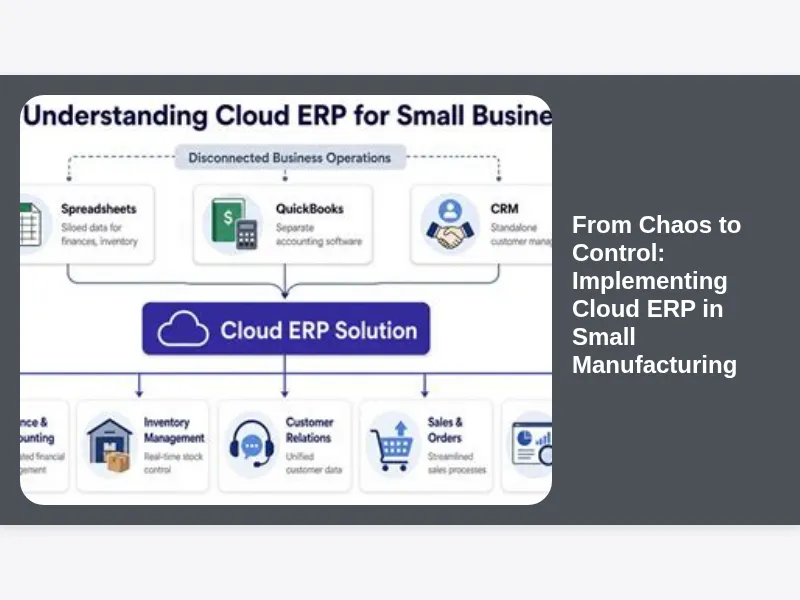
Small manufacturing operations, despite their agility and often tight-knit teams, frequently encounter a unique set of challenges that breed inefficiency and frustration. These aren't just minor inconveniences; they are fundamental flaws that can undermine profitability and prevent scaling. One of the most prevalent issues is the reliance on disparate systems and manual data entry. Imagine accounting software that doesn't talk to inventory management, which in turn has no connection to production scheduling or customer orders. This fragmented landscape creates data silos, where critical information is isolated, making it impossible to get a holistic view of the business.

This lack of integration leads directly to a cascade of problems. Inventory levels become a constant guessing game, resulting in either costly overstocking of slow-moving items or crippling stockouts of essential components, halting production lines and delaying customer orders. Production scheduling, often managed with spreadsheets or even whiteboards, becomes a daily exercise in firefighting, reacting to immediate crises rather than proactively planning. Quality control might be inconsistent, customer service struggles to provide accurate order statuses, and financial reporting becomes a retroactive analysis rather than a forward-looking strategic tool. This environment of reactive decision-making and manual reconciliation is the very definition of operational **chaos**, making the pursuit of **control** an urgent priority for any ambitious small manufacturer.

## What is Cloud ERP and Why Small Manufacturers Need This Solution?

At its core, ERP stands for Enterprise Resource Planning, a system designed to integrate all facets of an operation, including product planning, development, manufacturing, sales, and marketing. Traditionally, ERP systems were complex, expensive, on-premise installations requiring significant IT infrastructure and dedicated personnel, putting them out of reach for most small businesses. However, the advent of **Cloud ERP** has democratized this powerful technology, making it accessible and affordable for companies of all sizes, especially **small manufacturing**. Instead of hosting the software on your own servers, a **Cloud ERP solution** is delivered over the internet as a service, managed by a third-party provider. This means your data and applications reside in a secure, remote data center, accessible anytime, anywhere, from any device with an internet connection.

For small manufacturers, this shift from traditional to **Cloud ERP** is nothing short of revolutionary. It eliminates the need for hefty upfront investments in hardware and software licenses, replacing them with predictable monthly or annual subscription fees. The burden of IT maintenance, updates, and security is offloaded to the vendor, allowing your team to focus on what they do best: manufacturing. Beyond cost savings and reduced IT overhead, **Cloud ERP for small manufacturing** offers unparalleled flexibility and scalability. As your business grows, your ERP system can easily expand to accommodate increased users, data, and functionalities without requiring a complete system overhaul. This agility is crucial for small businesses looking to adapt quickly to market demands and maintain a competitive edge.

## The Promise of Control: How Cloud ERP Transforms Operations

The allure of **Cloud ERP** for small manufacturing lies in its promise of profound operational transformation, moving businesses definitively **from chaos to control**. By unifying disparate data points and processes into a single, integrated system, it provides a centralized source of truth for your entire organization. Imagine logging into a single dashboard and seeing real-time updates on inventory levels, production schedules, sales orders, financial performance, and customer interactions. This level of transparency empowers management to make data-driven decisions swiftly and confidently, replacing guesswork with insight.

The transformation extends across every department. In sales, teams can access accurate product availability and pricing instantly, improving customer service and order fulfillment. Production managers gain a clear view of resource allocation, machine capacity, and work-in-progress, enabling them to optimize schedules and minimize bottlenecks. Finance teams benefit from automated processes, accurate reporting, and simplified compliance, freeing them from tedious manual tasks. Ultimately, a well-implemented **Cloud ERP system** doesn't just streamline existing processes; it redefines them, creating a more efficient, agile, and responsive manufacturing operation. This newfound **control** allows small manufacturers to focus on innovation, product quality, and market expansion, rather than being bogged down by day-to-day operational headaches.

## Inventory Management: Taming the Warehouse Wild West with Optimized Inventory Management

One of the most significant areas where small manufacturers experience chaos is in inventory management. Without a robust system, inventory can feel like a "wild west" of unreliable counts, misplaced items, and costly errors. Overstocking ties up valuable capital and space, leading to obsolescence, while understocking causes production delays, missed sales opportunities, and frustrated customers. Traditional methods often involve manual counting, spreadsheets, or basic accounting software that lacks real-time tracking and intelligent forecasting capabilities. This results in reactive purchasing decisions and a constant struggle to balance supply and demand.

**Cloud ERP solutions** revolutionize inventory management by providing real-time visibility into every item, from raw materials to finished goods. It tracks inventory movement across multiple locations, manages batch and lot numbers, and automates reorder points based on historical data and projected demand. With features like barcode scanning and integration with warehousing systems, human error is drastically reduced. This leads to significantly **optimized inventory management**, ensuring you have the right stock, at the right place, at the right time. Manufacturers can minimize carrying costs, reduce waste, improve cash flow, and most importantly, prevent production halts due to material shortages, allowing them to deliver on customer promises consistently.

## Streamlining Production Processes: From Manual Mayhem to Automated Efficiency

The production floor in many small manufacturing facilities often resembles a scene of manual mayhem, characterized by fragmented workflows, paper-based instructions, and a lack of real-time insight into manufacturing progress. Schedules are frequently adjusted on the fly, machine downtime goes unreported, and bottlenecks remain undetected until they bring operations to a standstill. This reactive approach not only delays orders but also leads to wasted materials, increased labor costs, and compromised product quality. The absence of a unified system to manage the entire production lifecycle makes achieving consistent **production efficiency** an uphill battle.

**Cloud ERP systems** bring unprecedented order and automation to the manufacturing process. They integrate production planning, scheduling, and execution into a single platform. Manufacturers can create detailed Bills of Material (BOMs), manage routings, track work orders, and monitor machine performance in real-time. This allows for precise scheduling, optimal resource allocation, and proactive identification of potential delays or issues. With data flowing seamlessly from sales to production, the system can automatically trigger production orders based on demand, eliminating manual handoffs and reducing errors. This shift **from chaos to control** in production management allows small manufacturers to achieve higher output, reduce lead times, improve product consistency, and ultimately enhance their competitive position.

## Sales and Customer Relationship Management (CRM): Building Stronger Bonds

In the absence of an integrated system, managing sales and customer relationships in small manufacturing can be a disjointed and frustrating experience. Sales teams might operate with outdated product information or unclear inventory levels, leading to incorrect quotes and missed promises. Customer inquiries about order status often require internal investigations across multiple departments, delaying responses and eroding trust. Without a centralized repository for customer interactions, understanding customer history, preferences, and issues becomes a Herculean task, hindering efforts to build loyalty and drive repeat business.

Many modern **Cloud ERP solutions** include robust CRM functionalities or offer seamless integration with leading CRM platforms. This means that customer data, sales orders, quotes, pricing, order history, and communication logs are all unified within the ERP system. Sales representatives gain instant access to accurate product availability, pricing, and customer-specific discounts, enabling them to generate precise quotes and confirm delivery dates confidently. Furthermore, customer service teams can quickly access a complete 360-degree view of each customer, including their purchase history, support tickets, and previous interactions, allowing them to provide personalized and efficient support. This **integrated CRM** capability not only streamlines the sales process but also significantly enhances the customer experience, fostering stronger relationships and encouraging long-term loyalty.

## Financial Clarity and Strategic Insight: Beyond the Balance Sheet

For many small manufacturers, financial management often extends no further than basic accounting software, which, while capable of managing ledgers, rarely provides the depth of insight needed for strategic decision-making. Reconciling inventory values with actual stock, tracking true production costs, or forecasting cash flow accurately often requires tedious manual data extraction and manipulation. This reactive approach means that financial reports are typically historical snapshots rather than tools for forward-looking strategy, making it difficult to identify areas of profitability or loss, manage cash flow effectively, or make informed investment decisions.

**Cloud ERP for small manufacturing** transforms financial management by integrating it directly with all operational activities. Every sales order, purchase order, production run, and inventory movement automatically updates the financial ledger. This provides real-time **financial visibility**, allowing businesses to track costs associated with specific projects, products, or production lines with unparalleled accuracy. Features like automated invoicing, expense management, fixed asset tracking, and comprehensive general ledger functionality streamline daily tasks. Beyond basic accounting, **Cloud ERP** provides powerful reporting and analytics tools that go far beyond a simple balance sheet. Manufacturers can generate custom reports on profitability by product line, analyze cost variances, forecast cash flow, and conduct in-depth financial performance analysis, empowering them to make strategic decisions that drive growth and optimize profitability.

## Supply Chain Synergy: Connecting the Dots from Supplier to Customer

Small manufacturers often struggle with fragmented supply chains, where communication with suppliers is manual, purchase orders are tracked in isolation, and inbound logistics lack real-time visibility. This leads to delays in material arrivals, missed delivery windows, and an inability to adapt quickly to supplier issues or market fluctuations. Similarly, outbound logistics, from packaging to shipping, can be inefficient, causing delays and increasing transportation costs. The lack of synergy across the entire supply chain creates vulnerabilities and reduces responsiveness, making it challenging to deliver products on time and within budget.

A **Cloud ERP system** acts as the central nervous system for your supply chain, connecting every node **from supplier to customer**. It automates procurement processes, generates purchase orders based on real-time inventory levels and production schedules, and provides a centralized platform for supplier communication and management. Manufacturers can track inbound shipments, manage vendor performance, and optimize purchasing decisions to secure better pricing and terms. On the outbound side, **Cloud ERP** integrates with shipping carriers, automates order fulfillment, and provides real-time tracking information to customers. This comprehensive **supply chain optimization** minimizes disruptions, reduces lead times, cuts logistics costs, and ensures that raw materials arrive when needed and finished goods reach customers promptly, enhancing overall operational efficiency and customer satisfaction.

## The Digital Transformation Journey: Stepping Towards a Smarter Future

Embracing **Cloud ERP in small manufacturing** is not merely an IT project; it's a fundamental step in a broader **digital transformation journey**. In today's competitive landscape, businesses that fail to digitize their core operations risk being left behind. Digital transformation means leveraging technology to fundamentally change how you operate, deliver value to customers, and interact with your ecosystem. For small manufacturers, this involves moving away from outdated manual processes and siloed data towards an integrated, data-driven, and agile operational model. It's about building a foundation that supports innovation and prepares the business for future growth.

A **Cloud ERP system** provides the crucial backbone for this transformation. It centralizes all business data, making it accessible and actionable. It automates repetitive tasks, freeing up human capital for more strategic activities. It provides the tools for real-time monitoring and analysis, enabling proactive decision-making. By consolidating functions like inventory, production, sales, finance, and CRM into one platform, **Cloud ERP** facilitates a holistic view of the business, breaking down departmental barriers and fostering collaboration. This move towards a smarter, digitally integrated future not only enhances current performance but also builds resilience and adaptability, positioning the small manufacturer to thrive amidst evolving market demands and technological advancements.

## Choosing the Right Cloud ERP System: A Decision-Making Framework

The market for **Cloud ERP solutions** is vast and varied, making the selection process a critical step that requires careful consideration. For small manufacturers, it's not about finding the most feature-rich or expensive system, but rather the one that best aligns with their specific needs, budget, and growth aspirations. A well-structured **decision-making framework** is essential to navigate this landscape effectively. Begin by clearly defining your current pain points and future requirements. What are the key operational challenges you're trying to solve? What functionalities are absolutely essential (e.g., strong inventory management, robust production scheduling)? What are your long-term growth plans, and how should the ERP system support them?

Once your requirements are clear, research vendors that specialize in **Cloud ERP for small manufacturing**. Look for systems that are designed with manufacturing-specific features, rather than generic ERPs. Evaluate key factors such as industry-specific capabilities, ease of use, scalability, integration options with other tools you might use (e.g., CAD software, eCommerce platforms), and the vendor's reputation for customer support and implementation services. Don't overlook the importance of pricing models and the total cost of ownership, which includes subscription fees, implementation costs, training, and ongoing support. Request demos from a shortlist of vendors, involving key stakeholders from different departments, to see how each system addresses your unique workflows. The goal is to select a **Cloud ERP solution** that offers a compelling blend of functionality, usability, support, and value, ensuring a successful transition and long-term benefits.

## Implementing Cloud ERP: A Roadmap to Success with ERP Implementation Best Practices

The successful implementation of a **Cloud ERP system** is not just about installing software; it's a strategic project that requires careful planning, dedicated resources, and a clear understanding of the steps involved. Approaching implementation without a well-defined **roadmap to success** can lead to delays, budget overruns, and user resistance. The journey typically begins with a thorough discovery phase, where your implementation partner (often the ERP vendor or a specialized consultant) works with your team to map out current processes, identify customization needs, and define project scope and timelines. This foundational step is crucial for ensuring the system is configured to meet your unique operational requirements.

Following discovery, the system configuration and data migration phase begins. This involves setting up the ERP modules, configuring workflows, and, critically, transferring your existing data (customer information, product catalogs, historical transactions, etc.) from old systems into the new **Cloud ERP**. Data cleanliness is paramount here; "garbage in, garbage out" applies emphatically. User training is another vital component of **ERP implementation best practices**. Your team needs to be comfortable and proficient with the new system, so comprehensive and ongoing training tailored to different roles is essential for driving user adoption. Finally, a rigorous testing phase, including user acceptance testing, ensures that the system performs as expected before the official go-live. Post-implementation support and continuous optimization are also key to maximizing the return on your investment in **Cloud ERP in small manufacturing**.

## Overcoming Challenges in Cloud ERP Adoption: Addressing ERP Adoption Challenges

While the benefits of **Cloud ERP** are significant, the journey to full adoption is not without its hurdles. Small manufacturers, particularly those new to advanced digital systems, may encounter various **ERP adoption challenges** that need proactive management. One of the most common challenges is resistance to change from employees. People are naturally accustomed to their old ways of working, even if those ways are inefficient. Without proper communication, training, and a clear articulation of "what's in it for them," employees may view the new system as an added burden rather than an empowering tool, hindering its effectiveness.

Another significant challenge can be data migration. Transferring years of historical data from various spreadsheets and legacy systems into a new, integrated ERP can be complex, time-consuming, and prone to errors if not managed carefully. Data quality issues, inconsistencies, and duplicates can surface during this process, requiring significant effort to clean and standardize. Technical integration with existing specialized software (e.g., CAD, specific machine controllers) can also pose challenges if the chosen **Cloud ERP system** doesn't offer robust API or pre-built connectors. To overcome these obstacles, strong leadership and executive sponsorship are critical, championing the project and communicating its strategic importance. Investing in thorough training, providing accessible support, and celebrating early successes can significantly ease the transition and foster a positive environment for **Cloud ERP adoption**, ultimately leading your small manufacturing business **from chaos to control**.

## Measuring Success: KPIs and ROI from Your Cloud ERP Investment

Once your **Cloud ERP system** is up and running, it's vital to measure its impact to ensure you're realizing the promised benefits and achieving a positive **ROI from your Cloud ERP investment**. Simply having the system in place isn't enough; you need to quantify the improvements. Before implementation, establish clear Key Performance Indicators (KPIs) that directly relate to your initial pain points and goals. These might include metrics like inventory turnover rate, on-time delivery percentage, production cycle time, order fulfillment accuracy, cost of goods sold, accounts payable/receivable days, and customer satisfaction scores.

After implementation, regularly track these KPIs against your baseline data. A robust **Cloud ERP system** will provide the reporting and analytics tools to generate these metrics automatically, making performance measurement much easier. Look for improvements in efficiency, reductions in operational costs, decreases in inventory discrepancies, and increases in customer satisfaction. The financial return on investment can be calculated by comparing the total cost of the ERP system (including implementation, subscription fees, and training) against the quantifiable savings and revenue gains it generates. These might include reduced labor costs due to automation, lower carrying costs from optimized inventory, increased sales efficiency, and better resource utilization. Presenting clear data on **measuring ERP ROI** helps justify the investment and demonstrates the profound transformation **from chaos to control** that the system has brought to your small manufacturing business.

## Data Security and Cloud ERP: Protecting Your Most Valuable Assets

A common concern for small manufacturers considering **Cloud ERP** is data security. Entrusting sensitive business information – including intellectual property, customer data, financial records, and operational secrets – to a third-party cloud provider can understandably raise questions about its safety. However, it's crucial to understand that reputable **Cloud ERP vendors** invest heavily in security infrastructure and protocols that often far exceed what a small manufacturing business could afford or manage on its own. They employ dedicated cybersecurity experts, adhere to stringent compliance standards, and implement state-of-the-art technologies to protect your most valuable assets.

Modern **Cloud ERP solutions** typically incorporate multiple layers of security, including robust encryption for data in transit and at rest, multi-factor authentication, regular security audits, intrusion detection systems, and comprehensive disaster recovery plans. Vendors also employ physical security measures for their data centers and maintain compliance with various industry-specific regulations and international standards (e.g., ISO 27001, SOC 2). When selecting a **Cloud ERP system**, thoroughly vet the vendor's security practices, ask about their data privacy policies, and review their service level agreements (SLAs) regarding uptime and data protection. By choosing a trusted provider, small manufacturers can leverage enterprise-grade **cloud security** without the burden of managing it themselves, ensuring their critical business data is safeguarded against threats and breaches.

## Scalability and Future Growth: Preparing for Tomorrow's Opportunities with Scalable ERP Solutions

For ambitious small manufacturers, the chosen technology infrastructure must not only address current challenges but also support future growth. A significant advantage of **Cloud ERP in small manufacturing** is its inherent **scalability**. Unlike on-premise systems that require substantial hardware upgrades and manual configuration whenever your business expands, cloud-based solutions are designed to grow with you effortlessly. As your order volume increases, you add new product lines, expand into new markets, or onboard more employees, your Cloud ERP system can adapt without significant disruption or prohibitive additional costs.

This means you can start with the modules and functionalities you need today and easily add more as your business evolves. Need to integrate with an eCommerce platform? Expanding into international markets and require multi-currency or multi-language capabilities? Implementing advanced analytics or IoT connectivity? **Scalable ERP solutions** can accommodate these future demands by simply activating new features or upgrading your subscription. This flexibility protects your initial investment and ensures that your ERP system remains a strategic asset rather than becoming a bottleneck. By selecting a **Cloud ERP** that prioritizes scalability, small manufacturers are not just solving today's problems but are actively building a future-proof foundation that positions them to seize tomorrow's opportunities and sustain their journey **from chaos to control**.

## Integration with Existing Systems: Harmonizing Your Tech Stack through ERP Integration

In reality, most small manufacturing businesses don't operate with a completely blank technological slate. They often have existing specialized software for design (CAD/CAM), shop floor control, or other niche functions that are critical to their operations. A key consideration for **Cloud ERP in small manufacturing** is how well it can integrate with these existing systems. The goal isn't to replace everything, but to create a harmonized tech stack where all critical applications can communicate and share data seamlessly. Poor integration can negate many of the benefits of an ERP, leading to new data silos and operational headaches.

Reputable **Cloud ERP solutions** offer robust **ERP integration** capabilities, typically through Application Programming Interfaces (APIs) or pre-built connectors. These allow the ERP to exchange data with other enterprise applications, ensuring that information flows freely across your entire digital ecosystem. For instance, design specifications from a CAD system can automatically populate BOMs in the ERP, or sales data from an eCommerce platform can directly feed into order processing. When evaluating potential Cloud ERP systems, inquire about their integration frameworks, the availability of standard connectors for common industry software, and the ease with which custom integrations can be developed if needed. A well-integrated ERP system ensures that your existing valuable tools continue to function effectively while benefiting from the centralized control and visibility that the ERP provides.

## Training and User Adoption: Empowering Your Team with User Training

Even the most powerful **Cloud ERP system** will fail to deliver its full potential if your team members are unwilling or unable to use it effectively. Therefore, comprehensive **user training** and a thoughtful strategy for fostering adoption are absolutely critical for successful implementation in small manufacturing. Simply providing a manual or a single training session is rarely sufficient. People learn at different paces and require training tailored to their specific roles and responsibilities within the system. Production floor staff will need different training than finance personnel or sales representatives.

The training process should start early in the implementation cycle, providing an introduction to the new system's interface and basic navigation. As the system gets configured, more detailed, role-specific training sessions should be conducted, allowing users to practice with real-world scenarios. It's also beneficial to identify and empower "super-users" or "champions" within each department who can serve as internal resources and peer mentors after the formal training concludes. Ongoing support, refresher courses, and accessible documentation are also vital for sustaining proficiency and addressing any new questions that arise. By investing in thorough **user training** and creating a supportive environment for learning, small manufacturers can ensure that their team fully embraces the **Cloud ERP system**, unlocking its potential to drive efficiency and transition the business definitively **from chaos to control**.

## The Long-Term Impact: Sustained Control and Competitive Advantage

The decision to move **from chaos to control** through the implementation of **Cloud ERP in small manufacturing** is not just about solving immediate problems; it's about securing a long-term competitive advantage. The sustained control gained from a unified, real-time operational view allows businesses to become more agile, responsive, and efficient. This translates directly into tangible benefits that compound over time: reduced operational costs, improved product quality, faster time-to-market, enhanced customer satisfaction, and the ability to make more strategic, data-driven decisions. Small manufacturers that leverage **Cloud ERP** can punch above their weight, competing effectively with larger players by optimizing their internal processes and focusing on innovation.

Furthermore, a well-implemented **Cloud ERP system** provides a solid foundation for continuous improvement and innovation. With robust data at their fingertips, small manufacturers can identify new opportunities for optimization, experiment with new production methods, and rapidly adapt to market shifts. The visibility into every aspect of the business allows for proactive problem-solving rather than reactive firefighting. This sustained state of **control** empowers leadership to focus on strategic growth initiatives, knowing that the operational backbone of the business is strong and reliable. In an increasingly complex and competitive global marketplace, the long-term impact of **Cloud ERP** is nothing less than the transformation of a small manufacturing operation into a lean, efficient, and highly competitive enterprise, ready for whatever the future holds.

## Conclusion: Embracing the Future of Small Manufacturing with Cloud ERP

The journey **from chaos to control** is an essential narrative for any small manufacturing business aspiring to thrive in the modern era. The complexities of managing inventory, production, sales, and finances through fragmented systems or manual processes are no longer sustainable. They lead to inefficiencies, stifle growth, and prevent businesses from reaching their full potential. The good news is that a powerful, accessible solution exists: **Cloud ERP for small manufacturing**. This technology has democratized enterprise-grade operational excellence, making it a viable and transformative investment for companies of all sizes.

By embracing a **Cloud ERP system**, small manufacturers can unify their operations, gain real-time visibility, automate tedious tasks, and make truly informed decisions. It's about taming the inventory wild west, streamlining production, forging stronger customer bonds, and achieving unparalleled financial clarity. The path involves careful selection, meticulous implementation, and a commitment to user training, but the rewards are profound: sustained control, enhanced efficiency, significant cost savings, and a robust foundation for future growth. The future of small manufacturing is digital, integrated, and data-driven. The time to shed the shackles of operational chaos and step into an era of unprecedented control and competitive advantage with **Cloud ERP** is now. Your journey to a smarter, more profitable manufacturing future begins here.

---
*Disclaimer: This article provides general information and recommendations. For specific advice tailored to your business, it is recommended to consult with ERP consultants and industry experts. When incorporating trusted sources into a live article, ensure to use current, verifiable links from reputable industry publications, research firms (e.g., Gartner, Forrester), ERP vendor case studies, or academic journals.*