The manufacturing world, especially for small to medium-sized enterprises (SMEs), is undergoing a profound transformation. Gone are the days when sophisticated data tools were exclusively for industrial giants. Today, even the leanest operations can leverage powerful technology to gain a competitive edge. This article delves into how Data Analytics and Cloud ERP for Predictive Insights in Small Manufacturing are not just buzzwords, but essential tools for survival and growth, offering a pathway to efficiency, foresight, and unprecedented agility in an ever-evolving market.
The Small Manufacturing Landscape: Navigating Modern Challenges
Small manufacturing businesses are the backbone of many economies, yet they face a unique set of challenges. Resource constraints, limited capital, and a highly competitive global marketplace often force these enterprises into a reactive mode, constantly putting out fires rather than proactively planning for the future. They grapple with fluctuating raw material costs, unpredictable supply chain disruptions, tight production schedules, and the constant pressure to maintain high-quality standards with lean teams. The ability to forecast demand, optimize inventory, and predict equipment failures can mean the difference between thriving and merely surviving.
Historically, the solutions to these problems were often manual, relying on experienced but fallible human judgment and fragmented spreadsheets. This approach, while familiar, inherently limits visibility and scalability. Without a centralized system to capture, store, and analyze operational data, critical insights remain hidden, leaving small manufacturers vulnerable to inefficiencies, missed opportunities, and costly mistakes. The ambition to grow often clashes with the reality of operational complexities, making the adoption of modern, integrated solutions not just an advantage, but a necessity.
Demystifying Cloud ERP Systems for Small Businesses
Cloud Enterprise Resource Planning (ERP) represents a paradigm shift from traditional, on-premise software. Instead of installing and maintaining complex systems on local servers, Cloud ERP solutions are hosted on the internet and delivered as a service, accessible from anywhere with an internet connection. For small manufacturers, this dramatically lowers the barrier to entry for enterprise-grade tools, eliminating the need for significant upfront hardware investments, dedicated IT staff, and ongoing maintenance headaches. It transforms what was once a capital expenditure into a more manageable operational expense.
Beyond the cost savings, Cloud ERP provides a unified platform that integrates various core business functions. From procurement and inventory management to production planning, sales, finance, and human resources, all data flows into a single, cohesive system. This integration is crucial because it breaks down information silos that plague many small businesses, allowing different departments to access consistent, real-time data. This shared source of truth is the foundational layer upon which advanced analytical capabilities can be built, setting the stage for achieving predictive insights in small manufacturing. The agility and accessibility offered by the cloud environment mean that critical operational data is always at your fingertips, enabling faster, more informed decision-making.
Unpacking Data Analytics: A Powerhouse for Manufacturing Operations
Data analytics is the process of examining raw data to extract meaningful information, identify trends, and draw conclusions that can be used to improve business processes. For small manufacturers, this goes far beyond simply looking at past sales figures. It encompasses a spectrum of analytical approaches, from descriptive analytics that tells you “what happened,” to diagnostic analytics that explains “why it happened,” to the highly coveted predictive analytics that forecasts “what will happen,” and even prescriptive analytics that suggests “what should be done.” Each layer builds upon the last, providing progressively deeper and more actionable insights.
In a manufacturing context, data analytics can scrutinize everything from machine performance logs and sensor data to production output, scrap rates, inventory levels, and customer order histories. By applying statistical models and algorithms to this vast array of information, patterns emerge that would be invisible to the human eye. This capability is paramount for identifying bottlenecks, forecasting demand fluctuations, optimizing resource allocation, and maintaining quality control. Ultimately, the goal is to transform raw data, which is abundant but often unstructured, into intelligent action that drives operational excellence and provides a competitive advantage.
The Synergy: How Data Analytics and Cloud ERP Drive Predictive Insights
The true magic happens when data analytics and Cloud ERP solutions work hand-in-hand. A Cloud ERP system acts as the central repository for nearly all critical operational data within a small manufacturing business. It collects information from every touchpoint: orders placed, materials received, production steps completed, shipments dispatched, invoices paid, and much more. Without a robust ERP system, data would remain scattered across disparate spreadsheets, departmental databases, or even paper records, making comprehensive analysis virtually impossible. The ERP system standardizes, organizes, and centralizes this information, creating a clean, consistent data foundation.
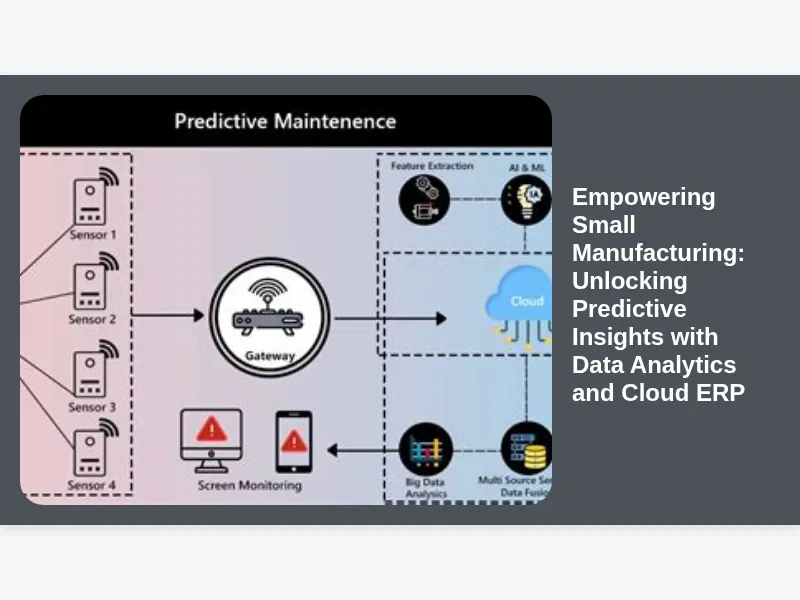
Once this data is consolidated within the Cloud ERP, data analytics tools can then be layered on top, or even integrated directly within the ERP platform, to process and interpret it. This partnership is what enables manufacturers to move beyond merely tracking past performance and instead generate predictive insights in small manufacturing. For example, by analyzing historical production data, maintenance records, and sensor readings collected by the ERP, predictive analytics can forecast when a specific machine component is likely to fail, allowing for proactive maintenance rather than reactive, costly breakdowns. This seamless flow from data collection in ERP to analysis and foresight provides a holistic view of operations, empowering decision-makers with information they need to anticipate future events and strategize effectively.
Beyond Hindsight: Embracing Predictive Analytics for Proactive Operations
For too long, many small manufacturers have operated primarily in a reactive mode, responding to events after they’ve occurred. A machine breaks down, and production halts. Inventory runs low, and rush orders lead to higher costs. Customer demand surges unexpectedly, and orders are missed. While reviewing past performance (descriptive and diagnostic analytics) is valuable for understanding what went wrong, it doesn’t equip businesses to prevent future problems or seize emerging opportunities. This is where predictive analytics truly shines, representing a fundamental shift from looking backward to looking forward.
Predictive analytics utilizes historical data, statistical algorithms, and machine learning techniques to identify the likelihood of future outcomes based on past patterns. It’s about predicting demand for specific products, anticipating equipment failures before they happen, forecasting raw material price fluctuations, or even identifying which customers are at risk of churning. By providing these probabilities and forecasts, small manufacturers can transform their operations from reactive to proactive. They can schedule preventative maintenance, optimize inventory levels based on predicted demand, adjust production schedules in anticipation of peak periods, and secure materials when prices are favorable. This foresight reduces waste, minimizes downtime, improves customer satisfaction, and ultimately boosts profitability, embodying the core benefit of Data Analytics and Cloud ERP for Predictive Insights in Small Manufacturing.
Real-World Applications: Optimizing the Supply Chain with Predictive Insights
The supply chain is often a labyrinth of complexities for small manufacturers, fraught with potential disruptions and inefficiencies. Managing inventory, coordinating with suppliers, and ensuring timely delivery are critical but challenging tasks. This is precisely where the synergy of data analytics and Cloud ERP can deliver transformative predictive insights in small manufacturing. By leveraging historical data on procurement cycles, supplier lead times, seasonal demand, and even external factors like weather patterns or geopolitical events, predictive analytics can forecast future supply chain performance.
For instance, a Cloud ERP system meticulously tracks every component of the supply chain, from purchase orders and goods receipts to stock levels and shipment tracking. Data analytics can then process this information to predict optimal reorder points, identify potential delays from specific suppliers, or even forecast the likelihood of price increases for key raw materials. Imagine a scenario where a small textile manufacturer can predict, based on past trends and current market indicators, that the cost of a specific type of yarn is likely to increase by 15% in the next quarter. With this insight, they can choose to place a larger order now, securing materials at a lower price and avoiding future cost hikes. Similarly, predicting accurate demand allows for just-in-time inventory strategies, reducing warehousing costs and minimizing the risk of obsolescence, thereby creating a lean and resilient supply chain.
Enhancing Production Efficiency and Quality Control through Foresight
At the heart of any manufacturing operation is the production line, where efficiency and quality are paramount. Even minor disruptions or defects can lead to significant losses in terms of time, materials, and reputation. Data Analytics and Cloud ERP for Predictive Insights in Small Manufacturing offer powerful tools to elevate performance in this critical area. By integrating data from production machinery, sensors, quality control checks, and the ERP system’s production planning modules, manufacturers can gain an unparalleled view of their operational health.
Predictive maintenance is a prime example. Instead of relying on fixed maintenance schedules or waiting for equipment to break down, analytics can predict when a machine component is likely to fail based on its operational history, vibration patterns, temperature readings, and other sensor data collected via the ERP. This allows for scheduled, proactive maintenance during off-peak hours, preventing costly unplanned downtime and extending the lifespan of valuable assets. Furthermore, by analyzing process parameters and defect rates, predictive models can identify specific conditions or steps in the manufacturing process that are likely to lead to quality issues. This enables proactive adjustments to machine settings, material inputs, or operator procedures before defects occur, significantly reducing scrap rates and ensuring a consistently high-quality product output, which is vital for customer satisfaction and brand integrity.
Bolstering Financial Forecasting and Strategic Planning
Accurate financial forecasting and robust strategic planning are crucial for the long-term viability of any business, particularly for small manufacturers operating with tighter margins. Traditional methods often rely on historical averages and quarterly reviews, which can be slow and less responsive to rapid market changes. This is where the integration of Data Analytics and Cloud ERP for Predictive Insights in Small Manufacturing becomes a game-changer, transforming the finance department from a historical record-keeper into a forward-looking strategic partner.
A Cloud ERP system centralizes all financial transactions, from sales orders and purchase invoices to payroll and expense reports. When this rich dataset is fed into data analytics tools, it can unlock highly accurate financial predictions. Predictive models can forecast future sales volumes based on historical trends, seasonal variations, and even external market indicators. They can anticipate cash flow challenges by predicting customer payment patterns and supplier payment obligations. This foresight enables better budgeting, optimized working capital management, and more informed investment decisions. Furthermore, by analyzing profitability by product line, customer segment, or even individual production runs, manufacturers can make strategic decisions about product development, pricing, and market expansion with a much clearer understanding of their potential financial impact. This proactive financial management empowers small manufacturers to navigate economic uncertainties with greater confidence.
Enhancing Customer Relationships with Predictive Sales and Service Insights
For small manufacturers, building and maintaining strong customer relationships is not just good practice; it’s often a key differentiator against larger competitors. Understanding customer needs, anticipating their next purchase, and providing proactive service can significantly boost loyalty and repeat business. This is where the power of Data Analytics and Cloud ERP for Predictive Insights in Small Manufacturing extends beyond the factory floor into the realm of customer engagement.
A Cloud ERP system, especially one with integrated CRM (Customer Relationship Management) capabilities, centralizes all customer interactions, purchase history, preferences, and feedback. By applying data analytics to this treasure trove of information, manufacturers can gain predictive insights into customer behavior. For instance, analytics can identify patterns that suggest which customers are likely to place repeat orders, allowing for targeted marketing and sales efforts. It can also predict which customers might be at risk of churn, prompting proactive outreach and service interventions to retain them. Furthermore, by analyzing product usage data and past service requests, manufacturers can predict future service needs or even anticipate product failures, enabling them to offer proactive support or recommend relevant upgrades. This level of personalized, data-driven engagement fosters deeper customer relationships, improves satisfaction, and drives long-term revenue growth through intelligent sales and service strategies.
Overcoming Implementation Challenges for Small Manufacturers
While the benefits of Data Analytics and Cloud ERP for Predictive Insights in Small Manufacturing are clear, small businesses often face unique hurdles during implementation. The perceived cost, the availability of in-house expertise, and the inherent resistance to change within established teams can all seem daunting. Many small manufacturers operate with lean teams, meaning existing staff often wear multiple hats and have limited bandwidth for learning new, complex systems or managing large-scale IT projects. The initial investment in software, training, and potential consultants, while significantly less for cloud solutions than on-premise, can still appear substantial to a budget-conscious operation.
However, many Cloud ERP providers now offer scaled-down versions or modular approaches specifically designed for SMEs, allowing them to start with essential functionalities and expand as their needs and budgets grow. It’s crucial to select a solution that aligns with current processes and offers intuitive user interfaces to minimize the learning curve. Furthermore, partnering with an experienced implementation provider who understands the nuances of small manufacturing can mitigate risks. They can guide the process, provide essential training, and ensure a smooth transition. Addressing the human element through clear communication about the benefits to employees, providing comprehensive training, and celebrating early successes is vital for fostering adoption and overcoming internal resistance, transforming apprehension into excitement for enhanced capabilities.
Choosing the Right Cloud ERP and Analytics Solution
Selecting the appropriate Data Analytics and Cloud ERP for Predictive Insights in Small Manufacturing is a critical decision that requires careful consideration. The market is saturated with various providers, each offering a distinct set of features, pricing models, and industry specializations. For a small manufacturer, the “best” solution isn’t necessarily the most feature-rich or the most expensive; rather, it’s the one that best fits their specific operational needs, budget, and long-term growth aspirations. The first step involves a thorough assessment of current processes, pain points, and future goals, clearly defining what capabilities are non-negotiable and which are desirable.
Key considerations should include industry-specific functionalities (e.g., discrete manufacturing, process manufacturing), scalability to accommodate future growth, ease of use for non-technical staff, robust data security measures, and the level of integration between the ERP and analytics modules. It’s also vital to evaluate the vendor’s reputation, customer support, and their commitment to ongoing updates and innovation. Requesting demos, comparing pricing structures (subscription models, per-user costs), and reading independent reviews or seeking peer recommendations can provide valuable insights. A phased implementation approach might also be beneficial, allowing a small manufacturer to implement core ERP functions first, then gradually introduce more advanced data analytics capabilities as their team becomes comfortable and data accumulates. This methodical approach minimizes disruption and maximizes the likelihood of a successful adoption, ensuring the chosen solution truly supports the journey towards predictive insights.
Cultivating a Data-Driven Culture in Small Manufacturing
Implementing powerful tools like Data Analytics and Cloud ERP for Predictive Insights in Small Manufacturing is only half the battle; the other, equally critical half, is fostering a data-driven culture within the organization. Technology alone cannot unlock its full potential without people who are willing and able to use it, interpret its insights, and incorporate those insights into daily decision-making. For small manufacturers, where team members often have diverse responsibilities, this cultural shift requires intentional effort and strong leadership.
It begins with education and training. Employees at all levels need to understand not just how to use the new systems, but why they are important and how their individual contributions to data accuracy feed into the larger picture of predictive insights. Leadership must champion the initiative, clearly articulating the vision for how data will improve efficiency, reduce costs, and create a more secure future for the company and its employees. Encouraging curiosity, rewarding data-backed decision-making, and creating an environment where asking “what does the data say?” becomes second nature are crucial steps. This cultural transformation might involve regular workshops, creating data champions within teams, and celebrating successes driven by insights from the new systems. Ultimately, a truly data-driven culture ensures that the investment in technology translates into sustained operational improvements and strategic advantage.
Security and Compliance in the Cloud Environment
One of the primary concerns for any business moving its critical operations to the cloud, especially in manufacturing with proprietary designs and sensitive customer information, is data security and compliance. Small manufacturers often have limited in-house IT security expertise, making the security posture of their chosen Cloud ERP and Data Analytics for Predictive Insights in Small Manufacturing solution a paramount consideration. The good news is that reputable cloud providers invest significantly more in security infrastructure, protocols, and expert personnel than most small businesses could ever afford on their own.
Cloud providers employ robust encryption, multi-factor authentication, regular security audits, and advanced threat detection systems to protect data. However, it’s crucial for small manufacturers to understand their shared responsibilities: while the provider secures the cloud infrastructure, the user is responsible for securing their data within the cloud – through strong passwords, access controls, and adherence to best practices. Furthermore, compliance with industry-specific regulations (e.g., ISO standards, specific product certifications) and data privacy laws (e.g., GDPR, CCPA) must be thoroughly vetted. Manufacturers need to ensure their chosen Cloud ERP and analytics solution offers features and documentation that support their compliance efforts, including audit trails, data retention policies, and secure data handling procedures. Engaging with vendors who are transparent about their security measures and compliance certifications is essential for building trust and ensuring the long-term integrity of vital business data.
Future Trends: AI, IoT, and Advanced Predictive Analytics
The journey towards leveraging Data Analytics and Cloud ERP for Predictive Insights in Small Manufacturing is an evolving one, with exciting future trends promising even greater capabilities. Artificial Intelligence (AI) and the Internet of Things (IoT) are rapidly becoming integral components of advanced analytics, offering small manufacturers opportunities to push the boundaries of foresight and automation. IoT devices – embedded sensors in machinery, tools, and even raw materials – are generating unprecedented volumes of real-time data, providing a granular view of every operational detail.
When this IoT data stream is fed into a Cloud ERP system and then analyzed by AI-driven predictive models, the insights become incredibly sophisticated. AI algorithms can detect subtle anomalies in machine performance that human operators might miss, predicting failures with even greater accuracy. They can optimize energy consumption based on production schedules and electricity prices, or fine-tune process parameters in real-time to maximize yield and quality. Furthermore, generative AI might soon assist in product design or supply chain scenario planning, offering new strategic possibilities. For small manufacturers, embracing these emerging technologies means not just staying competitive, but potentially leapfrogging competitors by creating highly intelligent, self-optimizing production environments. The combination of cloud accessibility, smart sensors, and powerful AI will continue to democratize advanced capabilities, making sophisticated predictive insights a standard rather than an exception.
The Tangible ROI of Data Analytics and Cloud ERP
Investing in Data Analytics and Cloud ERP for Predictive Insights in Small Manufacturing might seem like a significant undertaking, but the return on investment (ROI) can be substantial and multifaceted. Beyond the immediate benefits of operational efficiency, the strategic advantages unlocked by predictive insights directly contribute to the bottom line and long-term sustainability. Calculating ROI involves looking at both tangible cost savings and intangible gains in efficiency, quality, and market responsiveness.
Tangible benefits include reduced operational costs due to optimized inventory levels (less waste, lower storage costs), minimized downtime through predictive maintenance, and improved resource utilization. Increased production efficiency leads to higher output with the same resources, while enhanced quality control reduces rework and scrap. Better financial forecasting results in smarter purchasing and cash flow management, preventing costly shortfalls or missed opportunities. Intangible benefits, though harder to quantify, are equally impactful: improved customer satisfaction and retention, faster time to market for new products, greater agility in responding to market changes, and enhanced decision-making across all levels of the organization. Ultimately, the ability to anticipate and proactively respond to future events allows small manufacturers to operate more profitably, grow more sustainably, and build a more resilient business against unforeseen challenges, making the investment a strategic imperative rather than just an expense.
Practical Steps for Getting Started on the Predictive Journey
For small manufacturers considering how to embark on the journey of leveraging Data Analytics and Cloud ERP for Predictive Insights in Small Manufacturing, the path can seem overwhelming. However, a structured, phased approach can make the transition manageable and successful. The first crucial step is a thorough internal assessment: identify your most pressing pain points (e.g., inventory stockouts, frequent machine breakdowns, inaccurate forecasts) and define clear objectives for what you hope to achieve with these technologies. This initial clarity will guide your selection process and provide benchmarks for success.
Next, research and select a Cloud ERP solution that is specifically designed for small manufacturing, focusing on ease of use, scalability, and robust integration capabilities. Consider starting with core ERP modules like inventory management and production planning, which lay the foundational data needed for analytics. Once the ERP is established and data begins to accumulate, then gradually introduce or enhance data analytics capabilities. This might involve integrating an analytics dashboard, leveraging built-in ERP reporting, or partnering with a specialist analytics consultant. Begin with one or two high-impact areas where predictive insights can yield quick wins, such as predictive maintenance or demand forecasting. Provide comprehensive training for your team, foster a culture of data literacy, and celebrate early successes to build momentum. This iterative, step-by-step approach minimizes disruption, manages costs, and ensures that your small manufacturing operation steadily progresses towards a data-driven, predictive future.
Illustrative Scenarios: Small Manufacturers Benefiting from Predictive Insights
To truly grasp the impact of Data Analytics and Cloud ERP for Predictive Insights in Small Manufacturing, it’s helpful to consider some conceptual scenarios. Imagine “Precision Parts Inc.,” a small manufacturer of custom metal components. Before, they struggled with erratic inventory levels, often running out of specific alloys or overstocking less popular items, leading to production delays and tied-up capital. After implementing a Cloud ERP that centralized procurement, production, and sales data, they layered on predictive analytics. Now, the system analyzes historical order patterns, upcoming project schedules, and even market trends for raw material prices. It can accurately predict the demand for specific metals months in advance, allowing Precision Parts Inc. to optimize their purchasing, reduce inventory holding costs by 20%, and virtually eliminate stockouts, ensuring timely delivery for their clients.
Consider “GreenWood Furniture Co.,” a small workshop specializing in handcrafted, sustainable wooden furniture. Their challenge was inconsistent production quality and frequent downtime of their aging woodworking machinery. Their Cloud ERP began collecting sensor data from their machines – temperature, vibration, motor current – alongside production output and quality inspection results. Predictive analytics models were then applied. The system learned to identify subtle changes in machine behavior that indicated impending component failure. Instead of a router breaking down mid-shift, the system now predicts a potential bearing failure in two weeks. GreenWood Furniture can schedule maintenance during planned downtime, order the specific part in advance, and avoid costly, reactive repairs and lost production days. This proactive approach has not only increased operational efficiency by 15% but also significantly improved product consistency and reduced waste, cementing their reputation for quality craftsmanship through Data Analytics and Cloud ERP for Predictive Insights in Small Manufacturing.
Debunking Myths About Advanced Technology for SMEs
There are many misconceptions that prevent small manufacturers from embracing advanced technologies like Data Analytics and Cloud ERP for Predictive Insights in Small Manufacturing. One common myth is that these solutions are too expensive and only designed for large enterprises. While enterprise-grade solutions can be costly, the rise of cloud computing has democratized access, offering scalable, subscription-based models that are significantly more affordable for SMEs. The ROI often far outweighs the investment through cost savings, increased efficiency, and new revenue opportunities. Another myth is that implementation is too complex and requires a dedicated IT team. Modern Cloud ERPs are increasingly user-friendly, with intuitive interfaces and often include built-in analytics capabilities. Furthermore, many vendors and consulting partners specialize in SME implementations, providing the necessary support and expertise.
A third misconception is that small manufacturers don’t generate enough data to make analytics worthwhile. In reality, every operational activity—from a purchase order to a machine cycle—generates valuable data. Even seemingly small datasets, when analyzed correctly, can reveal critical patterns and trends. The key is to consolidate and structure this data, which is precisely what Cloud ERP excels at. Finally, some believe that their business is too unique for off-the-shelf solutions. While every business has unique aspects, core manufacturing processes share many commonalities. Cloud ERPs often offer configurable modules and integrations that can be tailored to specific needs without requiring extensive custom coding. Debunking these myths is essential for small manufacturers to realize that these powerful tools are not just aspirational but achievable and necessary for their future success.
Empowering Small Teams with Big Data Tools
A significant advantage of Data Analytics and Cloud ERP for Predictive Insights in Small Manufacturing is their ability to empower small teams with capabilities traditionally reserved for much larger organizations. In a small manufacturing environment, each team member often plays multiple roles, and resources are stretched thin. The introduction of integrated cloud systems and intuitive analytics tools means that these lean teams can achieve more with less, effectively democratizing access to “big data” insights without needing a large, specialized data science department.
Cloud ERP consolidates data from across the business, making it accessible to relevant team members in real-time. This means a production manager can instantly view inventory levels and upcoming order forecasts, or a sales team member can access historical customer data to personalize offers. When predictive analytics is integrated, these team members gain the foresight to make proactive decisions directly within their workflows. For example, a maintenance technician can receive an alert about a potential machine issue and schedule preventive action, rather than waiting for a failure to be reported. This decentralization of information and insights enables greater autonomy and efficiency at every level, transforming individual contributors into more strategic decision-makers. It augments human intelligence with data-driven foresight, allowing small manufacturing teams to operate with the agility and intelligence typically associated with much larger enterprises, leveling the playing field in competitive markets.
Conclusion: The Imperative for Predictive Insights in Small Manufacturing
In an increasingly complex and competitive global marketplace, the ability to anticipate and adapt is no longer a luxury but a fundamental necessity for small manufacturers. The synergistic combination of Data Analytics and Cloud ERP for Predictive Insights in Small Manufacturing offers a transformative pathway, empowering these vital businesses to move beyond reactive decision-making and embrace a future of proactive foresight. From optimizing the supply chain and enhancing production efficiency to bolstering financial planning and cultivating deeper customer relationships, these integrated technologies provide the tools to unlock hidden patterns, predict future outcomes, and guide strategic action.
The journey might involve overcoming initial challenges, but the tangible ROI and long-term strategic advantages are undeniable. By adopting scalable, affordable Cloud ERP solutions and leveraging the power of data analytics, small manufacturers can streamline operations, minimize waste, improve product quality, and significantly boost their profitability. More importantly, they can build a resilient, agile, and intelligently run enterprise capable of navigating market fluctuations and seizing new opportunities with confidence. The time for small manufacturing to embrace the data revolution and unlock its predictive potential is now, securing a competitive edge and paving the way for sustainable growth in the digital age.