The Unfolding Challenges Facing Small Manufacturing Today
In an era defined by rapid change, unprecedented disruptions, and fiercely competitive markets, small manufacturing businesses find themselves at a critical crossroads. The romanticized image of a resilient, self-sufficient workshop often clashes with the harsh realities of global supply chain volatility, escalating cyber threats, and the constant pressure to innovate while keeping costs in check. From unexpected raw material shortages that halt production lines to the insidious creep of data breaches, the risks confronting these enterprises are multifaceted and ever-present. Many small manufacturers, often operating on razor-thin margins and with limited resources, are particularly vulnerable to these shocks, which can quickly spiral into existential threats if not managed effectively. The ability to pivot, adapt, and maintain operations in the face of adversity is no longer a luxury; it has become the bedrock of survival and sustained growth.
The complexities don’t stop at external threats. Internally, small manufacturing businesses frequently grapple with outdated legacy systems, fragmented data, and manual processes that are prone to human error. This patchwork approach to operations creates significant blind spots, making it incredibly difficult to achieve real-time visibility into inventory, production schedules, or financial health. When a crisis hits, whether it’s a sudden surge in demand or a key piece of machinery breaking down, the lack of integrated, accessible information can cripple decision-making and delay critical responses. Without a robust framework for managing these intricate operational elements, small manufacturers risk falling behind their larger, more agile competitors, losing market share, and ultimately undermining their long-term viability. This precarious situation underscores the urgent need for a transformative solution that can build resilience from the ground up, ensuring operational stability and mitigating risks with Cloud ERP for small manufacturing business continuity.
Understanding Business Continuity in Manufacturing: More Than Just Disaster Recovery
Business continuity planning, often abbreviated as BCP, is a comprehensive approach designed to ensure that an organization can continue to function during and after a disruptive event. For small manufacturing businesses, this concept extends far beyond simply recovering data or restarting servers after a disaster; it encompasses the proactive strategies and processes needed to maintain essential operational functions, from procurement and production to sales and customer service. It’s about having a clear roadmap that allows your enterprise to withstand shocks, whether they stem from natural disasters like floods and wildfires, technological failures such as server crashes, economic downturns, or even public health crises like pandemics that impact workforce availability and supply chains. Without a well-defined BCP, a single significant disruption can lead to prolonged downtime, lost orders, irreparable damage to customer relationships, and even permanent closure.
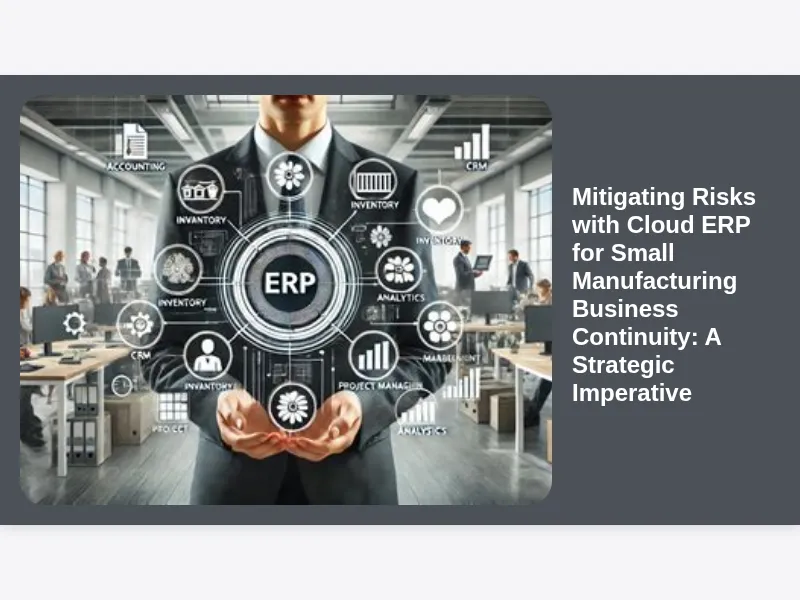
The unique environment of manufacturing introduces its own set of distinct challenges to business continuity. Production lines can be incredibly complex, relying on intricate machinery, specialized labor, and a delicate balance of inputs and outputs. A disruption in any single component—be it a critical raw material, a power outage, or the sudden unavailability of skilled personnel—can have a cascading effect, bringing the entire operation to a standstill. The cost of downtime in manufacturing is notoriously high, measured not just in lost revenue from unfulfilled orders but also in wasted materials, idle labor, damaged equipment, and the erosion of trust with clients and suppliers. Therefore, a truly effective business continuity strategy for a small manufacturing business must be deeply integrated into its daily operations, enabling swift adaptation and resilience. This is precisely where a modern, cloud-based Enterprise Resource Planning (ERP) system emerges as a powerful enabler for mitigating risks with Cloud ERP for small manufacturing business continuity.
Traditional ERP vs. Cloud ERP: A Paradigm Shift for SMBs
For decades, Enterprise Resource Planning (ERP) systems have been the backbone of large organizations, integrating disparate business functions like finance, human resources, manufacturing, and supply chain management into a single, cohesive platform. However, traditional, on-premise ERP implementations were often characterized by exorbitant upfront costs for hardware, software licenses, and specialized IT staff, placing them largely out of reach for small manufacturing businesses. These legacy systems typically required substantial capital expenditure (CAPEX) investments, ongoing maintenance fees, and the internal expertise to manage complex servers, databases, and network infrastructure. The sheer financial and operational burden of such systems meant that many small and medium-sized manufacturers were forced to rely on a patchwork of disconnected spreadsheets, siloed departmental software, and manual processes, severely limiting their visibility, efficiency, and agility.
The advent of cloud computing fundamentally reshaped the ERP landscape, ushering in an era of accessibility and flexibility that is particularly transformative for small manufacturing businesses. Cloud ERP solutions are delivered as a service (SaaS), meaning the software and its underlying infrastructure are hosted and managed by a third-party provider and accessed over the internet. This paradigm shift eliminates the need for significant upfront CAPEX, replacing it with predictable operational expenditure (OPEX) in the form of monthly or annual subscriptions. Beyond the cost advantages, Cloud ERP offers unparalleled scalability, allowing manufacturers to easily expand or contract their resources based on fluctuating business needs without investing in additional hardware. Crucially, it liberates small manufacturers from the burden of IT maintenance, upgrades, and security management, allowing them to focus their limited resources on their core competency: manufacturing. This inherent flexibility and reduced overhead make Cloud ERP a strategic differentiator, providing a robust platform for mitigating risks with Cloud ERP for small manufacturing business continuity.
Enhancing Data Security and Disaster Recovery with Cloud ERP
In an increasingly digital world, data is the lifeblood of any business, and for small manufacturers, proprietary designs, customer information, production schedules, and financial records are invaluable assets. The proliferation of cyber threats, from sophisticated ransomware attacks to insider data breaches, poses a significant and growing risk. On-premise systems, especially those managed by small teams with limited cybersecurity expertise, are often vulnerable to these attacks. A single security incident can lead to catastrophic data loss, operational paralysis, severe financial penalties due to regulatory non-compliance, and irreparable damage to a company’s reputation. Moreover, traditional disaster recovery plans for physical servers can be complex, costly, and often fall short when a major unforeseen event renders on-site infrastructure inaccessible or destroyed.
Cloud ERP, by its very nature, offers a dramatically enhanced posture for data security and disaster recovery, making it a cornerstone for mitigating risks with Cloud ERP for small manufacturing business continuity. Leading cloud ERP providers invest heavily in enterprise-grade security infrastructure, employing teams of dedicated cybersecurity experts, utilizing advanced encryption protocols (both in transit and at rest), and implementing multi-factor authentication, robust access controls, and intrusion detection systems that far exceed what most small businesses could reasonably afford or manage themselves. Data centers are often geographically redundant, meaning your data is mirrored across multiple locations, ensuring that even if one facility is compromised or affected by a localized disaster, your operations can seamlessly failover to another. Furthermore, automated backups are a standard feature, providing multiple restore points and significantly reducing the risk of permanent data loss. This comprehensive, professionally managed security environment provides a level of peace of mind that is simply unattainable with most self-managed on-premise solutions.
Streamlining Supply Chain Management to Reduce Disruptions
The global supply chain has proven to be a particularly fragile ecosystem in recent years, with events ranging from natural disasters and geopolitical tensions to pandemics exposing severe vulnerabilities. For small manufacturing businesses, dependence on a limited number of suppliers or reliance on lengthy, complex distribution networks can quickly lead to production stoppages when a single link in the chain breaks. Delayed raw material deliveries, unexpected price hikes, or quality control issues from a key vendor can ripple through the entire operation, resulting in missed deadlines, increased costs, and frustrated customers. Traditional, fragmented systems make it incredibly difficult to gain comprehensive, real-time visibility into the entire supply chain, leaving manufacturers reacting to problems rather than proactively preventing them.
Cloud ERP systems fundamentally transform supply chain management by providing a centralized, integrated platform that offers unparalleled visibility and control. By connecting procurement, inventory, production, and sales data in real-time, manufacturers can gain a holistic view of their supply chain from end-to-end. This means being able to track raw materials from order placement through delivery and consumption, monitor supplier performance against key metrics, and even anticipate potential delays or shortages. Advanced forecasting tools leverage historical data and current trends to optimize inventory levels, reducing both carrying costs and the risk of stockouts. Furthermore, Cloud ERP facilitates the identification and management of alternative suppliers, enabling quicker pivots when primary sources face disruptions. This proactive capability to monitor, predict, and adapt within the supply chain is invaluable for mitigating risks with Cloud ERP for small manufacturing business continuity, ensuring a more resilient and agile operation in an unpredictable world.
Optimizing Production and Operations for Uninterrupted Flow
For any small manufacturing business, the heart of its operations lies in its production floor. Inefficient processes, inaccurate production scheduling, and poor visibility into shop floor activities can lead to significant bottlenecks, costly downtime, and wasted resources. Many small manufacturers still rely on manual whiteboards, spreadsheets, or outdated software to manage production, which makes it incredibly difficult to respond quickly to changes in demand, machine breakdowns, or labor availability. Without a real-time pulse on what’s happening on the factory floor, identifying and resolving issues becomes a reactive, time-consuming effort, directly impacting output, delivery schedules, and ultimately, profitability.
Cloud ERP systems bring a new level of sophistication and control to manufacturing operations, crucial for mitigating risks with Cloud ERP for small manufacturing business continuity. By integrating production planning, scheduling, and execution into a single platform, manufacturers can optimize workflows, balance workloads across machines and personnel, and reduce idle time. Real-time data collection from the shop floor, often through integrated IoT devices or shop floor terminals, provides immediate insights into machine status, production progress, and material consumption. This visibility allows managers to identify potential issues before they escalate, make informed adjustments to production schedules on the fly, and even implement preventative maintenance programs based on equipment usage rather than arbitrary timelines. The ability to simulate production scenarios, manage bills of materials (BOMs) with precision, and track work-in-progress (WIP) with accuracy ensures a smoother, more predictable manufacturing flow, minimizing disruptions and maximizing output.
Financial Resilience and Agile Decision-Making
Financial stability is the bedrock of business continuity for any small manufacturing enterprise. Unexpected cash flow shortages, inaccurate financial forecasting, or an inability to quickly adapt to economic shifts can rapidly undermine an otherwise healthy operation. Many small manufacturers struggle with fragmented financial data, often stored in separate accounting software that doesn’t fully integrate with their operational systems. This disconnect creates delays in reporting, makes it difficult to reconcile costs with production outputs, and hampers the ability to gain a true, consolidated view of the company’s financial health in real-time. Without accurate, up-to-the-minute financial insights, making strategic decisions about investments, pricing, or cost reductions becomes a speculative exercise, fraught with potential errors.
Cloud ERP systems provide a unified financial management suite that is indispensable for building financial resilience and fostering agile decision-making, directly contributing to mitigating risks with Cloud ERP for small manufacturing business continuity. By integrating all financial transactions—from sales orders and inventory costs to payroll and vendor payments—into a single ledger, Cloud ERP offers comprehensive, real-time financial reporting and analytics. This means manufacturers can instantly access profit and loss statements, balance sheets, and cash flow projections, enabling them to identify trends, pinpoint areas of inefficiency, and proactively manage liquidity. Enhanced budgeting and forecasting tools allow for more accurate planning, while automated expense management and invoicing streamline processes, reduce administrative overhead, and improve cash flow. In an unpredictable economic landscape, the ability to quickly generate accurate financial reports, analyze key performance indicators (KPIs), and make data-driven decisions on the fly is paramount for navigating challenges and seizing opportunities, ensuring the financial health and continuity of the business.
Talent Retention and Remote Work Capabilities
The modern workforce, particularly in manufacturing, is evolving rapidly. Attracting and retaining skilled talent, especially younger generations, requires offering competitive working environments and adopting technologies that streamline tasks and foster collaboration. Many small manufacturing businesses face an uphill battle in this regard, often burdened by outdated systems that create tedious, manual work, leading to frustration and burnout among employees. Furthermore, the notion of “remote work” might seem counterintuitive for a manufacturing operation, but disruptions like pandemics or localized emergencies can necessitate the ability for administrative, sales, or even certain engineering functions to continue off-site. Without the infrastructure to support such flexibility, entire segments of the business can grind to a halt.
Cloud ERP systems are instrumental in enhancing talent retention and enabling remote work capabilities, thus playing a vital role in mitigating risks with Cloud ERP for small manufacturing business continuity. By automating repetitive administrative tasks and providing intuitive interfaces, Cloud ERP reduces employee frustration and allows staff to focus on more strategic, value-added activities. This improved efficiency and reduced manual data entry contribute to a more satisfying work experience, making your business more attractive to top talent. Crucially, because Cloud ERP is accessible via the internet, employees who do not need to be physically on the shop floor – such as those in sales, finance, purchasing, or management – can access critical information and perform their duties from anywhere, provided they have an internet connection and proper authorization. This inherent flexibility ensures that essential business functions can continue even if the physical office or plant is inaccessible, safeguarding operations during unforeseen circumstances and providing invaluable resilience.
Compliance and Regulatory Adherence Made Easier
Small manufacturing businesses operate within a complex web of industry-specific regulations, safety standards, environmental guidelines, and financial compliance requirements. From ISO certifications and OSHA safety mandates to local zoning laws and tax regulations, the burden of adherence can be overwhelming. Failure to comply can result in hefty fines, legal penalties, reputational damage, and even operational shutdowns, posing significant risks to business continuity. Manually tracking and documenting compliance activities across disparate systems or paper-based records is not only inefficient but also highly prone to error, leaving businesses vulnerable to audits and potential infractions.
Cloud ERP systems significantly streamline compliance and regulatory adherence, transforming a potential liability into a manageable process and effectively contributing to mitigating risks with Cloud ERP for small manufacturing business continuity. A well-implemented Cloud ERP provides a centralized repository for all operational data, creating an automatic audit trail for every transaction, change, and activity. This comprehensive record-keeping capability simplifies the process of demonstrating compliance during inspections or audits, saving countless hours and reducing stress. Many Cloud ERP solutions offer modules specifically designed to manage quality control, track product recalls, or monitor environmental impact, helping manufacturers meet stringent industry standards. Furthermore, by integrating financial and operational data, ERP systems ensure accurate tax reporting and adherence to accounting principles. The proactive management of compliance through an integrated system not only reduces the risk of penalties but also fosters a culture of quality and accountability, enhancing the overall resilience and trustworthiness of the manufacturing operation.
Scalability and Future-Proofing Your Manufacturing Business
One of the most exciting yet challenging aspects of running a small manufacturing business is the potential for growth. However, rapid growth can quickly expose the limitations of traditional systems and infrastructure. A sudden increase in order volume, the expansion into new product lines, or the acquisition of new machinery can strain existing IT resources, leading to performance issues, data bottlenecks, and the need for expensive, time-consuming upgrades. This can create a paradoxical situation where success itself becomes a source of risk, hindering the very growth it initially spurred. Without a scalable foundation, small manufacturers might find themselves unable to capitalize on market opportunities, jeopardizing their long-term potential.
Cloud ERP systems inherently offer unparalleled scalability and flexibility, making them an ideal solution for future-proofing your manufacturing business and essential for mitigating risks with Cloud ERP for small manufacturing business continuity. Unlike on-premise solutions that require significant hardware investments and manual configuration every time your business needs expand, Cloud ERP allows you to easily scale your resources up or down on demand. Whether you need to add more users, integrate new production facilities, or manage a larger volume of transactions, the cloud provider handles the underlying infrastructure, ensuring seamless performance. This means you can grow your business without worrying about outgrowing your IT system, eliminating a major bottleneck for expansion. Furthermore, leading Cloud ERP providers continuously invest in research and development, regularly updating their platforms with the latest technologies, security enhancements, and new functionalities. This ensures that your business always has access to cutting-edge tools, adapting to evolving market demands and technological advancements without the need for costly, disruptive overhauls every few years, solidifying your competitive edge for the long run.
Overcoming the Implementation Hurdles: A Practical Approach
The prospect of implementing a new ERP system, particularly for a small manufacturing business with limited internal IT resources, can seem daunting. Concerns about cost, complexity, disruption to ongoing operations, and the sheer effort involved often deter businesses from making this crucial investment. The fear of a botched implementation, which can lead to data loss, operational paralysis, and financial setbacks, is a very real barrier. Without a clear strategy and the right support, transitioning to a Cloud ERP can indeed present significant challenges, ranging from data migration complexities to user adoption issues.
However, approaching Cloud ERP implementation with a practical, phased strategy can significantly mitigate these risks, ensuring a smoother transition and ultimately strengthening your ability in mitigating risks with Cloud ERP for small manufacturing business continuity. The first critical step is choosing the right Cloud ERP partner, one with extensive experience in the manufacturing sector and a proven track record with businesses of your size. A reputable partner will guide you through a thorough discovery phase, understanding your specific processes and pain points. Often, a phased implementation approach is advisable, starting with core modules that address immediate needs, such as financial management or inventory control, before gradually integrating other functionalities like production planning or CRM. This allows your team to adapt incrementally, minimizing disruption. Comprehensive training for all users is paramount, ensuring they understand the new system’s benefits and how to effectively utilize its features. Strong change management strategies, including clear communication and stakeholder buy-in, are also vital to overcome resistance and foster successful adoption, transforming potential hurdles into stepping stones towards operational excellence.
Measuring the ROI of Cloud ERP for Risk Mitigation
While the qualitative benefits of Cloud ERP for mitigating risks with Cloud ERP for small manufacturing business continuity are evident, a practical small manufacturing business owner will also want to see a clear return on investment (ROI). The initial investment in a Cloud ERP subscription and implementation, though less than traditional systems, still represents a significant commitment. Quantifying the ROI can be challenging because many of the benefits, particularly those related to risk mitigation, are often preventative and intangible—they represent costs avoided rather than revenues generated. However, understanding how to measure both the direct and indirect returns is crucial for justifying the investment and demonstrating its value to stakeholders.
The ROI of Cloud ERP can be measured through a combination of tangible and intangible benefits. Tangible returns often include reductions in operational costs, such as decreased inventory carrying costs due to optimized stock levels, lower IT infrastructure and maintenance expenses, and improved labor efficiency through automation. For instance, a reduction in production downtime due to better scheduling or faster issue resolution translates directly into increased output and revenue. Similarly, fewer errors in order processing or invoicing lead to fewer financial adjustments and improved customer satisfaction. Intangible benefits, while harder to put a precise monetary value on, are equally critical for business continuity. These include improved decision-making capabilities through real-time data, enhanced customer satisfaction due to on-time deliveries, greater regulatory compliance reducing the risk of fines, and increased employee morale from streamlined processes. Moreover, the inherent resilience provided by Cloud ERP, preventing catastrophic data loss or prolonged operational shutdowns during crises, represents an invaluable long-term benefit that safeguards the entire enterprise, offering a profound return on investment in the form of sustained business viability.
Case Studies: Real-World Successes in Small Manufacturing
While theoretical discussions about Cloud ERP’s benefits are valuable, nothing quite illustrates its power for mitigating risks with Cloud ERP for small manufacturing business continuity like real-world examples. Consider “Precision Gears Inc.,” a small machine shop specializing in custom components. Prior to Cloud ERP, they struggled with fragmented inventory data, often leading to overstocking of some parts and critical shortages of others, causing frequent production delays. When a major supplier experienced a sudden labor strike, Precision Gears was initially blindsided, unable to quickly identify alternative sources or assess the full impact on their production schedule. Their manual system simply couldn’t cope with the rapid adjustments needed.
After implementing a Cloud ERP solution, Precision Gears gained real-time visibility into their entire inventory and supply chain. When a subsequent supplier disruption occurred (this time, a natural disaster affecting a key raw material), their Cloud ERP immediately flagged potential shortages. Leveraging the system’s integrated supplier management module, they quickly identified and contacted pre-qualified alternative vendors, assessed their lead times and pricing, and rerouted procurement within hours. Their production schedule was adjusted seamlessly, and critical customers were notified proactively, minimizing impact. This quick adaptation, directly enabled by Cloud ERP, allowed them to maintain production continuity, avoid costly penalties for late deliveries, and even strengthen customer trust by demonstrating resilience. Their experience highlights how Cloud ERP transforms reactive crisis management into proactive risk mitigation, proving its worth far beyond mere operational efficiency.
Integrating Cloud ERP with Other Essential Tools
In today’s digital landscape, a small manufacturing business rarely operates with just one software system. Alongside Cloud ERP, companies often utilize specialized tools for customer relationship management (CRM), manufacturing execution systems (MES), computer-aided design (CAD) and computer-aided manufacturing (CAM), and various e-commerce platforms. While each of these tools serves a crucial purpose, operating them as isolated silos can create new risks: duplicated data entry, inconsistencies between systems, and a fragmented view of the business. This lack of integration can lead to errors, delays, and a significant drain on efficiency, ultimately hindering rather than helping business continuity efforts.
The true power of Cloud ERP for mitigating risks with Cloud ERP for small manufacturing business continuity is significantly amplified when it acts as the central hub, integrating seamlessly with these other essential tools. Modern Cloud ERP platforms are designed with robust APIs (Application Programming Interfaces) that facilitate smooth data exchange between different software applications. For example, integrating your CRM with ERP ensures that sales forecasts automatically feed into production planning and inventory management, providing a unified view of customer demand and fulfillment capabilities. Connecting MES with ERP allows real-time production data from the shop floor to update inventory levels and financial records instantly, giving a precise picture of work-in-progress and costs. This interconnected ecosystem eliminates manual data transfers, reduces the likelihood of errors, and provides a single source of truth for all business operations. By fostering a unified digital environment, integration maximizes data flow and intelligence, enabling faster, more informed decision-making across the entire organization and building a truly resilient operational framework.
The Importance of Vendor Selection and Support
Choosing a Cloud ERP system is not merely selecting a software package; it’s entering into a strategic partnership with a technology provider. For a small manufacturing business, this decision is paramount, as the chosen vendor will be responsible for hosting your critical data, maintaining the system’s security, and providing ongoing support that directly impacts your operational continuity. A poor vendor choice can introduce significant risks, such as inadequate security measures, unreliable system performance, unresponsive customer support, or a lack of understanding of the unique needs of manufacturing, any of which could severely undermine the very business continuity you aim to achieve.
Therefore, meticulous vendor selection and the quality of their ongoing support are critical components in mitigating risks with Cloud ERP for small manufacturing business continuity. When evaluating potential Cloud ERP providers, small manufacturers must look beyond just features and pricing. Key considerations include the vendor’s financial stability and long-term viability, their specific industry experience (particularly in manufacturing), their commitment to security (certifications like ISO 27001 are a strong indicator), and their track record for system uptime and reliability. It’s essential to scrutinize Service Level Agreements (SLAs) for guaranteed performance, data recovery protocols, and support response times. Furthermore, inquire about the quality of their customer support—is it 24/7, are there dedicated account managers, and do they offer comprehensive training resources? A vendor that provides robust, proactive support and truly understands your business needs transforms from a mere supplier into a trusted partner, ensuring that your Cloud ERP system remains a reliable asset for business continuity rather than a potential source of future headaches.
Cybersecurity Threats and Cloud ERP as a Defense
The digital age, while offering unprecedented opportunities, also ushers in a continuously evolving landscape of cybersecurity threats. Small manufacturing businesses are increasingly becoming targets for cybercriminals, who perceive them as potentially easier to penetrate than larger corporations but still possessing valuable intellectual property, customer data, and financial resources. Ransomware attacks, phishing scams, and industrial espionage can cripple operations, expose sensitive information, and inflict severe financial and reputational damage. Many small manufacturers lack the specialized IT staff and resources to implement and maintain a robust, in-house cybersecurity defense system capable of fending off these sophisticated threats.
This is precisely where Cloud ERP, when chosen and managed correctly, acts as a formidable defense in mitigating risks with Cloud ERP for small manufacturing business continuity. Leading Cloud ERP providers operate at a scale that allows them to invest in state-of-the-art cybersecurity infrastructure, threat intelligence, and expert security teams that are far beyond the reach of most small businesses. They employ multi-layered security protocols, including advanced firewalls, intrusion detection and prevention systems, continuous vulnerability scanning, and sophisticated encryption techniques to protect your data both at rest and in transit. While cloud security operates under a shared responsibility model (meaning the vendor secures the cloud infrastructure, and the customer is responsible for securing their data within the cloud, such as access controls and user permissions), partnering with a reputable Cloud ERP provider significantly elevates your overall security posture. This dramatically reduces the likelihood of successful cyberattacks and provides a secure foundation for your critical business data, allowing you to focus on manufacturing with greater peace of mind.
Future Trends: AI, IoT, and Cloud ERP’s Evolving Role
The manufacturing sector is on the cusp of another technological revolution, driven by advancements in Artificial Intelligence (AI) and the Internet of Things (IoT). These innovations promise to bring unprecedented levels of automation, intelligence, and connectivity to the factory floor and beyond. For small manufacturers, however, the prospect of adopting these complex technologies can seem overwhelming, carrying risks of significant investment without clear returns, or simply being left behind if they fail to adapt. The challenge lies in integrating these cutting-edge tools into existing operations in a way that truly adds value and enhances resilience.
Cloud ERP is rapidly evolving to become the central platform that orchestrates and leverages these future trends, profoundly impacting how small manufacturers approach risk mitigation and business continuity. Many modern Cloud ERP systems are now incorporating AI and machine learning capabilities, enabling predictive analytics for a wide range of functions. For instance, AI can analyze historical production data, maintenance logs, and sensor readings to predict equipment failures before they occur, allowing for proactive maintenance and preventing costly downtime. Similarly, AI can enhance demand forecasting, improving inventory optimization and reducing the risk of stockouts or overproduction. The integration of IoT devices directly with Cloud ERP allows for real-time monitoring of machine performance, energy consumption, and environmental conditions, providing a continuous stream of data that can instantly inform decision-making. This enables small manufacturers to move from reactive problem-solving to proactive, intelligent operations, where risks are anticipated and addressed before they manifest, making Cloud ERP an even more powerful tool for mitigating risks with Cloud ERP for small manufacturing business continuity in the era of smart manufacturing.
The Human Element: Empowering Your Team with Cloud ERP
While technology is often seen as a driver of efficiency and risk mitigation, its ultimate success in a small manufacturing business hinges on the people who use it. Implementing a Cloud ERP system is not just about installing software; it’s about empowering your team, streamlining their daily tasks, and fostering a culture of data-driven decision-making. However, if not managed carefully, introducing new technology can be met with resistance, fear of the unknown, or a perception that it complicates existing workflows. Poor user adoption can undermine even the most sophisticated ERP system, rendering its potential benefits for business continuity moot.
Cloud ERP, when implemented with a focus on the human element, can be a powerful tool for empowering employees and significantly contributing to mitigating risks with Cloud ERP for small manufacturing business continuity. By automating repetitive, manual tasks such as data entry, reconciliation, and report generation, Cloud ERP frees up valuable employee time, allowing them to focus on more strategic, value-added activities. This not only increases productivity but also reduces the likelihood of human error, which is a common source of operational risk. Intuitive interfaces and accessible, real-time data empower employees across all departments – from shop floor operators to sales and finance teams – to make better, faster decisions based on accurate information. Comprehensive training, ongoing support, and involving employees in the implementation process can foster a sense of ownership and ensure high user adoption. When employees feel confident and competent in using the system, they become active participants in identifying and resolving issues, transforming the entire workforce into a more agile and resilient force capable of navigating challenges and ensuring continuous operations.
Developing a Comprehensive Business Continuity Plan Around Cloud ERP
While Cloud ERP is an incredibly powerful tool for mitigating risks with Cloud ERP for small manufacturing business continuity, it is not a standalone solution. Its full potential is realized when it is integrated as a core component within a broader, comprehensive business continuity plan (BCP). Simply having the technology is not enough; a well-defined plan ensures that your team knows how to leverage the system during a crisis, what steps to take, and who is responsible for each action. Without a clear strategy, even the most robust Cloud ERP could be underutilized or misused when a critical situation demands rapid, coordinated responses.
Developing a robust BCP that revolves around your Cloud ERP involves several key steps. First, identify all potential risks to your small manufacturing business, both internal and external, and assess their potential impact. For each identified risk, define how your Cloud ERP will be utilized to either prevent the risk, mitigate its impact, or facilitate recovery. This includes outlining procedures for accessing the Cloud ERP remotely during an emergency, ensuring secure login credentials are known to key personnel, and understanding the vendor’s disaster recovery protocols. Test your BCP regularly, simulating various scenarios to ensure your team is proficient in using the Cloud ERP for crisis management, whether it’s rerouting production due to a material shortage or accessing financial reports during an economic downturn. Regularly review and update your plan, especially as your business grows or as new risks emerge. By making Cloud ERP an integral and actively practiced part of your business continuity strategy, small manufacturers can create a truly resilient operation, minimizing downtime and safeguarding their future.
Conclusion: The Strategic Imperative for Small Manufacturers
The landscape for small manufacturing businesses is fraught with challenges, from volatile supply chains and cyber threats to labor shortages and economic uncertainties. These risks, if unaddressed, can rapidly undermine hard-earned progress and threaten the very existence of an enterprise. In this complex environment, relying on outdated systems, fragmented data, and manual processes is no longer a viable strategy; it is a direct pathway to vulnerability and potential failure. The need for robust, adaptive, and intelligent operational frameworks has never been more urgent.
Cloud ERP emerges not merely as an IT upgrade, but as a strategic imperative for small manufacturing businesses seeking to navigate these turbulent waters and ensure their long-term viability. As we’ve explored, a modern Cloud ERP system offers unparalleled advantages in mitigating risks with Cloud ERP for small manufacturing business continuity. From enhancing data security and facilitating rapid disaster recovery to streamlining supply chain management, optimizing production, and building financial resilience, Cloud ERP provides the integrated platform necessary for sustained operations. It empowers remote work, simplifies compliance, and offers the scalability needed to future-proof your growth. By embracing Cloud ERP, small manufacturers gain real-time visibility, foster agile decision-making, and create a resilient operational backbone that can withstand shocks, adapt to change, and capitalize on new opportunities. The investment in Cloud ERP is an investment in your business’s future, transforming potential liabilities into enduring strengths and securing a pathway to continuous success in an unpredictable world.